
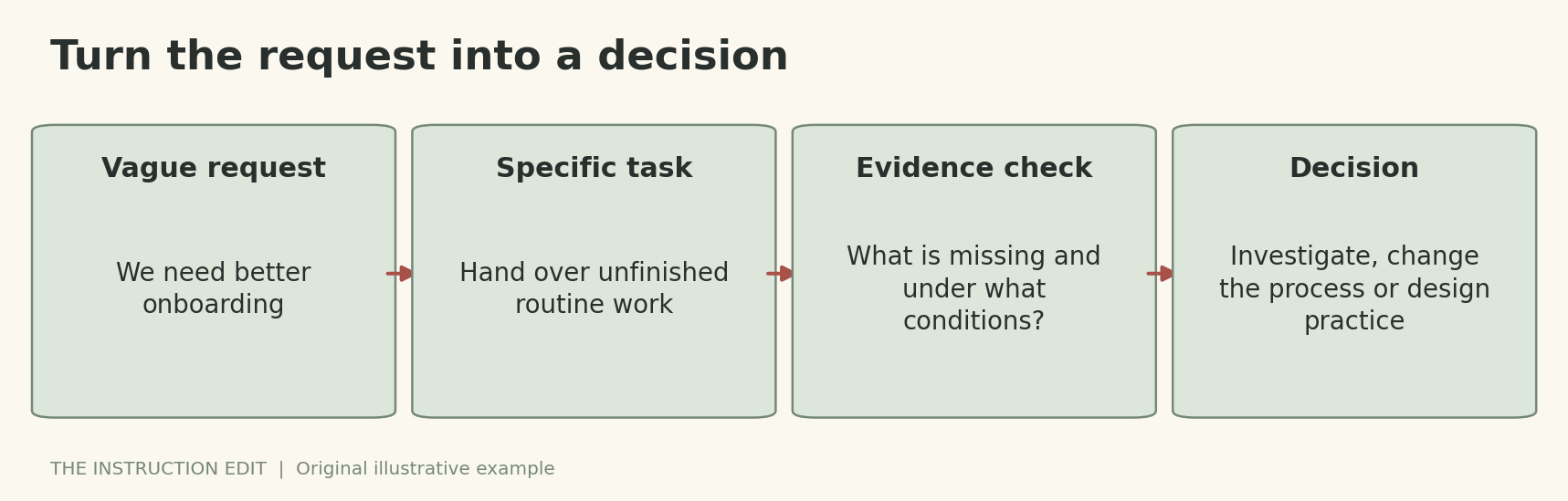
Turn a vague training request into a decision brief before turning it into a course outline. The brief should state the work people need to do, the evidence of a problem, the constraints and the next decision. Its purpose is to make a useful choice possible, including the choice to investigate further or use a nontraining response.
A request such as “We need better onboarding” contains a concern, but not yet a design specification. A one-page brief creates a shared record of what the team means and what it has not established. It also prevents an early suggestion, such as “make a video,” from quietly becoming the project’s fixed solution.
Start with the decision the sponsor actually needs
Ask what must be decided now. Is the sponsor choosing whether to fund discovery, approve a small pilot, revise an existing resource or commission a full program? These decisions need different amounts of evidence. Do not pretend a first conversation can support a confident organization-wide launch recommendation.
The CDC’s Quality Training Standards connect needs assessment, objectives and evaluation. The brief below uses that general logic in a fictional workplace setting. It is an original decision tool, not a mandated CDC format or a claim of CDC endorsement.
For the example, imagine a small operations team asking for a course on shift handovers. The concern is that the receiving shift has to ask follow-up questions before continuing routine work. The project team has not yet established how often this happens or whether the cause is knowledge, an unclear template or competing workload.
Draft the brief before filling every gap
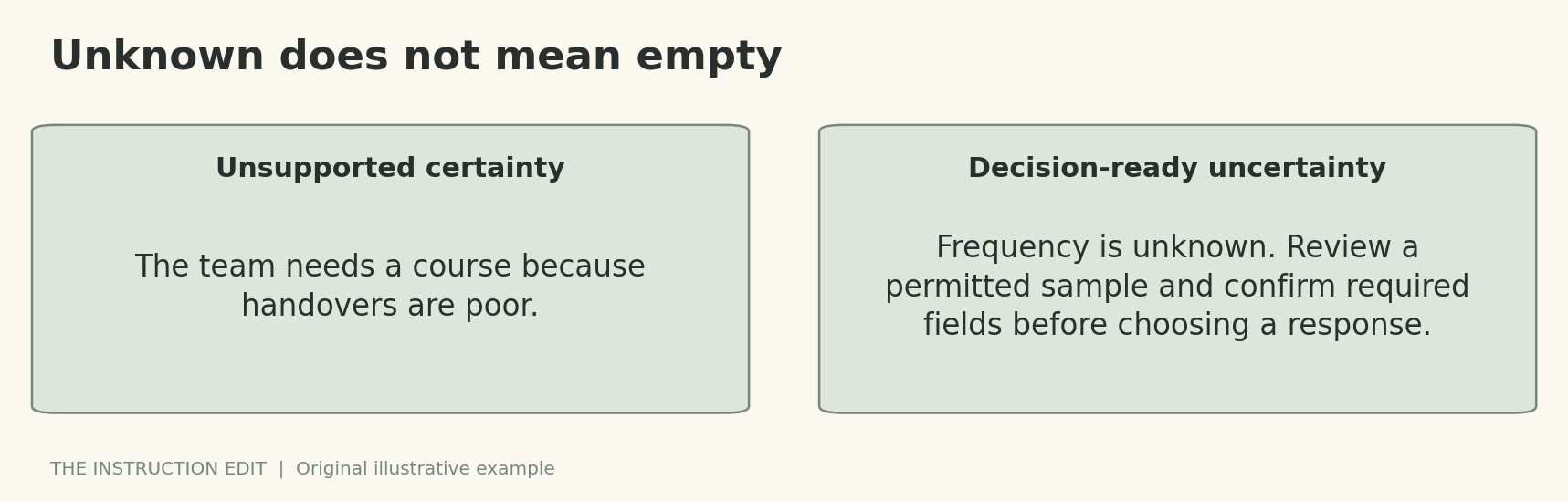
A useful first brief can contain explicit unknowns. “Frequency not yet established” is better than an invented baseline. “Process owner to confirm required fields” is better than treating one manager’s preference as policy.
Illustrative one-page decision brief. All details are invented for demonstration. In use, keep the completed brief concise enough to review in one sitting.
Brief field: Decision requested
Example content: Approve a small discovery check before choosing a course or a template change
Brief field: Task and audience
Example content: Shift coordinators hand over unfinished routine work to the receiving coordinator
Brief field: Intended performance
Example content: Handover identifies the item, current status, next action, owner and relevant deadline
Brief field: Evidence available
Example content: Sponsor reports repeated clarification requests; no representative sample reviewed yet
Brief field: Plausible explanations
Example content: Missing shared expectations, unclear template, insufficient time, or difficulty selecting relevant details
Brief field: Constraints
Example content: Use approved systems; do not move personal or customer data into training files; account for overlap time
Brief field: Proposed next step
Example content: Review a permitted de-identified sample and walk through one handover with each shift
Brief field: Decision rule
Example content: Consider practice if coordinators cannot select required details with a usable template; change the process if the task is blocked by tools or expectations
Brief field: Ownership and review
Example content: Sponsor confirms scope; operations owner confirms the rule; learning lead returns a recommendation at the agreed review point
The brief does not promise that a course will reduce clarification. It specifies what evidence would make a learning intervention plausible and what would point elsewhere.

Make the performance statement concrete
Replace “understand good communication” with a description of the work product. For a handover, that may mean a record another coordinator can use without guessing the next action or owner. State the important conditions, such as access to the current template and the information available before the shift ends.
Avoid building the assessment around stylistic preferences that do not affect the task. A handover can be concise without using one manager’s favorite phrasing. Conversely, a beautifully written paragraph can still omit the owner. Success criteria should distinguish those cases.
Check that the intended performance is achievable within the employee’s authority. If the outgoing coordinator cannot assign an owner, the process must specify how ownership is confirmed. Do not write an objective that requires someone to exercise authority they do not have.
Give uncertainty a next action
Every important unknown should lead to a bounded check. If the problem’s frequency is unknown, agree on a suitable sample and its limits. If the rule is unclear, ask the authorized process owner to confirm it. If the available time is uncertain, observe the handover conditions rather than relying only on estimates.
A sample can reveal a useful pattern without being representative of the whole organization. Record where it came from and which situations it excludes. Do not convert “three recent examples” into “most coordinators” in the next version of the brief.
Keep the brief proportionate to the stakes. A low-risk internal pilot may need a modest evidence check. A task affecting safety, regulated decisions or sensitive information needs the relevant specialist review and governance before a training team defines acceptable performance.
Use the brief to compare realistic options
Once the checks are complete, update the decision section. The options might be to clarify the template, provide a short worked example and practice, change the overlap arrangement, or combine those actions. Include the no-new-course option. An existing resource may already be adequate but difficult to find.
Describe the tradeoff that matters. A new module may take longer to maintain than a brief job aid. A job aid may not address judgment that requires practice. A manager reminder may be quick but leave inconsistent expectations unresolved. The brief should help the sponsor choose between these specific consequences rather than between fashionable formats.
Identify the evidence you will collect if an option is tried. In the fictional handover case, review whether the next action and owner are present and whether the receiving coordinator still needs clarification. Record changes to the template or work conditions at the same time, so later interpretation does not credit training for every improvement.
Close the decision and preserve the rationale
When the sponsor decides, record the chosen option, the reason, the owner and the review point. Keep the previous uncertainty visible where it still matters. A brief is useful partly because it explains why the team did not build every requested feature.
If the decision is to investigate further, say that plainly. Discovery is a legitimate outcome when the evidence is insufficient. It should still have a focused question and a responsible person, not an indefinite promise to “circle back.”
For the next vague request, draft the task, evidence and decision fields before scheduling a design workshop. Send the brief for correction of facts and scope. You will have a smaller document than a course plan, but a much clearer reason for whatever you build next.
