
Start a classroom headphone purchase with an inventory, not a pack size. Which devices already work? Which learners have suitable approved equipment? Which activities genuinely require simultaneous individual audio? An existing set with a clear checkout routine may meet the need without another order.
If new shared headphones are necessary, choose a model that fits the actual devices and a realistic maintenance process. Purchase price is only one part of the decision. A classroom set that cannot connect, cannot be cleaned appropriately or stays uncomfortable is not a bargain.
Define access before standardization
List the listening tasks: narrated instructions, language practice, text-to-speech, video or assessment. Add whether learners also need to record speech. Headphones play sound; a headset includes a microphone. A listening-only purchase will not solve a recording requirement.
Record the actual ports on the classroom devices. A 3.5 mm headphone plug does not connect directly to a USB-C-only device. Any adapter must support the required audio function on that exact device and should be included in the trial. Do not assume a charging adapter carries audio.
Ask learners about fit and practical use. Consider glasses, ear coverage, preferred controls and existing accommodations. A single standard model can simplify storage without becoming appropriate for every learner. Keep an alternative route available rather than treating discomfort as a compliance problem.
One documented wired candidate
This article contains affiliate links. The Instruction Edit may earn a commission if you purchase through them. As an Amazon Associate I earn from qualifying purchases.
The HamiltonBuhl SchoolMate SC-7V on Amazon, affiliate link, is a plausible listening-only candidate where the devices have a compatible 3.5 mm audio connection. The exact model is SC-7V; do not substitute a different SchoolMate model or assume a bundle includes the same accessories.

HamiltonBuhl SchoolMate SC-7V. Product photo source: HamiltonBuhl.
The manufacturer product page describes an over-ear design, an earcup volume control and a wired 3.5 mm connection. Its specification sheet identifies replaceable leatherette ear cushions and a five-foot PVC-sleeved braided cord. It lists refresh kit 5077 with two replacement cushions and a storage bag.
The useful repairability claim is narrow: the cushions are documented as replaceable. That does not establish that the cable, plug or internal components can be replaced by the school. Do not interpret the manufacturer's durability language as proof from a classroom trial. No such trial is claimed here.
The volume knob is a control, not evidence of a safe-volume limiter. Likewise, closed-back construction is not active noise cancellation or a guarantee that a learner will hear every instruction comfortably. Verify any required volume-limiting specification separately.
| Choice | Useful fit | Important limit |
|---|---|---|
| SC-7V wired headphones | Listening on devices with compatible 3.5 mm audio; documented replaceable cushions | No microphone; no verified volume-limiter or user-replaceable cable claim |
| Existing approved headphones | Small groups or scheduled access without a new purchase | Condition, fit, connectors and fair access still need checking |
| A microphone headset category | Tasks require recording as well as listening | Input/output connector compatibility and microphone placement |
| Alternative accessible format | Audio is unsuitable or unavailable for a learner | Preserve the same essential information and intended thinking |
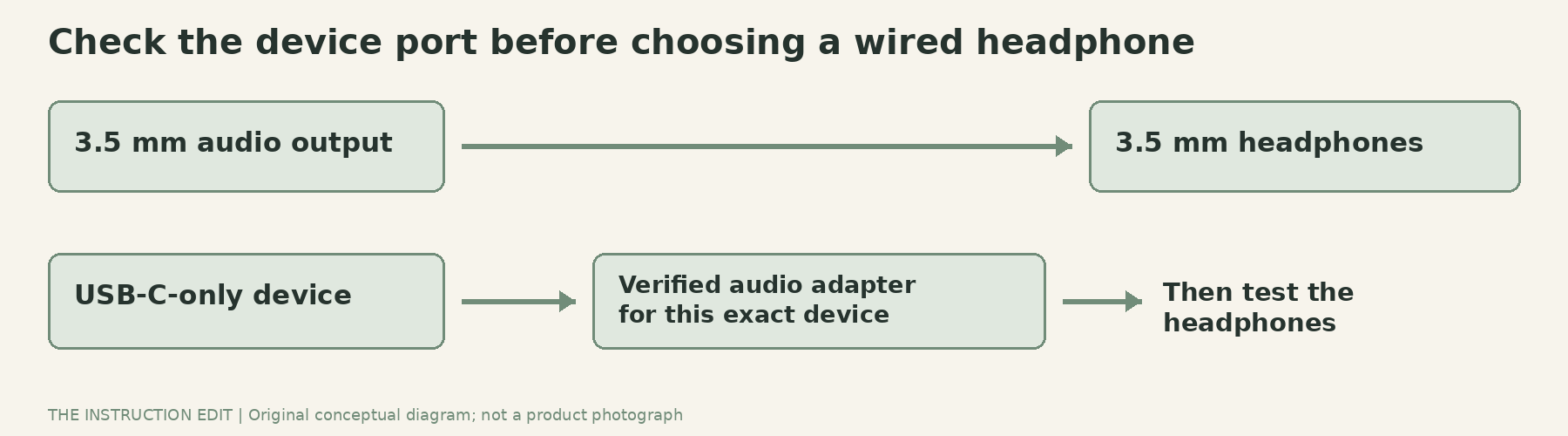
A shared headphone must pass three different checks. Original conceptual illustration.
Trial a unit before committing to a class set
If purchasing rules permit, borrow or obtain a sample through an approved route. Use the exact classroom device, protective case and application. Confirm both channels play the intended content and that the plug remains secure during normal movement.
Ask a small, varied group of willing users to try the fit for the duration of a normal activity. Record observations rather than a vague comfort score. Does the headband adjust sufficiently? Do glasses create pressure? Can the learner reach the volume control? Can the cable lie safely without pulling the device?
The goal is not to make every learner tolerate a uniform product. It is to discover whether the proposed standard works for enough of the intended use while preserving appropriate alternatives. Follow individual support plans and the school's listening guidance.
An illustrative maintenance comparison
Suppose a team needs twelve listening places for a rotating station. One proposal is to buy twelve identical units immediately. Another is to use eight working units already held by the department, add suitable replacements only where needed, and schedule the station in groups. These are planning scenarios, not costed offers.
Compare more than the initial order. Record the number of usable places, connection adapters, compatible replacement cushions, storage space and staff time for checks. Ask the supplier for current part compatibility and purchasing terms. Do not assume a replacement part will remain available merely because a specification sheet names it.
Create a simple repair decision: a worn cushion may have a documented replacement route; a damaged cable may require the unit to leave use and be assessed under local procedures. Keep damaged equipment separate so it does not quietly return to the next group.
A calculation can remain useful without invented prices. Total ownership cost includes initial units, necessary adapters, compatible consumables and replacements over the planned period. Add the staff time involved. Compare those categories using actual institutional quotes, not an online headline price.
Make daily care explicit
Assign each unit a visible inventory number and a storage location. Use a check-in routine for missing parts, visible damage and tangled cords. Store cables without tight bends or strain on the plug. Keep a small record of repeated failures so the next purchase is based on the actual weak point.
Follow manufacturer cleaning instructions and the institution's hygiene policy for the materials involved. Do not improvise a disinfectant concentration or soak the electronics. A wipeable-looking cushion is not a universal chemical-compatibility statement. Ask the manufacturer when an approved cleaning method is unclear.
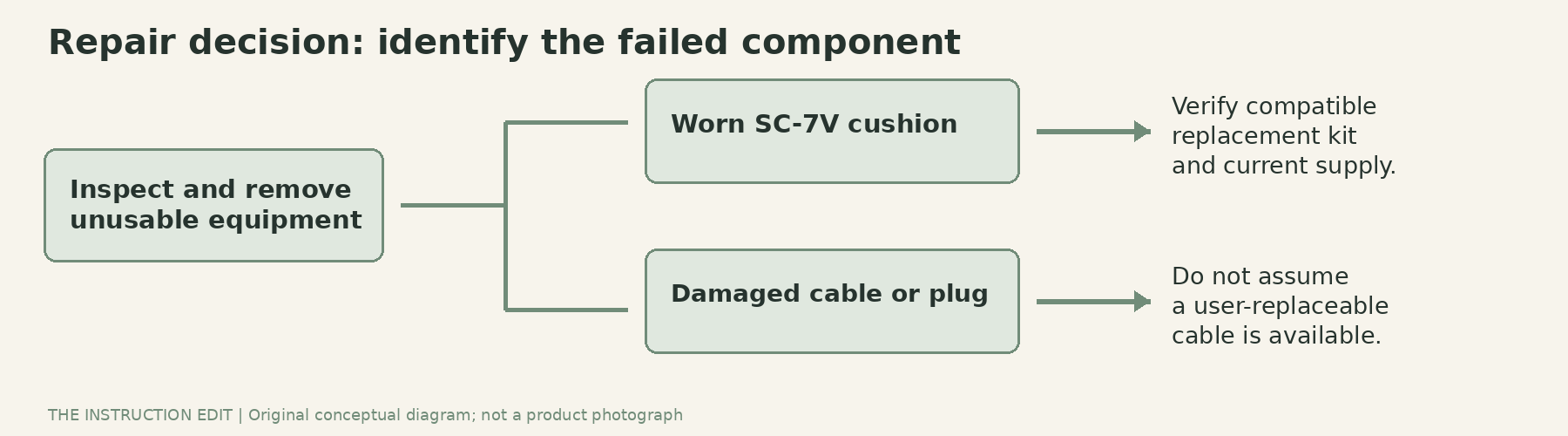
Separate a replaceable part from a replaceable device. Original conceptual illustration.
Who should not buy
Skip the SC-7V if learners need microphones, the devices lack a compatible audio route, a required volume limiter is not documented, or the fit trial identifies a problem. It is also unnecessary when approved existing equipment and scheduled access meet the instructional need.
For a listening station with suitable ports, replaceable cushions make this model worth investigating. The next useful action is a one-page inventory and a connection-and-fit trial. A large carton should come after that, not serve as the trial.
Sources and selection basis
This is a research-based equipment decision, not a comfort, durability or sound test. The manufacturer page, specification sheet and Amazon model/ASIN were checked on 25 October 2026. No price, stock, replacement-part availability or hearing-safety guarantee is made.
