

An educator can genuinely save time with AI while a colleague takes on more checking. Both statements can be true. To understand whether AI creates a useful time dividend, follow the work beyond generation and identify who makes the result safe and suitable to use.
This is not an argument against using AI. It is an argument for an honest unit of comparison: a completed task with its review work included. That matters especially when a school or learning team moves from individual experimentation to shared materials.
Read the survey claim at its actual scale
Gallup's October 14, 2026 report draws on an online survey of 1,952 U.S. K–12 educators, including teachers, paraprofessionals and other classroom staff, conducted July 28 to August 14 through its probability-based panel. Among educators who reported using AI during the 2025–2026 school year, 64% said it gave them somewhat or a lot more time for the parts of teaching that mattered most to them. Read Gallup's findings.
That is a meaningful report of perceived benefit among AI users. It is not a randomized comparison, a stopwatch study or a finding that every educator saves a fixed number of hours. The survey question also concerns time for valued work, not merely the number of outputs produced.
Those distinctions should improve the next question rather than dismiss the result. If educators say a tool frees time for work they value, ask which tasks changed and what made the benefit possible. Do not turn the percentage into a promise to every school or an assumed reduction in staffing needs.
Trace one generated resource
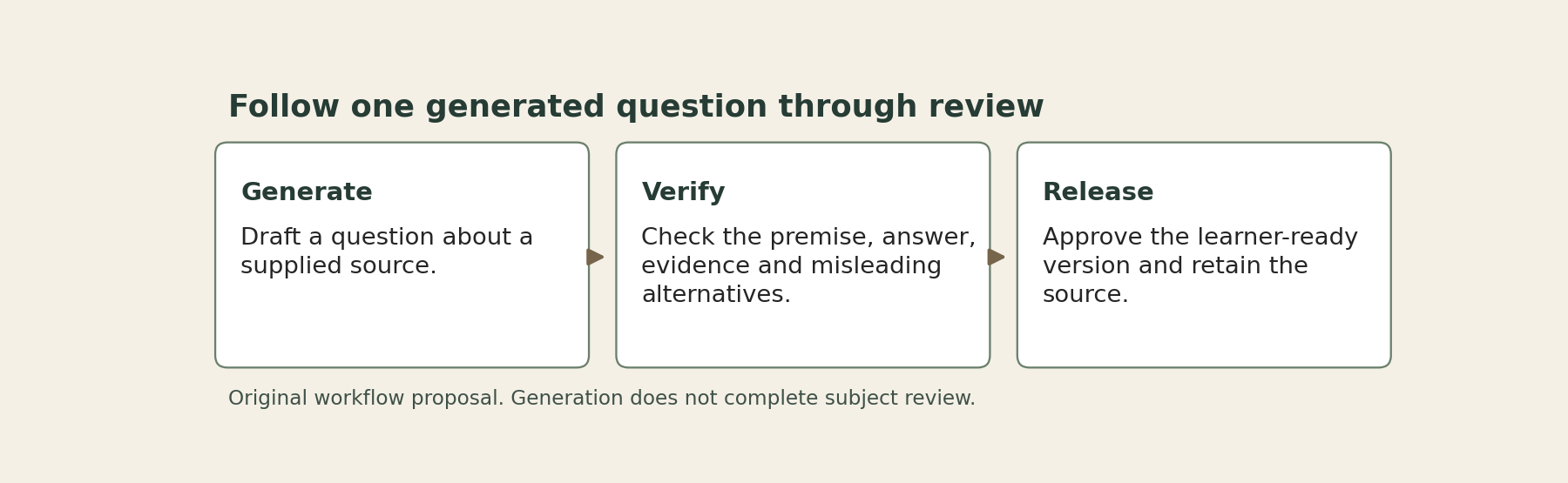
Imagine a department using AI to draft questions from a short historical source. This is an illustrative workflow, not a tested implementation. A coordinator provides the source and intended learning goal, then receives a question set and answer key.
Several checks remain. Do the questions actually require interpretation rather than word matching? Is each answer supported by the source? Does a distractor misrepresent a historical fact? Does the wording introduce ambiguity? Are important context and learner access needs handled? A fluent answer key can still contain a weak justification.
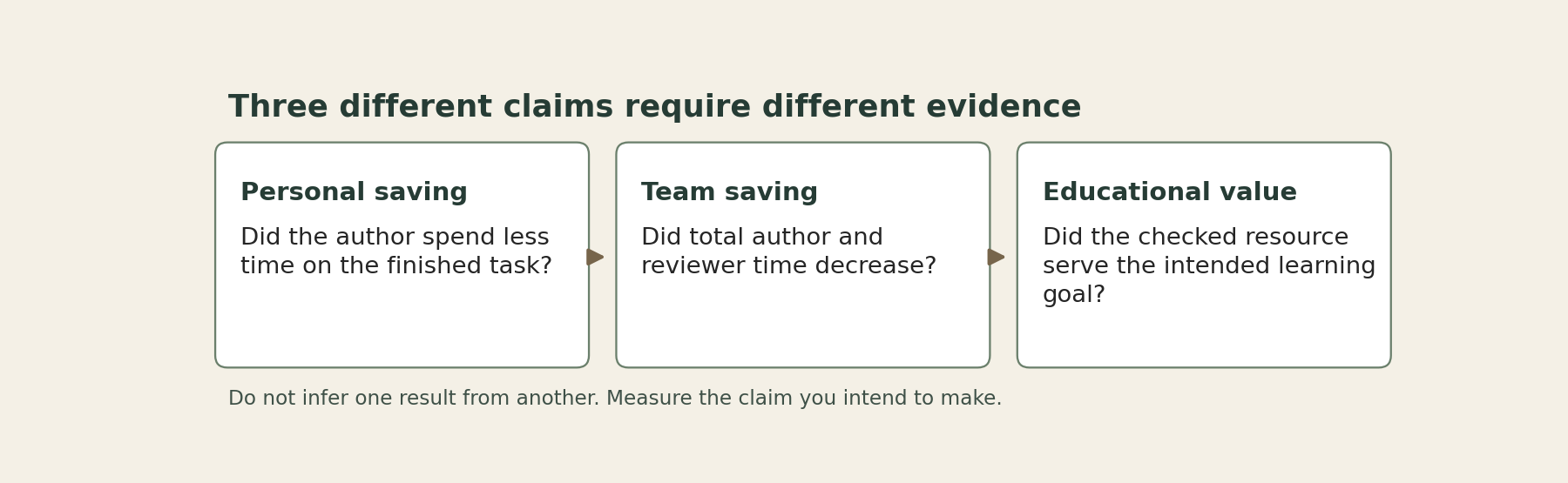
The coordinator may be qualified to complete these checks. If so, include that time in the task. If a subject teacher completes them later, record that transfer. “The coordinator finished in ten minutes” is not yet a statement about the department's total workload.
Now consider a different use: AI helps reorganize a teacher's own non-sensitive notes into a checklist, which the teacher checks against the original. The verification burden may be quite different. A team's decision should distinguish tasks instead of assigning one expected saving to “AI use” as a whole.
Make the responsibility visible
For the question set, use a small responsibility matrix. The roles can belong to the same person; the point is to name the work rather than multiply reviewers.
Review question: Does the question match the goal?
Responsible role: Instructional author
Evidence before release: Required reasoning is identified
Review question: Is the answer defensible?
Responsible role: Subject reviewer
Evidence before release: Answer is checked against the supplied source
Review question: Can learners use the resource?
Responsible role: Classroom teacher or designer
Evidence before release: Instructions, format and supports are inspected
Review question: Is the approved version identifiable?
Responsible role: Resource owner
Evidence before release: Date, source and final version are retained
Review question: Who corrects an error later?
Responsible role: Named maintainer
Evidence before release: A correction route is clear
Avoid a workflow in which everyone assumes someone else checked the answer key. Equally, avoid a redundant review chain where several people reread the whole resource without different responsibilities. Review has a purpose: to find the errors or mismatches that matter for the use case.
For a low-stakes planning aid, a short check may be enough. For material that determines a consequential decision about a learner, the required review and institutional rules may be much stricter. Do not reduce those safeguards to make the timing look better. Use approved tools and established data practices; this article does not authorize placing learner information into an AI service.
Notice when work moves rather than disappears
A central team might generate many resources and distribute them as drafts. Teachers then adapt and verify each one. The central output count rises, but that alone says nothing about the amount of useful work completed across the system.
The same issue appears when a tool makes it easy to create more than anyone needs. Ten alternative activities may be a helpful starting set. They may also create a selection and review task that did not previously exist. Count the alternatives you actually use, not just the ones a system can produce.
There may be real benefits that are not time savings. A teacher might find it easier to begin a difficult planning task, compare wording options or identify an omission. Describe those benefits accurately. A reduction in blank-page friction does not need to masquerade as a measured reduction in hours.
A useful review conversation asks whether the burden has become more appropriate as well as smaller. If a specialist checks a reusable resource once rather than every teacher correcting it separately, the team may have a sensible division of work. That possibility needs a clear version and maintenance process to remain credible.
Measure a useful dividend rather than a draft count
Choose one recurring task and define its finished state. Record authoring, checking, correction and handoff time separately for a bounded sample. Note whether the output meets the same criteria as the previous approach. Do not treat an easier or lower-quality task as an equivalent comparison.
Ask the people doing the review what changed. Did they receive fewer errors, different errors or simply more material? Were corrections easy to make? Could they identify the source used? A short account of those conditions is more useful than a headline average detached from the workflow.
Also ask what happened to any time released. It may support feedback, preparation or a more manageable workday. None of those benefits requires increasing the output target until the saving vanishes.
The strongest conclusion may be specific: this use helps this team produce this kind of checked resource under these conditions. That is a practical result worth keeping. It is also a better foundation for expansion than assuming that whoever presses “generate” is the only person doing the work.
Sources
Gallup, Teachers Using AI Say It Frees Up Time for What Matters Most. October 14, 2026 report; online survey July 28 to August 14, 2026, of 1,952 U.S. K–12 educators.
