

A learner reads a page again and recognizes every sentence. Another closes the page and struggles to explain the main idea. The first experience feels smoother, but smoothness now is not the same question as remembering later.
Retrieval practice means attempting to bring previously encountered information to mind. Rereading means encountering the information again. Both can have a place in learning. The important decision is when the learner needs another explanation and when they need a chance to reconstruct what they have already understood.
For a teacher, the useful implication is not “replace reading with quizzes.” It is to make recall a planned part of practice, then use the response to guide correction and further teaching.
What the original comparison actually tested
Roediger and Karpicke's 2006 paper reported two experiments with Washington University undergraduates learning short prose passages. Participants restudied or completed free-recall tests without feedback. Final recall was assessed after five minutes, two days or one week, depending on the experiment. Restudying performed better at the short delay; prior testing performed better at longer delays. Repeated study also increased confidence. Read the primary paper.
That is evidence about retention under those conditions, not a promise about every age, subject or quiz format. It did not test the full classroom routine proposed below, which adds feedback. Nor does passage recall alone establish transfer to a new problem. The practical lesson is to inspect later performance rather than treating immediate ease as the only guide.
Decide what needs to be remembered
Begin with something learners will need again. In an illustrative middle-school science sequence, the target might be to explain how evaporation and condensation differ and use the distinction to interpret water forming on the outside of a cold container.
A prompt asking for the definitions is one useful check. A prompt asking why the water appears outside the container asks learners to use the ideas. These are related but different demands. A class may remember two terms without being ready to explain the example.
Choose a small set of important ideas rather than turning the opening of every lesson into a lottery of unrelated facts. State why the recall matters: “We will use these ideas to explain a new observation.” This gives the routine a curricular purpose beyond accumulating scores.
Also check that the material was taught and understood well enough to attempt. If learners never had a usable explanation, repeated blank-page struggle is not a substitute for instruction. The next step may be a model, a clearer example or a short return to the text.
Build a small routine around meaningful content
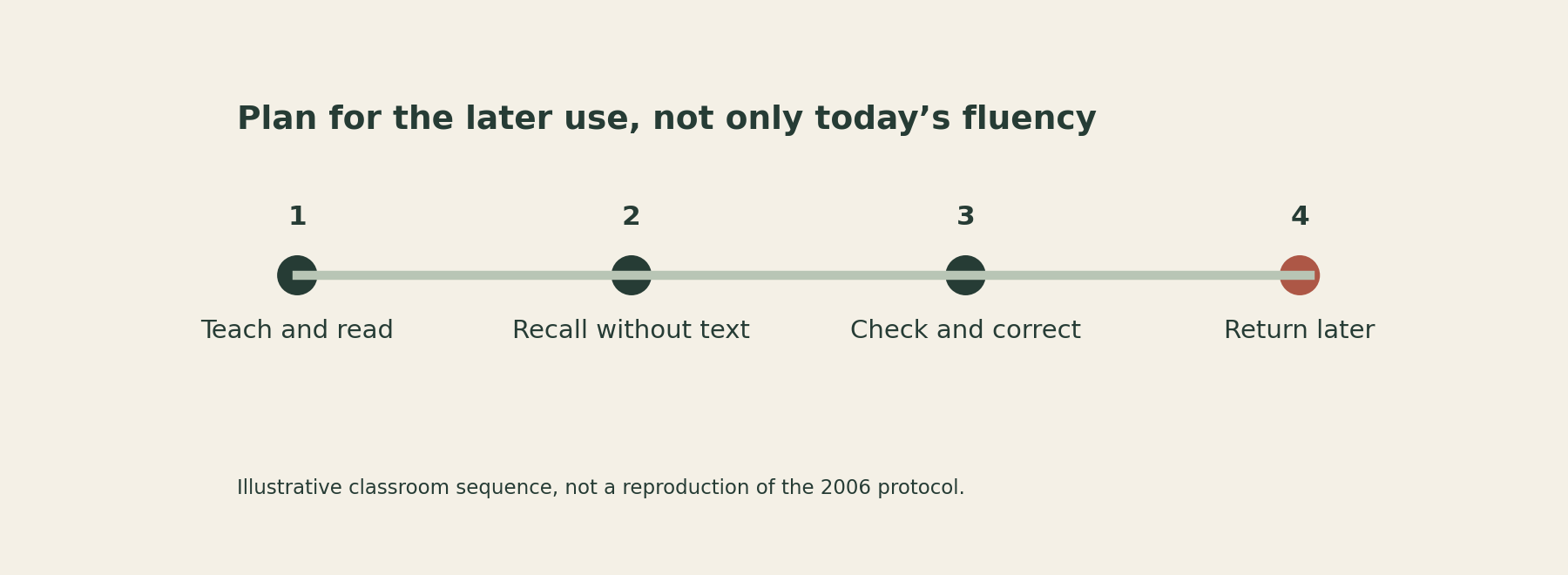
After teaching and discussion, ask learners to close or cover the source and respond privately: “Explain the difference between evaporation and condensation. Include what changes and what stays the same.” Offer an accessible response route that preserves the intended recall, such as speech or a supported written response where appropriate.
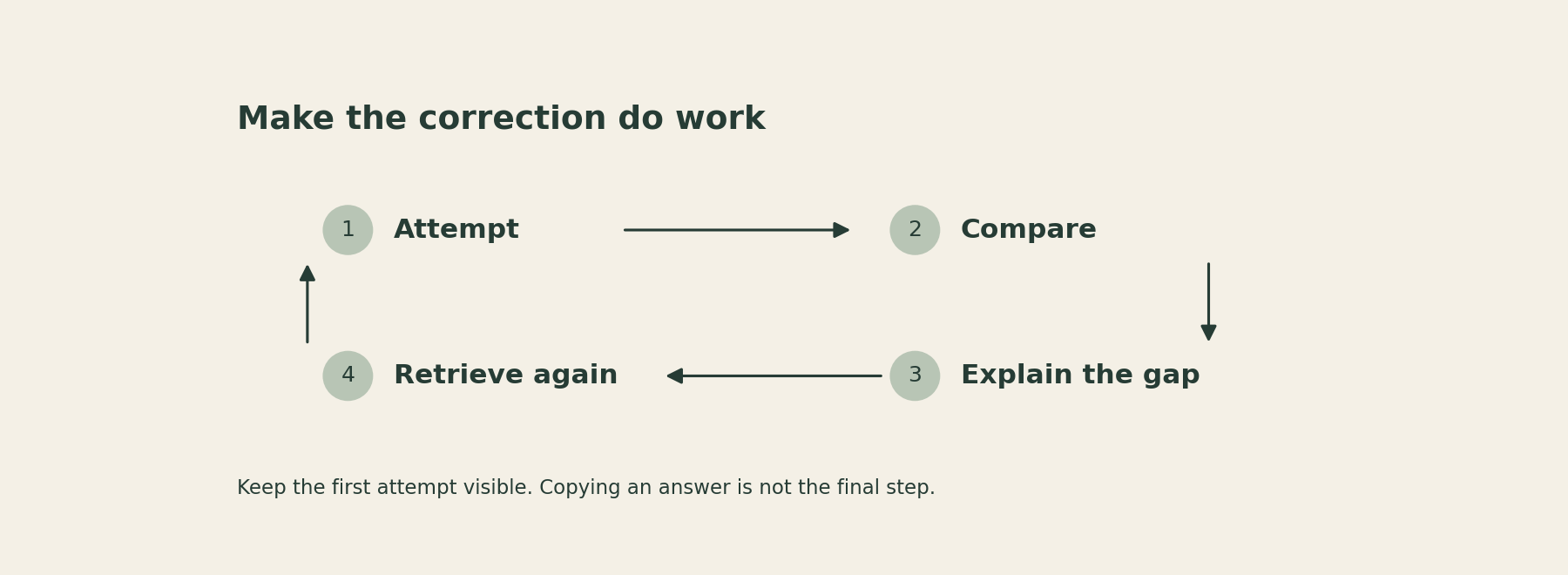
Keep the task low stakes. Explain that missing pieces are information for the next step, not a public ranking. A teacher can inspect a few responses while learners compare their answers with an accurate explanation.
Then require a correction that identifies the gap. “I mixed up the direction of the change” is more useful than copying the whole paragraph in another colour. Learners can add a brief explanation of why their original answer needs revision.
Return to the idea in a later lesson, without leaving the answer visible. The later prompt can first check the distinction and then ask learners to apply it to the cold-container example. That separates remembering a definition from using it.
This sequence is an original design proposal. Its timing should fit the curriculum and learner responses; the source paper does not prescribe this exact lesson schedule.
Learning need: The explanation is unfamiliar
A useful move: Read, model and discuss
What to inspect: Can the learner explain the idea with support?
Learning need: The idea was understood but must be retained
A useful move: Attempt recall without the source
What to inspect: What can the learner reconstruct?
Learning need: The recall includes an error
A useful move: Compare and explain a correction
What to inspect: Does the learner understand the difference?
Learning need: The definition is available but application is weak
A useful move: Work through and compare examples
What to inspect: Can the learner justify a new case?
Learning need: The answer appears fluent today
A useful move: Revisit later
What to inspect: Is the knowledge still available?
Keep rereading purposeful
Rereading is not a failed strategy simply because retrieval can support later retention. A learner may need to locate a missed relationship, clarify a phrase or check a correction. The problem is treating another pass over familiar words as sufficient evidence that the material can be recalled independently.
Give rereading a question. After a recall attempt, ask learners to find the sentence or diagram that addresses a particular gap. Then close the source and explain the corrected relationship in their own words. The source becomes a tool for repair rather than a permanent prompt.
The balance also depends on the goal. If the eventual task permits reference materials, teach learners how to use those materials well. Some knowledge may need to be immediately available; other information may appropriately remain in a reference. A closed-book quiz is not automatically the right model for every authentic task.
Avoid making speed the main success criterion unless speed is genuinely part of the intended performance. A fast response may be incomplete, and a slower response may reveal careful reconstruction. Give enough time to inspect the knowledge you actually care about.
Use the response to decide what comes next
Before collecting answers, identify a plausible teaching decision. If many learners reverse the two processes, revisit that distinction with an example. If they recall accurately but cannot explain the container, model the connection between the observation and the concepts. If both are secure, introduce a contrasting case.
Do not infer that a single successful response establishes durable understanding. Equally, do not treat one unsuccessful attempt as a stable label for the learner. Performance depends on the prompt, support, prior teaching and what is being asked.
Try the routine with one important idea in an existing sequence. Keep the initial response, the correction and a later response. Those artifacts will not constitute a controlled experiment, but they can help you make a better local teaching decision.
The aim is not more testing for its own sake. It is practice that makes knowledge available when learners need it, with enough feedback and teaching to make the next attempt more informed.
Sources
Roediger and Karpicke (2006), Test-Enhanced Learning. Primary paper, Psychological Science, 17(3), 249–255; doi:10.1111/j.1467-9280.2006.01693.x.
