
Find the consequential choice inside the policy, then build a scenario around that choice. Give learners the information they would need, offer plausible actions, and explain each option using the stated rule. A scenario should let you inspect a decision, not test whether someone noticed a trick word.
This is especially useful when a policy paragraph contains a condition, an exception or an approval requirement. Reading the paragraph may be necessary, but recognizing the rule in a realistic case is a separate task. The scenario makes that task available for practice.
Use a complete rule with a clear scope
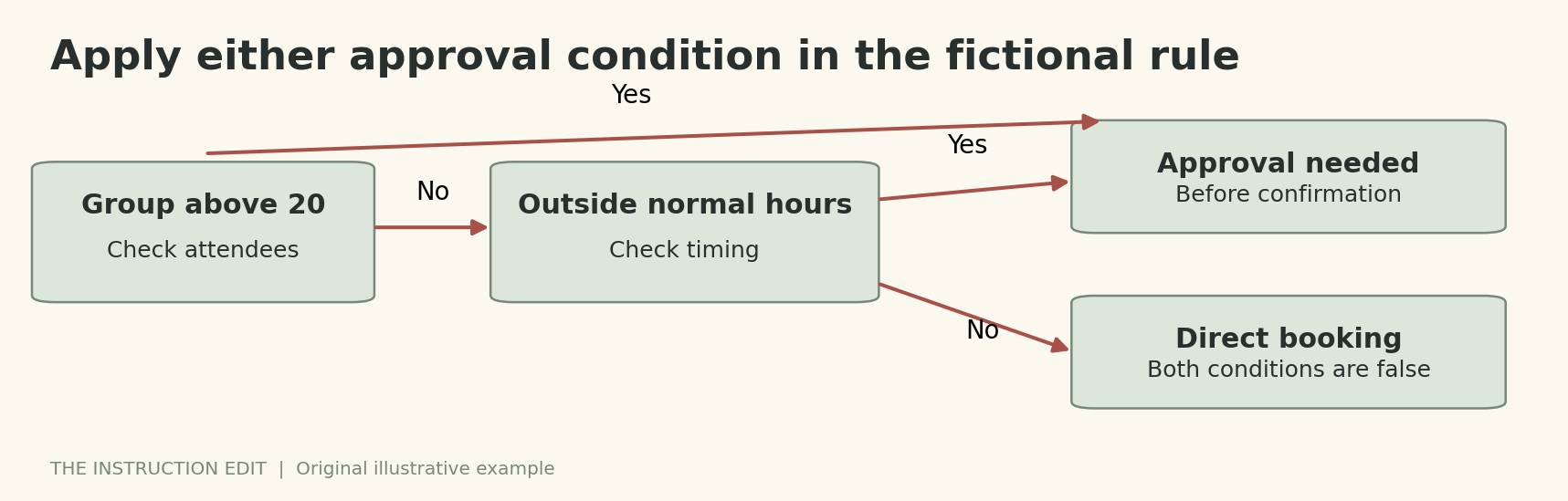
Here is a fictional internal room-booking rule created only for this example: “Routine meeting rooms may be booked directly for up to 20 attendees during normal office hours. Requests for more than 20 attendees or for use outside normal office hours require coordinator approval before the booking is confirmed.”
This is not a real organization’s policy or legal advice. Its purpose is to demonstrate a design process. In an actual project, use the current authorized rule and have the responsible owner verify the interpretation, including exceptions and definitions.
The CDC’s Quality Training Standards recommend assessments connected to learning objectives and relevant work situations. The original scenario below applies that principle to a low-stakes fictional booking decision. The specific choices and feedback are not a validated assessment.
Identify the decision and the deciding information
The decision is whether the employee may confirm the booking directly or must request approval first. The deciding information is group size and timing. Room color, the organizer’s personality and a long backstory do not help the learner apply this rule.
Use this scenario: “You receive a request for a routine meeting room tomorrow from 2 p.m. to 3 p.m., within normal office hours. The organizer expects 24 attendees and asks you to send confirmation now so they can finish the invitation. What should you do?”
The pressure to confirm is plausible, but it does not change the rule. The scenario makes one condition ordinary and one condition approval-triggering. That lets you see whether the learner treats “or” as meaning either condition is sufficient.

Build plausible options from real decision errors
Illustrative scenario options and feedback. The policy and situation are fictional.
Option: A Confirm now because the meeting is during normal hours
Why it might seem reasonable: Learner checks timing but overlooks group size
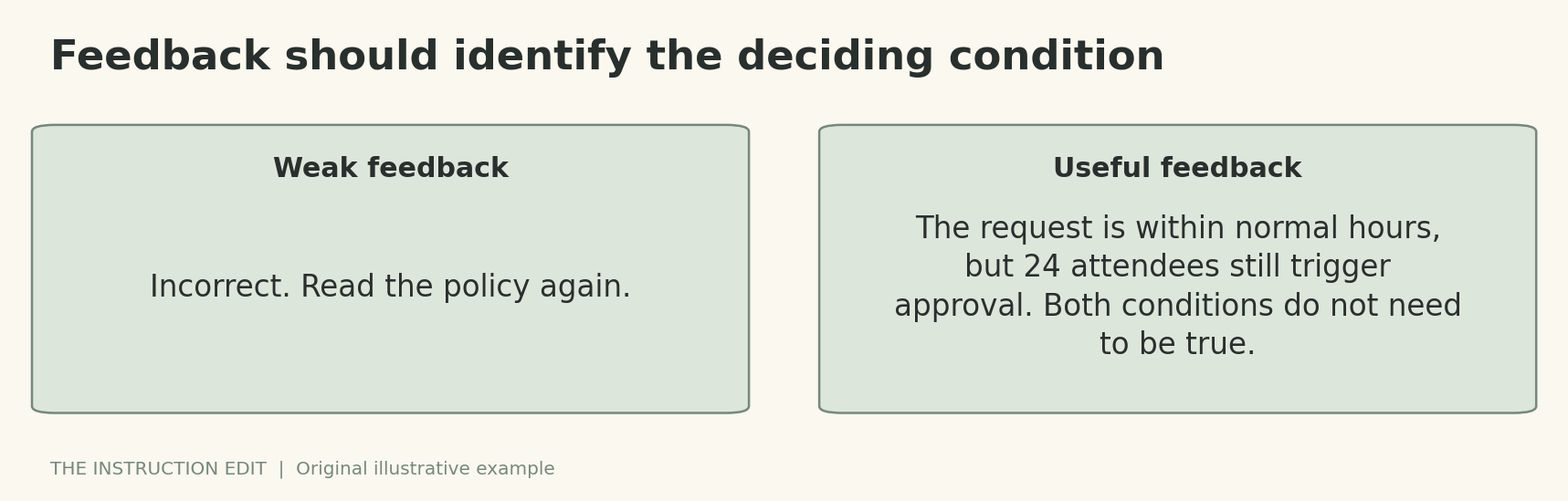
Feedback grounded in the stated rule: More than 20 attendees independently requires approval. Normal hours do not remove that condition
Option: B Request coordinator approval and tell the organizer the booking is pending
Why it might seem reasonable: Learner applies the size condition and preserves status
Feedback grounded in the stated rule: This follows the stated rule. Do not describe the booking as confirmed until approval is obtained
Option: C Confirm now and request approval afterward
Why it might seem reasonable: Learner prioritizes speed and treats approval as a later administrative step
Feedback grounded in the stated rule: The rule requires approval before confirmation, so the sequence matters
Option: D Reject the request because groups above 20 are prohibited
Why it might seem reasonable: Learner converts an approval requirement into a ban
Feedback grounded in the stated rule: The rule allows a request for approval. It does not say that a larger group is automatically prohibited
Option B is the best response under the stated rule. The feedback identifies both the triggering condition and the required sequence. It does not praise the learner’s character or label another choice careless.
Avoid obviously foolish distractors. An option such as “ignore the request forever” may be easy to reject without understanding the policy. A useful wrong option reflects a plausible interpretation, competing priority or missing check.
Give feedback before adding complexity
After the learner chooses, ask them to identify the detail that determined the action. If they chose B for the wrong reason, such as believing all bookings need approval, a correct selection would otherwise conceal the misunderstanding.
Use a short explanation: “The group has 24 attendees, which exceeds the direct-booking limit. That condition is sufficient even though the meeting is during normal hours. The appropriate status is pending approval.” Then ask the learner to revise an incorrect response in their own words.
Do not make the feedback depend on a rule you did not provide. If the scenario requires knowing what “normal office hours” means, state that the given time falls within them or provide the relevant reference. Hidden definitions create ambiguity that may have little to do with the intended skill.
Test a boundary and a contrasting case
Next, offer a request for 20 attendees during normal hours. Under this fictional rule, direct booking is permitted. The boundary matters because “up to 20” includes 20. Ask the learner to explain why this differs from the 24-person case.
Then offer 12 attendees outside normal hours. Approval is required because the timing condition is sufficient on its own. This checks whether the learner understands the rule’s structure rather than memorizing “large group means approval.”
For a more experienced audience, let learners consult the policy and write the response they would send to the organizer. Score whether they state the correct status and next action. Do not score unaided recall if reference use is normal and allowed at work.
Check the scenario with the people who own the work
Have the policy owner verify the rule and a representative learner check whether the situation is recognizable. Ask whether an option is genuinely feasible under the role’s permissions and whether another policy would change the decision. If two choices are defensible, revise the scenario or accept both with a clear rationale.
For high-stakes or regulated work, a short fictional scenario is not a substitute for specialist review, supervised practice or formal competency requirements. Keep the training’s scope and limits explicit. Do not simplify away a condition that protects people merely to make a neat multiple-choice question.
Maintain the scenario with the policy. Record the version used and the trigger for review. If the threshold, approval route or confirmation process changes, the example and its feedback need updating together.
For your next policy paragraph, underline the action, circle the conditions and identify the exception or approval step. Draft one ordinary case and one case that changes a single condition. If the answer changes for a clear reason, you have the basis of a useful scenario.
