
If the marking pile keeps growing, the most useful feedback book is not necessarily the one with the most comment examples. Choose a reference that helps you decide what learners need next and how they will act on it. Start with a task you already teach and the free EEF guidance before buying anything.
Two books serve different purposes here. Susan M. Brookhart offers a focused route into feedback messages and learner response. Dylan Wiliam places feedback within a broader formative-assessment system. Neither should be bought as a promise that every piece of work can be marked thoroughly without trade-offs.
Try the no purchase baseline
The EEF's Teacher Feedback to Improve Pupil Learning guidance, published in 2021 for learners aged 5 to 18, emphasizes useful feedback principles rather than making written versus verbal delivery the central issue. It also recognizes that feedback consumes time and is not automatically beneficial.
Choose one recent task. Write down its intended learning, the evidence you actually have and the next action a learner could take. If the next action is unclear, writing more comments is unlikely to solve the uncertainty. If there is no lesson time or other realistic opportunity to act, plan that before adding feedback.
Borrow a candidate book through the library or a colleague where possible. A professional book is worth keeping when it repeatedly improves a decision, not because it makes the shelf look industrious.
The narrower choice: Brookhart on useful feedback
This article contains affiliate links. The Instruction Edit may earn a commission if you purchase through them. As an Amazon Associate I earn from qualifying purchases.
How to Give Effective Feedback to Your Students, second edition, on Amazon, affiliate link, by Susan M. Brookhart, is the more focused candidate if your recurring question is how to make a comment usable. The identified edition is ASCD's 2017 paperback, ISBN 9781416623069.
How to Give Effective Feedback to Your Students, 2nd edition, by Susan M. Brookhart. Cover image source: ASCD.
The publisher contents and public chapter on feedback over time place attention on students using feedback, modeled revision, self- and peer assessment, and further attempts on related tasks. This supports choosing it for the response side of feedback rather than treating comments as a finished product.
The limitation is scope. A focused feedback reference will not independently solve unclear curriculum goals, an unmanageable school marking policy or missing evidence about what the class understands. Choose it when those wider conditions are sufficiently clear for a better feedback routine to be useful.
The broader choice: Wiliam on formative assessment
Dylan Wiliam's Embedded Formative Assessment, second edition, is a broader alternative. The identified 2017 Solution Tree edition has ISBN 9781945349225. This publisher link is not an affiliate link; an exact Amazon destination has not been verified for this guide.
The publisher's contents and lawful excerpt situate feedback alongside learning intentions, classroom evidence, peer learning and learner responsibility. That makes it the more relevant candidate when the marking problem starts earlier: the task reveals too little, questions do not expose reasoning, or the teacher discovers misconceptions only after collecting a full set of books.
This is a selection inference from the documented scope, not a claim that the whole book was read or that adopting its framework will reduce marking time. A wider framework also requires more coordinated attention than changing one comment routine.
| Your recurring problem | More relevant starting point | What remains your responsibility |
|---|---|---|
| Comments do not lead to revision | Brookhart, second edition | Plan an understandable response task and a chance to use it |
| Work reveals misunderstandings too late | Wiliam, second edition | Redesign evidence collection and decide how teaching will respond |
| Marking expectations are unrealistic | Existing school policy discussion plus EEF guidance | Resolve workload and purpose with the responsible team |
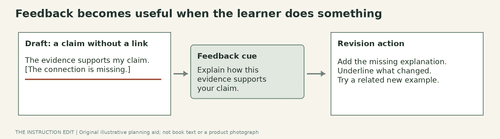
From comment to learner response. Original conceptual illustration.
An illustrative one-comment redesign
Suppose a middle-school learner has selected relevant evidence for an argument but has not explained the connection to the claim. This is an original example, not an excerpt from either book or a report of a classroom intervention.
Instead of writing a paragraph covering every issue, identify the decision that matters now: linking evidence and claim. A possible comment is: Explain how this detail supports your claim, and check whether the detail supports the full size of your claim. Point to the relevant sentence so the learner can locate the work.
Build the response into the next lesson. Ask the learner to add the explanation, highlight the change and write one sentence explaining why it helps the reader. Then use a new short example to see whether the connection can be made without the same prompt.
The point is not that one comment is always enough. It is that the comment, response and later check form a usable sequence. If the learner cannot begin, inspect the missing knowledge or unclear direction rather than concluding that the feedback was ignored.
Choose a reading task before choosing a book
For Brookhart, bring three comments that did not produce the intended response. Use the public material or a borrowed copy to examine the wording, focus and follow-through. For Wiliam, bring a task where you learned too late that the class had misunderstood. Look for the earlier evidence opportunity.
Read with a colleague if the decision affects a shared policy. Agree what you will change, what you will leave alone and what evidence would make you reconsider. Avoid turning a useful reference into a requirement to adopt every technique at once.
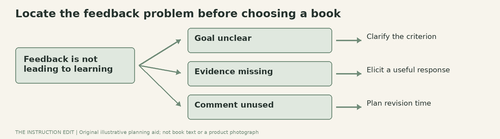
Locate the feedback problem before choosing a book. Original conceptual illustration.
Who should not buy
Skip both books for now if you have not identified whether the problem is feedback quality, evidence collection, time to respond or institutional workload expectations. Also pause if you already own a suitable reference that has not yet been applied to a concrete task.
Choose Brookhart for a focused feedback-and-response problem. Choose Wiliam when the problem spans the lesson's evidence system. The immediate next step is smaller than either purchase: design one learner response and decide how you will check what happens after it.
Sources and selection basis
This comparison uses the linked publisher contents, Brookhart's public chapter, the publisher-accessible Wiliam excerpt and EEF guidance, checked on 25 October 2026. It is not a full-book review or firsthand implementation report. Only Brookhart's exact Amazon destination is verified here; no price or stock claim is made.
