

A teacher can be well organised and still have more work than the available time permits. A school can also have genuine workflow problems that are worth fixing. The mistake is treating those two observations as competitors.
Useful productivity advice reduces unnecessary effort within a task. A staffing or capacity decision changes the amount of work, the people available or the time protected for doing it. One may help without resolving the other.
Before suggesting another planning template, ask what is consuming the time and who has the authority to change it. That question is more respectful of teachers and more useful to leaders than assuming the problem is either entirely personal or entirely beyond improvement.
Read the workload evidence at the right level
In Pew Research Center's April 2024 report, 84% of U.S. public K–12 teachers said they lacked enough time during regular work hours for tasks such as planning, grading and paperwork. Seventy percent described their school as understaffed. The survey included 2,531 teachers and was conducted in October and November 2023. These are reported conditions and perceptions, not a causal estimate of what an additional staff member would change. Workload findings and methodology.
The findings give reason to examine capacity rather than treating every unfinished task as an organisation failure. They do not tell a particular school which position to hire or which duty to remove. That requires local information about the work.
Name the problem before choosing the remedy
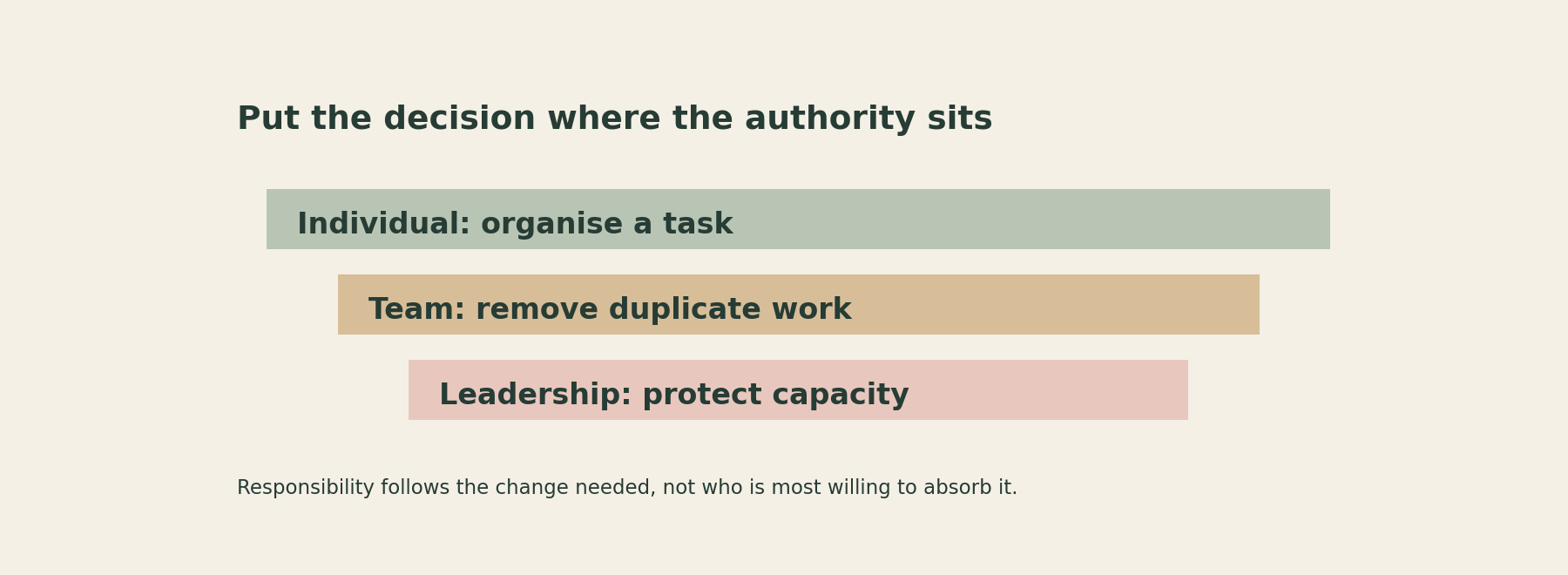
Consider three different statements. “I cannot find the latest version of the unit plan” describes retrieval friction. “Three people enter the same information into separate trackers” describes coordination or process duplication. “My planning period is repeatedly used to cover an absent colleague” describes a loss of protected capacity.
A shared naming convention may help the first. A team decision may remove the second. Neither restores the planning period in the third. The teacher might still benefit from a tidy folder, but that is not an answer to the stated problem.
The same distinction applies to new technology. A tool that shortens one task may be valuable. Its benefit should be described at the scale it actually affects, rather than presented as evidence that the overall workload is now reasonable.
It is also possible to misclassify a problem in the other direction. A frustrating approval chain may look like insufficient staffing when a redundant step could be removed. Start by mapping the work, not by defending a favourite solution.
Make a small capacity ledger
Use one bounded period and one set of tasks. Do not create a permanent minute-by-minute surveillance system. The purpose is to expose the mismatch well enough to make a decision.
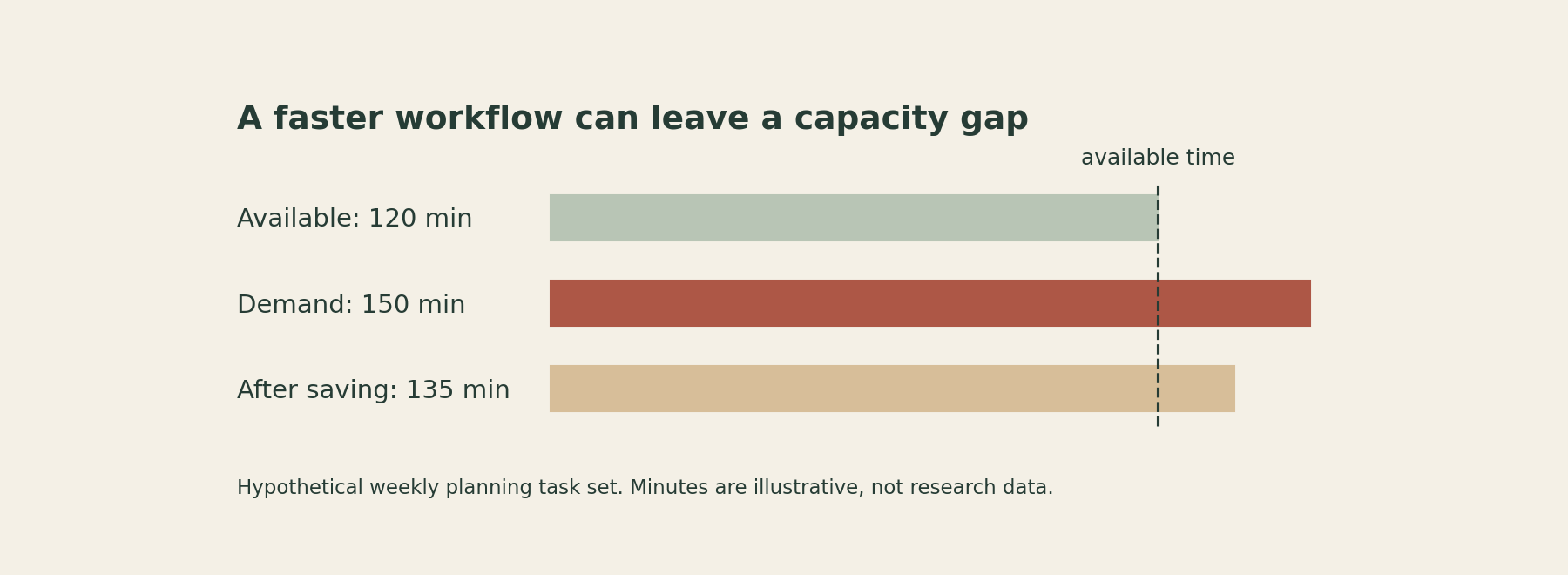
Here is an explicitly hypothetical example. A teacher has 120 minutes available for a particular weekly set of planning tasks. The tasks require an estimated 150 minutes. A revised template saves 15 minutes. That is a real improvement within the example, but the remaining demand is 135 minutes: still 15 minutes beyond the available time.
The arithmetic does not prove what happens in any school. It shows why “the new process is faster” and “there is still insufficient time” can both be true.
Record the task, required standard, likely time range, deadline and interruption. Estimates can be rough initially. Note uncertainty rather than making the ledger look more precise than the work allows.
Observation: Repeated search for the current file
Likely level of decision: Individual or team workflow
A useful next question: Can one version and location be agreed?
Observation: Duplicate reporting
Likely level of decision: Team or organisational process
A useful next question: Who can retire the redundant entry?
Observation: Planning time routinely reassigned
Likely level of decision: Leadership capacity
A useful next question: Which protected time or duty can change?
Observation: New requirement with no time allocation
Likely level of decision: Leadership priorities
A useful next question: What stops or becomes less frequent?
Observation: Task remains difficult after practice
Likely level of decision: Support and task design
A useful next question: Is training, a model or specialist support needed?
Include essential interruptions rather than dismissing them as poor discipline. A legitimate learner need may disrupt a plan. The question is whether the system has enough flexibility and support to respond without making unfinished work permanently invisible.
Avoid turning efficiency into an endless moving target
Suppose a team removes duplicate reporting. If the released time is immediately filled with another reporting requirement, the process improved but the workload did not fall. That may be an intentional choice, but it should be named.
Agree in advance what the saving is for. It might protect feedback time, reduce work carried home or make an existing task more reliable. Not every improvement needs to produce more outputs.
Also inspect where work moves. A central template may reduce classroom preparation while adding maintenance for a coordinator. That arrangement can be sensible if the responsibility and time are recognised. It is less sensible if the coordinator's effort disappears from the account of the saving.
None of this means an individual should avoid useful routines while waiting for structural change. A checklist, a reusable example or a clearer handoff can make tomorrow easier. Present it honestly as a local improvement, not as proof that a staffing concern has been solved.
Make the escalation specific and usable
An escalation is stronger when it describes a decision rather than only a feeling of overload. For example: “This recurring coverage duty removes the time allocated for the shared assessment review. We need a decision about coverage, the review deadline or another duty.”
Attach a small amount of relevant evidence: the planned time, how often it was displaced, the required task and the consequence. Do not include unnecessary personal information about learners or colleagues. The goal is to make the trade-off visible.
Offer feasible options where you can, but do not make the person experiencing the shortfall responsible for solving every constraint. Leaders may need to coordinate staffing, scheduling, priorities or specialist support beyond an individual's control.
A useful response names what changes, who owns it and when the team will inspect whether it helped. “Be more efficient” is not a decision. Neither is a new form that asks teachers to document overload indefinitely without a route to action.
Keep both kinds of improvement in view
Choose one friction point to simplify and one capacity issue to clarify. Evaluate them separately. Did the workflow become easier? Did the available time now match the required work? Different answers are possible.
The point is not to reject productivity advice. It is to stop asking that advice to do a job it cannot do. Good personal systems help people use their time. Good organisational decisions make the required work possible within that time.
Sources
Pew Research Center (2024), How teachers manage their workload. Primary teacher survey findings.
Pew Research Center, Teacher survey methodology. 2,531 U.S. public K–12 teachers surveyed October 17 to November 14, 2023.
