
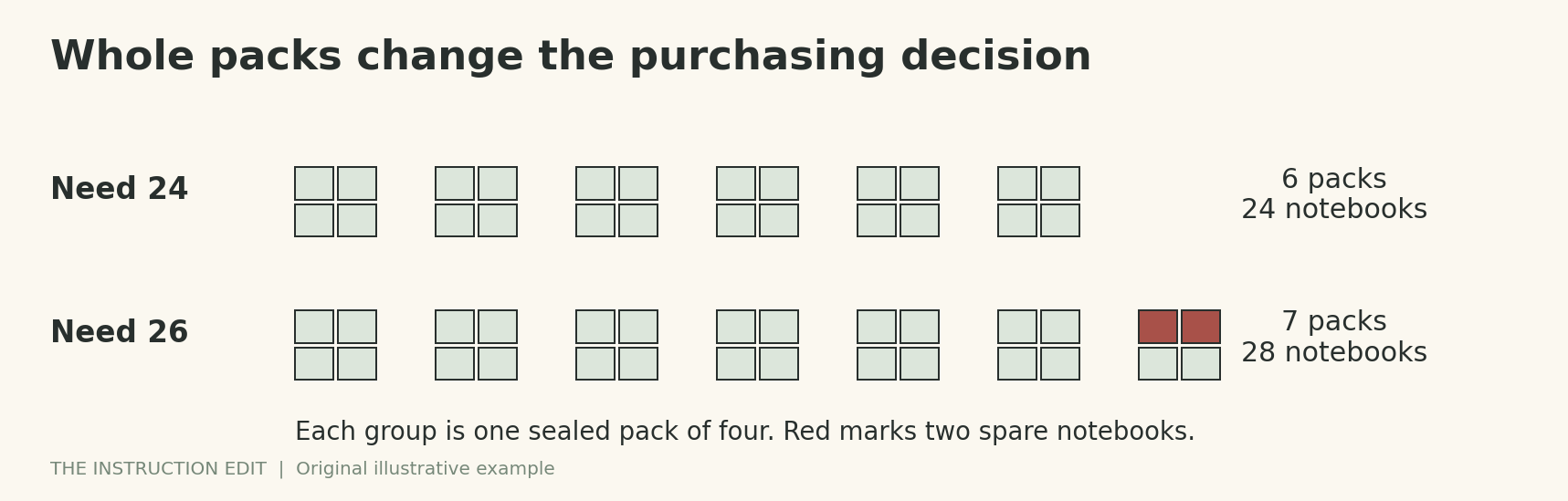
Replace one content slide with a pair of worked decisions. Show the reasoning for the first example, change one important condition in the second, and ask learners to explain why the decision changes. The pair should reveal a principle they can use, rather than give them two answers to copy.
A slide that says “read carefully, choose an operation, check your answer” may be accurate but leaves the actual decisions invisible. A worked example makes those decisions inspectable. The comparison then gives learners a reason to attend to the condition that matters.
Choose a decision that deserves explanation
Use an illustrative middle-school purchasing problem. A club needs notebooks, sold only in packs of four. In the first example it needs 24 notebooks. In the second it needs 26. The mathematical operation is similar, but the purchasing decision differs because a fractional pack cannot be bought.
The goal is to determine the number of whole packs needed and justify the decision in context. It is not merely to divide two numbers. The same design could be adapted for workplace training by comparing two scheduling, routing or approval cases, provided the rule is current and the consequences are appropriate for practice.
The IES practice guide on organizing instruction and study, released in 2007, recommends alternating worked solutions with problem solving and rates that recommendation as supported by moderate evidence. It does not establish that every two-example slide will work for every subject or learner. The notebook pair below is an original illustration of the design approach.
Write the reasoning that a polished answer hides
For 24 notebooks, the calculation gives six packs. Explain why this result answers the actual question: six complete packs contain exactly 24 notebooks. Then check the decision by multiplying six by four.
For 26 notebooks, division gives six and a half packs. That is useful information, but it is not a purchasable quantity under the stated condition. Six packs supply only 24 notebooks, so the club needs seven packs, providing 28. The extra two notebooks are a consequence of buying complete packs, not a calculation error.
Do not summarize the second example as “always round up.” The rule depends on the goal and the unit. A question about how many complete gift packs can be made from 26 notebooks would call for a different decision. The comparison should teach attention to the situation rather than a new shortcut detached from it.
Illustrative worked-example pair. All quantities are invented for teaching.
Reasoning step: Read the constraint
Example A: Packs contain four notebooks and cannot be split
Example B: Same constraint
Reasoning step: Identify the need
Example A: 24 notebooks
Example B: 26 notebooks
Reasoning step: Calculate
Example A: 24 divided by 4 is 6
Example B: 26 divided by 4 is 6.5
Reasoning step: Make the decision
Example A: Buy six whole packs
Example B: Buy seven whole packs because six are insufficient
Reasoning step: Check in context
Example A: Six packs supply exactly 24
Example B: Seven packs supply 28, covering the need with two spare
Reasoning step: Explain what changed
Example A: The required amount is an exact multiple of four
Example B: The required amount lies between six and seven complete packs

Make the comparison question do real work
After presenting the pair, ask: “Which detail makes six packs acceptable in A but insufficient in B?” Follow with: “Why would rounding 6.5 to the nearest whole number be a weaker explanation than checking how many notebooks six packs contain?”
The point is not to forbid conventional rounding. It is to make the justification depend on the required quantity. A learner should be able to explain the answer when the result is 6.25 as well as 6.5. If they only remember that .5 rounds up, the intended reasoning is still uncertain.
Ask learners to annotate the step where the second example diverges. They might circle the decision row rather than the arithmetic row. That distinction helps you see whether they understand that calculation and interpretation are related but separate parts of the task.
Adjust the support to what learners already know
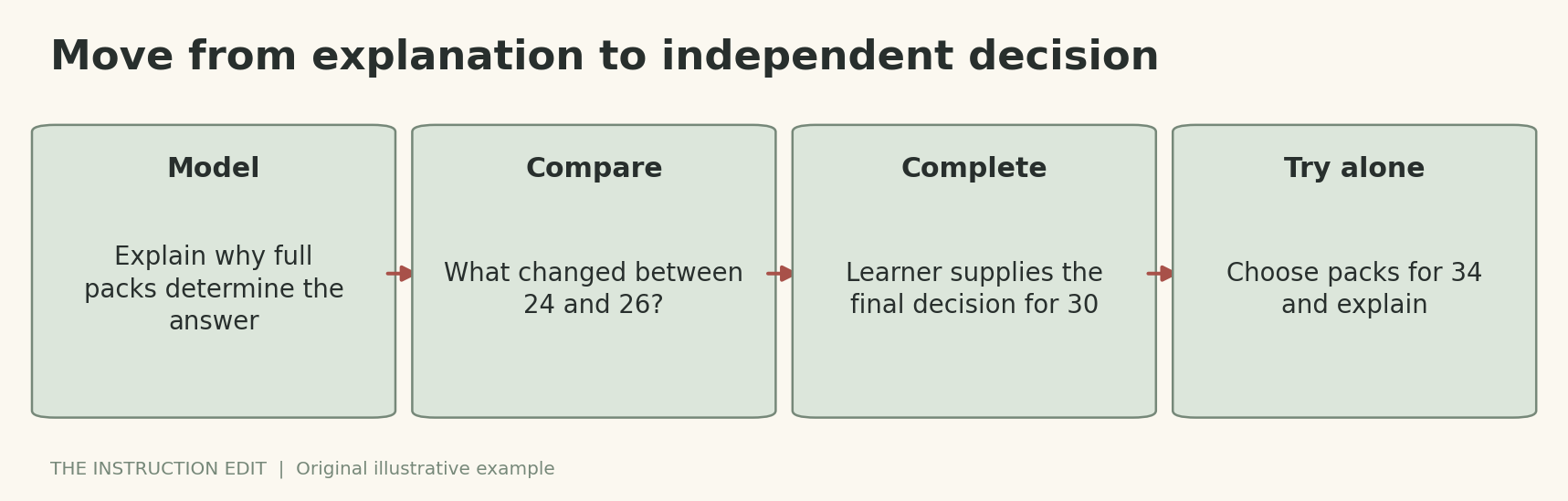
For someone new to the reasoning, show the complete first example and talk through the connection between packs and notebooks. Use a simple representation if needed, keeping labels next to the quantities they describe. Avoid adding decorative objects that make the four-per-pack structure harder to see.
Then offer a completion example: “The club needs 30 notebooks. Division gives 7.5. Finish the decision and check it.” The learner supplies the contextual step while the arithmetic is provided. A later task can require both calculation and explanation.
For learners who already make and justify the decision reliably, shorten the model. Ask them to compare a purchasing task with a packaging task or to write a case where rounding up would be wrong. Requiring experienced learners to copy a full solution may add work without revealing anything new.
Remove the model before judging independent performance
Try a fresh problem: the club needs 34 notebooks in packs of four. Ask for the purchase decision and a reason. A defensible response is nine packs, because eight provide only 32 and nine provide 36. If you supply those checks during the attempt, record the result as supported performance.
Then change the task structure: “There are 34 notebooks available. How many complete packs of four can be made?” The answer is eight complete packs with two notebooks left over. This is a useful boundary check because the numbers remain familiar while the purpose changes.
Do not interpret success on one pair as general mathematical understanding. Check later, vary the representation and consider whether prerequisite arithmetic is consuming the learner’s attention. If the goal is contextual decision-making, a calculator may be appropriate; if division fluency is the goal, it changes what you are assessing.
Edit one slide rather than the whole deck
Choose a slide that currently lists a procedure or rule. Replace it with one complete worked example and one carefully controlled variation. Write the comparison question before adding visuals, so the design has a clear job.
End with a fresh attempt and inspect the reason, not only the answer. Keep the pair only if it makes an important decision easier to see. Two examples are useful when their difference teaches something. Otherwise, they are simply twice as many examples.
