The dashboard is green. Everyone completed the course. Then the same question appears in the team chat: ‘What do I do with this order?’
Completion is useful information. It tells you something about participation or progress through the assigned material. It does not, on its own, show that someone can perform the task.
Before building a bigger dashboard, choose the question you actually need to answer.
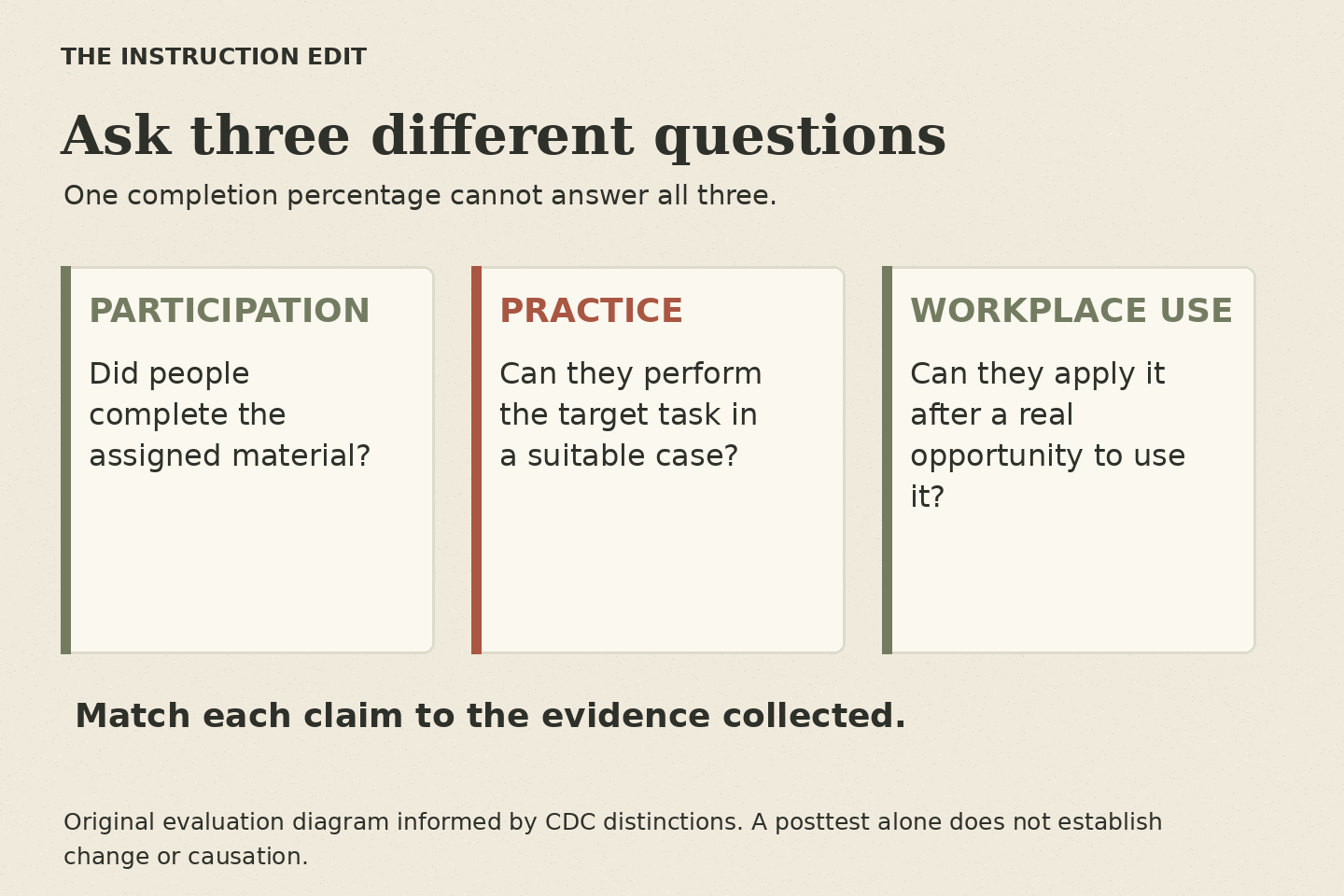
Separate three different questions
Did people participate? Completion records can help answer that.
Can they do the task in practice? You need a response or demonstration that resembles the skill you intended to teach.
Can they use it at work? You need appropriate follow-up after they have had a realistic opportunity to apply it.
CDC’s evaluation guidance distinguishes learning from learning transfer. It also explains that a posttest alone can show end-of-training proficiency without establishing how much changed. That distinction matters when reporting results.[1]
These questions can sit beside one another. The problem is using one measure as if it answers all three.
Choose an observable task
Imagine a fictional print studio. Before scheduling an order, employees must confirm three details: quantity, delivery date, and written approval of the artwork proof.
The training goal is to identify missing information and write an appropriate reply.
A quiz asking ‘Which department handles print orders?’ does not directly assess that task. A better-aligned assessment would present an order and ask the employee to identify the missing detail, explain the next step, and draft the reply.
For example: ‘Please print 80 posters. I approve the attached artwork proof for printing.’
The delivery date is missing. A suitable response would ask for that date before scheduling. Asking for approval again misses information already supplied. Assuming Friday imports a detail that is not in this order.
This is a deliberately simplified fictional rule. A real process owner would need to confirm the requirements and exceptions before using it for workplace assessment.
Decide what counts before you inspect the answers
For this sample, I would look for three things: the response identifies the missing date, does not promise scheduling before the required information is confirmed, and asks a clear question.
A brief checklist can make the review more consistent. Try it on a few invented responses first. Would two reviewers interpret the criteria similarly? Does a response fail because of an important process error, or because its wording differs from your preferred sentence?
Keep the assessment focused on the goal. If the skill includes clear communication, the reply matters. If the goal is only spotting missing information, do not quietly turn polished prose into the main criterion.
Use a different order for the final check than the one demonstrated during instruction. Otherwise, you may mainly be seeing whether someone remembers the worked answer.
Get a starting point if you want to discuss change
A suitable pre-training task can show what participants already know. A comparable task afterward can help you describe changes in performance on that task.
Comparable does not have to mean identical. The cases should make similar demands and use the same criteria, while avoiding an easy answer-memory effect.
If you only have a post-training assessment, say what it supports: how participants performed at that point. Do not report the result as a gain when you did not measure a starting point.
Even before-and-after improvement does not, by itself, prove that training caused the change. Other support, repeated practice, different case difficulty, or changes in who responded can affect the result. Keep the claim proportionate to the design.
Follow up when the work has actually happened
For the fictional studio, a supervisor might review an appropriate sample of later orders after employees have had opportunities to handle them. The organization would decide the timing, sample, access permissions, and use of those records.
Look for the task you taught: were missing details noticed, and did the reply ask for the right information? Also ask what got in the way. An employee may understand the process but lack a usable checklist or permission to pause an order.
Count opportunities as well as errors. ‘Three errors’ means something different across ten orders than across a thousand. Check whether the mix of cases changed before comparing periods.
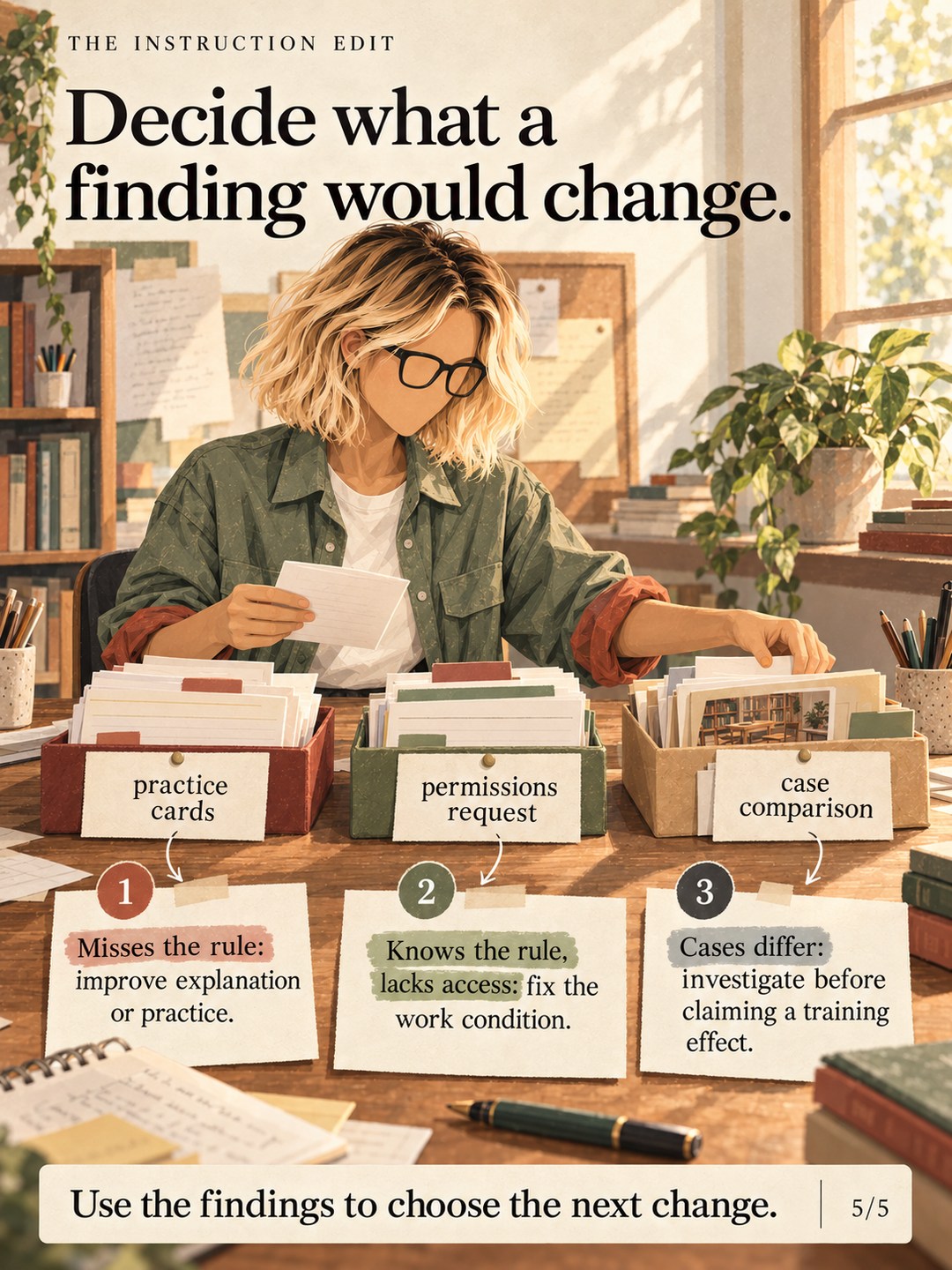
Use the findings to decide what support comes next. That could be another example, clearer feedback, an updated reference, or a workflow change.
A four-field measurement plan
Task: What should someone be able to do? For example, check an incoming order and request missing information.
Evidence: What will you inspect? Use a realistic practice response and, when appropriate, a later sample of work.
Timing: When will you collect it? Consider a starting task, a new case after instruction, and follow-up after actual use.
Next action: What will you change if the evidence shows a problem? Name the owner who can review the finding and act.
This is a small planning framework, not a complete evaluation system for every setting. High-stakes or regulated work may require specialist assessment and governance.
Keep the completion report. Put it beside evidence that answers the learning question. Before your next module, write the task and decide what a useful response would look like. That is a clearer starting point than another percentage with no explanation.
Sources
1. CDC, Evaluate Training: Measuring Effectiveness (2024). Cited for distinctions between learning, transfer, and pre/post assessment. The print-studio task and four-field plan are original applications.
https://www.cdc.gov/training-development/php/about/evaluate-training-measuring-effectiveness.html