

A lesson can look beautifully simple and still ask a learner to juggle too much. A complicated-looking diagram can be manageable for someone who already understands its parts. Cognitive load theory is useful because it directs attention to that relationship: the information in a task, the learner's knowledge and the support provided.
The practical question is not how little you can put on a slide. It is what learners need to hold together while making sense of the next step. Start there, then decide what to explain, what to show and what learners should attempt independently.
What the theory helps explain
In their 2019 review, Sweller, van Merriënboer and Paas describe working memory as limited when processing unfamiliar information. Organized knowledge in long-term memory changes what a person can handle. They distinguish complexity arising from interacting elements and prior knowledge from demands introduced by instructional arrangements. Their review also discusses worked examples and expertise reversal: support that helps a novice can become redundant for someone with more relevant knowledge. These are research-based explanations of learning conditions, not a universal limit on words or objects per screen. Read the review.
Consider a learner meeting a balance equation for the first time. They may need to track the meaning of the equal sign, the operation applied, the change on each side and the purpose of isolating a variable. An experienced learner may recognize that whole sequence as a familiar move. Counting the visible symbols does not tell you whether either learner is overwhelmed.
That difference should affect the teaching sequence. It should not become a permanent label attached to the learner. Someone can be experienced with one kind of equation and a novice when fractions or unfamiliar representations appear.
A worked example that does useful work
Here is an illustrative middle-school example, not a tested lesson. The goal is to explain why an equation stays equivalent when the same operation is applied to both sides.
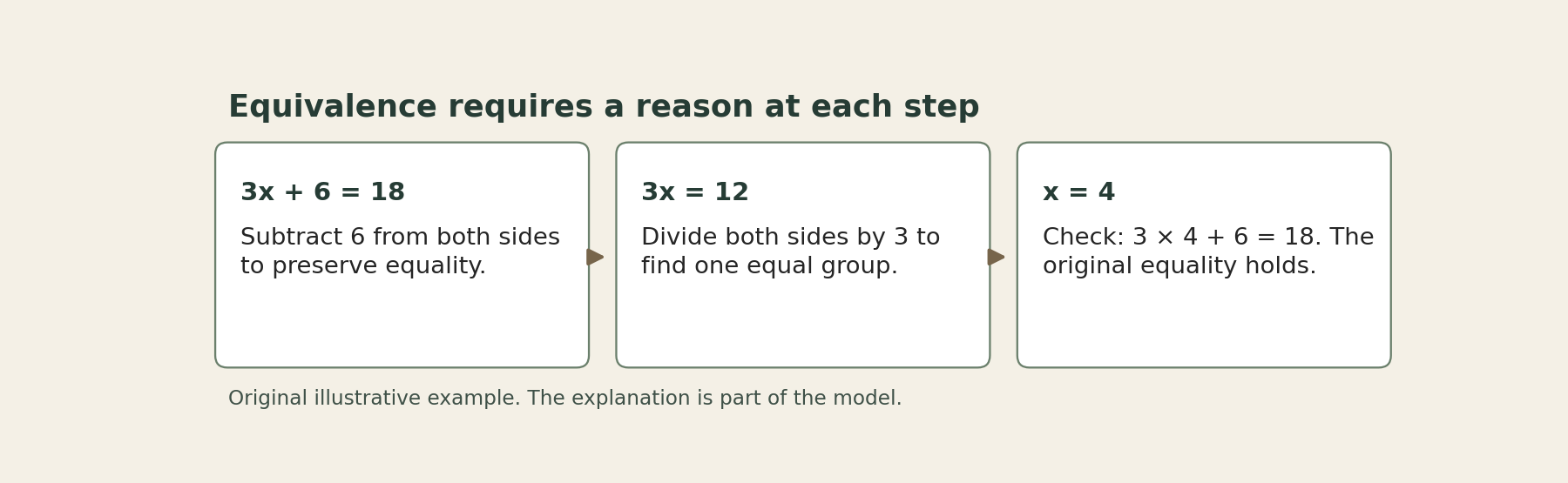
The starting problem is 3x + 6 = 18. A weak demonstration presents four lines of algebra and says, “Do the same thing on both sides.” The arithmetic is visible, but the reason for each transformation remains hidden. A learner may copy the shape of the procedure without knowing what must stay unchanged.
A more purposeful example shows one transformation at a time, with the explanation immediately beside it. Subtract 6 from both sides because removing equal amounts preserves equality. The result is 3x = 12. Divide both sides by 3 to find the value of one equal group. Then substitute x = 4 into the original equation to check the claim.
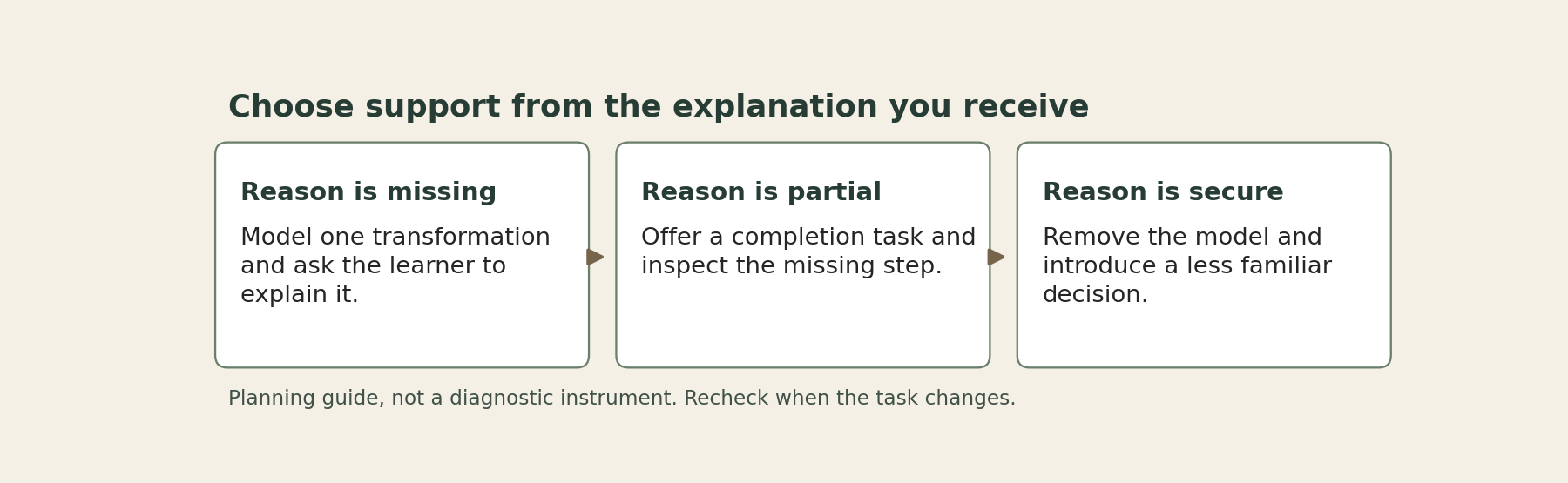
Ask learners to explain the first transformation before asking them to perform the whole solution. Follow with a partially completed equation in which they supply the reason for a step. Finally, offer a new equation without the model. Those choices make the planned withdrawal of help visible. They are a design proposal to test through learner responses, not a guaranteed sequence for every class.
Give different support without changing the goal
The comparison below keeps the learning goal stable. The support changes according to evidence of understanding, not age, speed or confidence alone.
Design decision: First task
Learner new to the process: Study a solution and explain one transformation
Learner with secure prior knowledge: Diagnose an incorrect solution and justify a correction
Design decision: Support
Learner new to the process: Keep operation and explanation together
Learner with secure prior knowledge: Offer the explanation only when needed
Design decision: Practice
Learner new to the process: Complete one missing step before solving independently
Learner with secure prior knowledge: Compare two valid approaches to a less familiar equation
Design decision: Evidence to inspect
Learner new to the process: Can the learner explain what remains equal?
Learner with secure prior knowledge: Can the learner justify a choice when the surface features change?
An experienced learner does not need to spend the entire lesson waiting through explanations they can already produce. Equally, an independent task is not automatically a better challenge. A pile of extra equations may add repetition without adding a useful decision.
A small entry task can help: ask everyone to explain why subtracting 6 from only one side is invalid. Use the reasoning, including incomplete explanations, to choose the next support. Do not infer mastery from one correct answer if copying or a lucky guess remains plausible.
Where design advice becomes too confident
“Reduce cognitive load” is sometimes used to justify removing every difficult element. But a lesson needs intellectual work. In this example, explaining equivalence is the work we want learners to do. Searching three pages for an unexplained symbol is a different demand. The useful distinction is between effort directed toward the goal and effort created by the way the task is arranged.
The 2019 review also notes measurement complications and that many early studies inferred support for the theory from learning outcomes rather than directly measuring comparative load. A neat-looking resource therefore cannot serve as a measurement of learning or cognitive load. See the review's discussion of measurement.
For a design review, avoid using visual simplicity as the verdict. Ask what the learner must coordinate, whether needed information is available at the point of use and what successful independent performance would look like. If a diagram explains an important relationship, deleting it may make the page quieter and the task harder.
Test the support rather than the slogan
Choose one point in an existing lesson where learners frequently lose the thread. Write down the exact decision they are supposed to make. Then identify which prerequisite ideas they must use at that moment.
Try a modest change: place a definition beside the relevant symbol, model the reasoning behind one step or remove an unnecessary navigation task. Keep the learning goal and final check the same so that you can interpret what happens. Gather the learner's explanation, not just a completion count.
If the support helps learners begin but they cannot continue without it, plan another step toward independence. If they already explain the process accurately, offer a task that requires a new judgment. The aim is responsive support, not a permanent diet of either worked examples or unguided problems.
Cognitive load theory earns its place in a designer's toolkit when it sharpens questions about the task and the learner. It becomes less useful when it is reduced to a rule about how a slide should look.
Sources
Sweller, van Merriënboer and Paas (2019), Cognitive Architecture and Instructional Design: 20 Years Later. Open-access research review of cognitive load theory and its development.
