
The exit ticket is complete. The students have left. You have a small pile of paper and a less small question: what am I supposed to do with this tomorrow?
An exit ticket is most useful when its answers help you make a decision. That does not mean every lesson needs a complicated assessment. It means choosing a prompt that gives you information you can reasonably use.
Start with the next decision
Before writing the question, ask what you might need to do next. Do students need another model? Are they ready for a new example? Do a few students need help with a particular misconception?
If every possible answer would lead you to teach the same thing in the same way, consider whether the prompt is collecting the information you need.
A confidence check can tell you how students feel. A recall question can tell you whether they can retrieve a fact. Those are legitimate purposes. They are not interchangeable with evidence that a student can explain or apply an idea.
EEF’s feedback guidance covers pupils aged 5–18 and emphasizes useful principles rather than a preferred delivery format. It offers context for using evidence and feedback thoughtfully. The ticket examples here are original illustrations, not validated diagnostic tests.[1]
Compare two prompts
Prompt A: ‘How well do you understand comparing fractions? Circle a number from one to five.’
Prompt B: ‘Sam says 3/8 is greater than 3/4 because eight is greater than four. Is Sam correct? Explain using equal-sized wholes.’
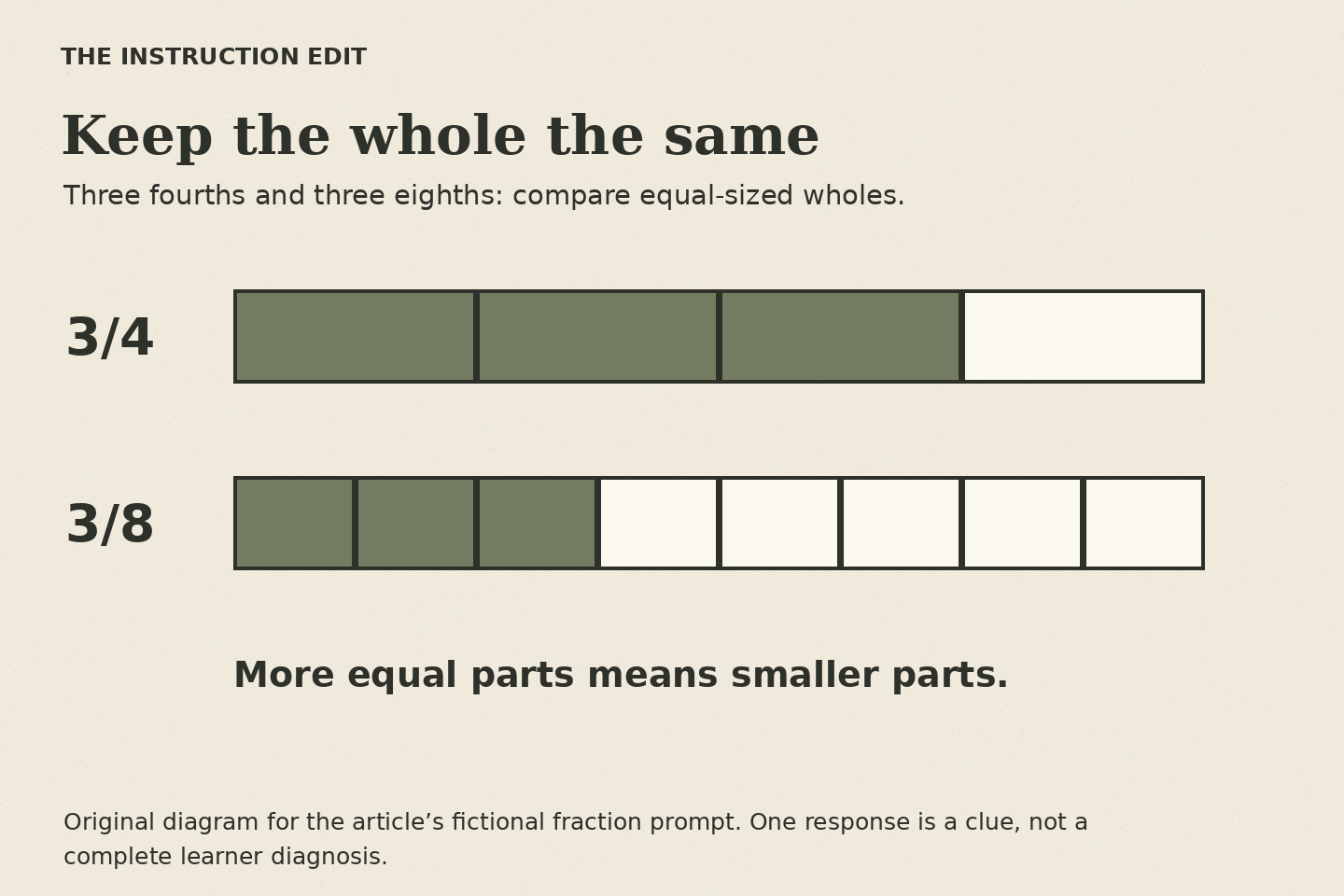
The first prompt gives a self-report. The second invites students to reveal how they interpret the denominator. For the intended comparison, 3/4 is larger: fourths are larger pieces than eighths of the same whole, and both fractions contain three of those pieces.
The phrase ‘equal-sized wholes’ matters. Comparing parts of differently sized wholes could introduce a different problem. Keep the prompt precise enough that a response is interpretable.
This example is appropriate only when students have had the necessary instruction. An exit ticket should not quietly assess a new concept while you interpret the result as failure to learn the previous one.
Three answers, three possible next moves
Fictional response 1: ‘Sam is correct because eight is bigger.’ This suggests that the student may be comparing the whole-number labels without considering the size of the parts. A possible next move is a side-by-side model of equal wholes divided into fourths and eighths. Ask what changes as the number of equal parts increases.
Fictional response 2: ‘Sam is wrong. 3/4 is bigger.’ The comparison is correct, but the reasoning is missing. Ask the student to explain or sketch the comparison before assuming the underlying idea is secure.
Fictional response 3: ‘Sam is wrong. With the same whole, fourths are larger than eighths. Three fourths is therefore larger than three eighths.’ This response provides the intended reasoning. A next task might change the numerators so the student has to think beyond the original pattern.
These are hypotheses about what to check next. One short response is not a complete picture of a learner. Language, time, handwriting, and the wording of the question can affect what reaches the paper.
Sort by the teaching need
You do not necessarily need a numerical score for every slip. For this example, try three temporary groups: revisit the idea, ask for reasoning, and extend or check transfer.
Use those groups to plan a short response. A whole-class model may make sense if a misconception is widespread. A brief small-group discussion may fit a smaller need. A follow-up question may be enough when the original answer is ambiguous.
Avoid turning the groups into fixed labels for students. They describe what this response suggests about this task on this day.
If the whole class misses the same part, inspect the lesson and the prompt as well as the answers. Perhaps the necessary model was absent or your wording introduced an unfamiliar demand.
Three prompt patterns worth adapting
Explain a tempting mistake: ‘Someone says ___. What would you change in their reasoning?’ This can reveal a specific misunderstanding when the misconception is plausible and the context is clear.
Choose and justify: ‘Which option fits the evidence? Use one detail to explain.’ This separates a selection from the reasoning behind it.
Apply with one change: ‘What changes if ___ changes? Explain why.’ This helps you inspect whether a student can move beyond the exact example already demonstrated.
In English, students might select evidence for a claim. In social studies, they might explain a source’s limitation. In science, they might identify a variable that makes a comparison difficult. Supply the background and success criteria appropriate to the subject and learners.
Make room to use the answers
Set aside a manageable review routine. Look for patterns rather than writing a paragraph on every slip. Note the next teaching move and a short question you will use to see whether that move helped.
For students who need another response route, an oral explanation, drawing, or accessible digital response may provide better evidence than a rushed written sentence. Preserve the intended thinking while adapting how it can be expressed.
An exit ticket earns its place when you can connect the answer to a reasonable next step. Before your next lesson, finish this sentence: ‘If students answer this way, I will…’ Then write the question that helps you make that decision.
Sources
1. Education Endowment Foundation, Teacher Feedback to Improve Pupil Learning (2021). The fictional fraction responses and sorting routine are original applications, not validated assessments.
https://educationendowmentfoundation.org.uk/education-evidence/guidance-reports/feedback