
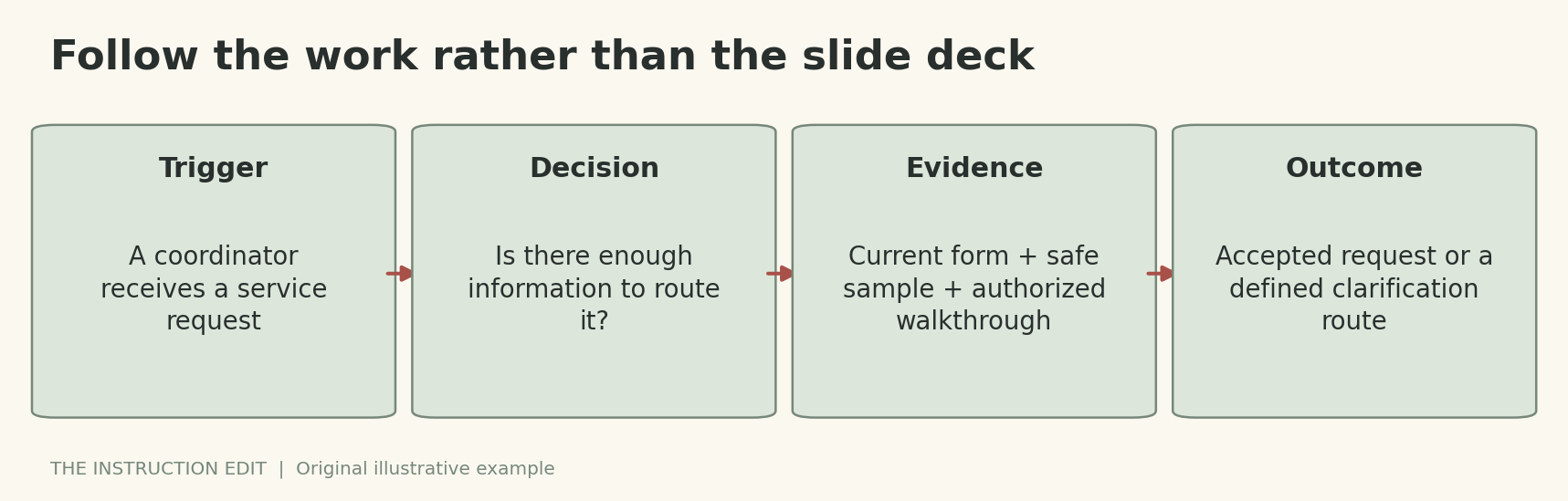
Ask the subject matter expert to walk through a real task before asking what the course should contain. Then separate what you can verify, what someone believes, and what remains unknown. That gives you a stronger starting point than a slide deck labeled “everything they need to know.”
An SME interview should help you understand the work and the decisions within it. It should not require the expert to become an instructional designer, and it should not treat confidence as evidence. Experts can be excellent at the work while overlooking steps that have become automatic for them.
Agree on the task before discussing content
Start with a narrow request: “Think of the last ordinary example of this task. What started it, what did you do, and what counted as finished?” Ask for a lawful, appropriately de-identified artifact if one exists, such as a blank form, an approved checklist or a sample record created for training.
Suppose a fictional service team asks for training because internal requests are being returned for correction. The SME initially says, “People need to understand the process.” That is too broad to design around. A better task description is: “A coordinator submits an internal service request with enough information for the receiving team to route it without clarification.”
The CDC’s Quality Training Standards begin with validating whether training is needed. Although written for public-health training, that principle offers a useful check for other workplace design projects. The interview guide here is an original adaptation, not a CDC checklist or certification process.
Ask for the decision points inside the task
Walk through the task in sequence. Ask what information is available at each point, what choices are possible and what would make a choice inappropriate. “What do you look for here?” is often more revealing than “What do learners need to know?”
For the fictional coordinator, the important decision may be whether a request belongs in the routine queue or needs clarification first. The expert might notice an unclear deadline, a missing location or a description that names a solution without stating the problem. Capture those cues. They are candidates for practice, not just headings for a presentation.
Ask for a near miss as well as a perfect example. “What looks complete at first but creates work later?” can expose tacit checks. Keep the discussion focused on the task rather than on identifying a colleague who supposedly does it badly.

Use an interview guide that preserves uncertainty
Illustrative SME interview guide. The service-request setting is fictional. Use local authorized evidence in a real project.
Interview question: What should a coordinator submit?
Evidence to request: Current approved form and acceptance criteria
How to record the answer: Verified requirement with owner and version
Interview question: What is actually being returned?
Evidence to request: De-identified returned examples across relevant request types
How to record the answer: Observed pattern with sample scope
Interview question: What separates an ordinary case from an exception?
Evidence to request: Contrasting cases and the decision rule
How to record the answer: SME explanation pending confirmation where needed
Interview question: Can coordinators find the rule while working?
Evidence to request: Walkthrough using the normal tools and permissions
How to record the answer: Observed access condition, not an assumed knowledge gap
Interview question: What else could explain the error?
Evidence to request: Workload, unclear fields, competing instructions or missing information
How to record the answer: Alternative explanation to investigate
Interview question: What decision must this interview support?
Evidence to request: Sponsor’s scope, deadline and authority
How to record the answer: Agreed next decision and unresolved questions
Do not fill every field with “fact” because an expert said it. “The form requires a service location” becomes a verified requirement when it matches the current approved form. “New starters ignore the instructions” remains an interpretation until you examine what happens and whether the instructions are usable.
Keep three kinds of notes separate
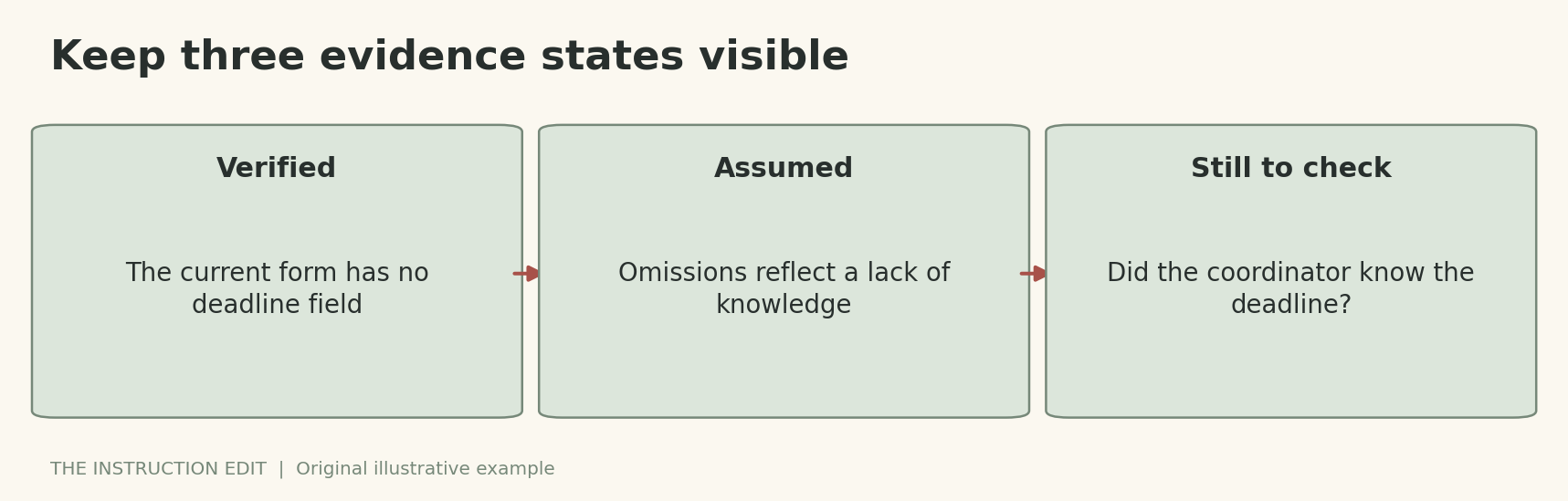
A fact note should identify its basis: “The current form has no dedicated deadline field.” An assumption note should identify the claim and the uncertainty: “The SME believes requesters omit deadlines because they do not understand routing.” An unresolved question should identify the next check: “Do requesters know the deadline when they submit?”
This distinction matters because the design response differs. If the deadline is unknown at submission, a lesson explaining deadlines may not help. The process may need a permitted “not yet known” route. If the field is absent, the form owner may need to change the tool. If the field is clear and available but learners cannot judge the required level of detail, a worked example and practice may be appropriate.
Ask the SME to help test interpretations rather than defend them. Try: “What would we expect to see if this were mainly a knowledge problem? What would make you change your mind?” This keeps the conversation collaborative while making room for disconfirming evidence.
End with a readback and a small evidence request
Use the last few minutes to summarize the task, the observed problem and the strongest alternative explanation. For example: “We have a current form and two illustrative returned requests. We do not yet know how common the problem is or whether the missing information was available to the coordinator. Before selecting training, we will review a small, authorized sample and observe the submission process.”
Agree who can confirm the requirement and who owns any process change. The SME may know the work but lack authority to approve a new rule. Do not turn a helpful workaround into official policy simply by placing it in a course.
Request only the evidence needed for the next decision. A complete export of customer records is rarely necessary for understanding a form. Prefer synthetic examples, redacted artifacts or an observation in an approved environment. Respect confidentiality, retention rules and the boundaries of the project.
Know what the interview cannot establish
One interview can produce a useful task model, but it cannot establish how all employees work or how often an error occurs. The expert’s preferred method may differ from the current approved process. A memorable failure may also be atypical.
Before building content, check the task model with an intended learner and the relevant process owner. Use disagreements to locate missing context, such as different permissions, regional rules or uncommon exceptions. Do not average incompatible procedures into a fictional compromise.
For the next SME meeting, bring a blank three-part note headed “Verified,” “Assumed” and “Still to check.” Leave with one task description, one consequential decision and one bounded evidence request. That is enough to move the project forward without pretending the handover answered every question.
