
A teacher changes a lesson. That fact alone tells a curriculum leader very little. The change might remove an access barrier, respond to a misconception, replace a weak example or quietly remove the very reasoning the lesson was designed to develop.
Treat adaptation as a decision to inspect rather than an automatic sign of failure or expertise. The useful questions are why the teacher changed the material, what learning demand remained and how the revised task fits the surrounding sequence. Those questions support professional judgment without pretending every change is beneficial.
Reported practice is a starting point
RAND's 2025 report on instructional materials describes widespread mixing and modification among U.S. K–12 ELA, mathematics and science teachers surveyed from 2019 to 2024. Nearly all reported modifying curriculum materials. This establishes that adaptation is common in reported practice; it does not show whether any particular change improves learning. Read the report.
The implication for leadership is practical. If teachers regularly alter materials, a curriculum system needs a way to understand and support that work. A rule that treats all changes as defects can make useful information harder to see. An equally broad celebration of teacher creativity can make it hard to notice when a coherent sequence has been lost.
A more productive conversation begins with an artifact and a reason. Put the original and revised task beside each other. Ask the teacher to identify the problem they were trying to solve before evaluating the solution.
Describe the barrier precisely
Consider an illustrative ratio lesson. Learners compare two paint mixtures using a table of quantities and explain whether the mixtures have the same ratio. The directions are on one page, the quantities on another and the response prompt on a third.
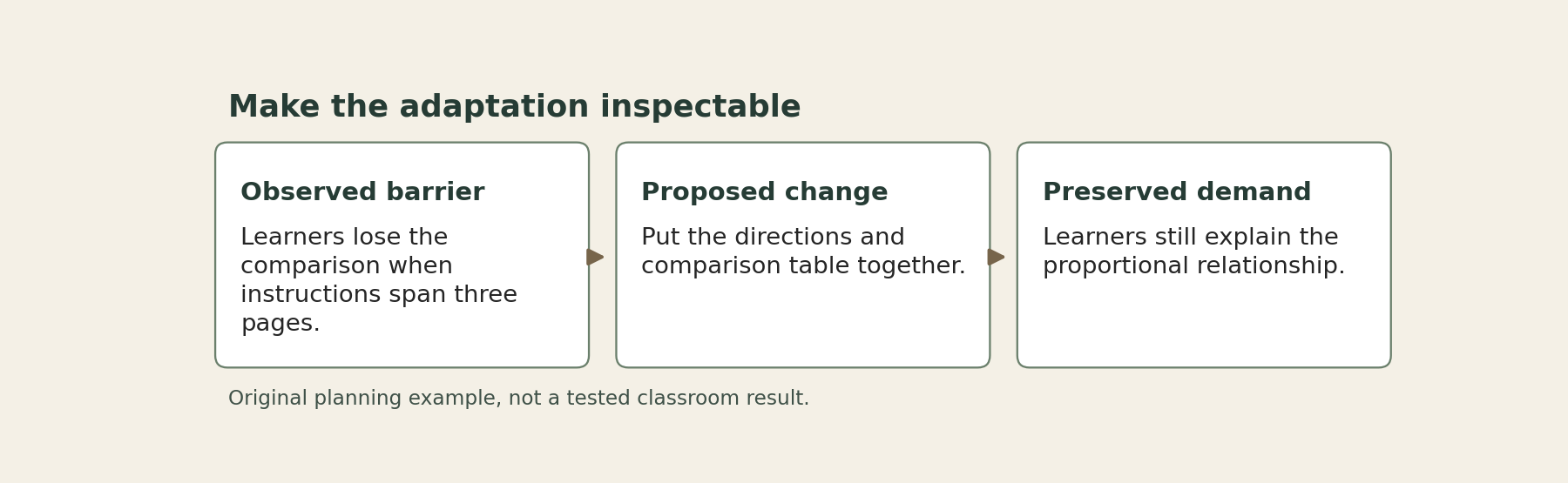
A teacher notices that several learners are answering a different question from the one intended. One possible response is to replace the lesson with a simpler worksheet. Another is to bring the directions, table and prompt together while preserving the comparison. These are materially different adaptations.
The first may change the learning demand. The second mainly changes how the information is arranged. Neither should be judged solely by how much of the published page remains visible.
A precise barrier statement helps: “Learners are losing track of which quantities to compare while moving between pages.” It is more useful than “This class cannot do the curriculum.” It also remains open to correction. If learners still compare additive differences after the navigation change, the original explanation was incomplete and the reasoning needs attention.
Distinguish changes that solve different problems
Use the table to name the kind of decision being made. It is an original planning tool, not a taxonomy validated by the RAND survey.
Proposed adaptation: Put directions beside the data
What it may preserve: The comparison and explanation demand
What needs checking: Whether the layout is actually usable
Proposed adaptation: Explain an unfamiliar context
What it may preserve: The mathematical relationship
What needs checking: Whether the explanation gives away the answer
Proposed adaptation: Replace awkward numbers
What it may preserve: The intended reasoning, if chosen carefully
What needs checking: Whether the new numbers remove the important contrast
Proposed adaptation: Add a worked example
What it may preserve: Access to the procedure or reasoning
What needs checking: Whether learners later act without the model
Proposed adaptation: Remove the explanation prompt
What it may preserve: Faster completion
What needs checking: Whether evidence of understanding has disappeared
The last row is particularly important. A task can become more manageable because a barrier was removed, or because the learning was removed. Completion alone cannot distinguish the two.
Suppose the original mixtures are 2 cups of blue to 3 cups of white and 4 cups of blue to 6 cups of white. If a replacement task uses only identical quantities, it may no longer require learners to reason about equivalent ratios across scaled amounts. A seemingly modest number change can alter the conceptual work.
That is why “keep the goal” needs to mean more than keeping the objective printed at the top. Inspect the decisions the task actually requires.
Protect the connections around the lesson
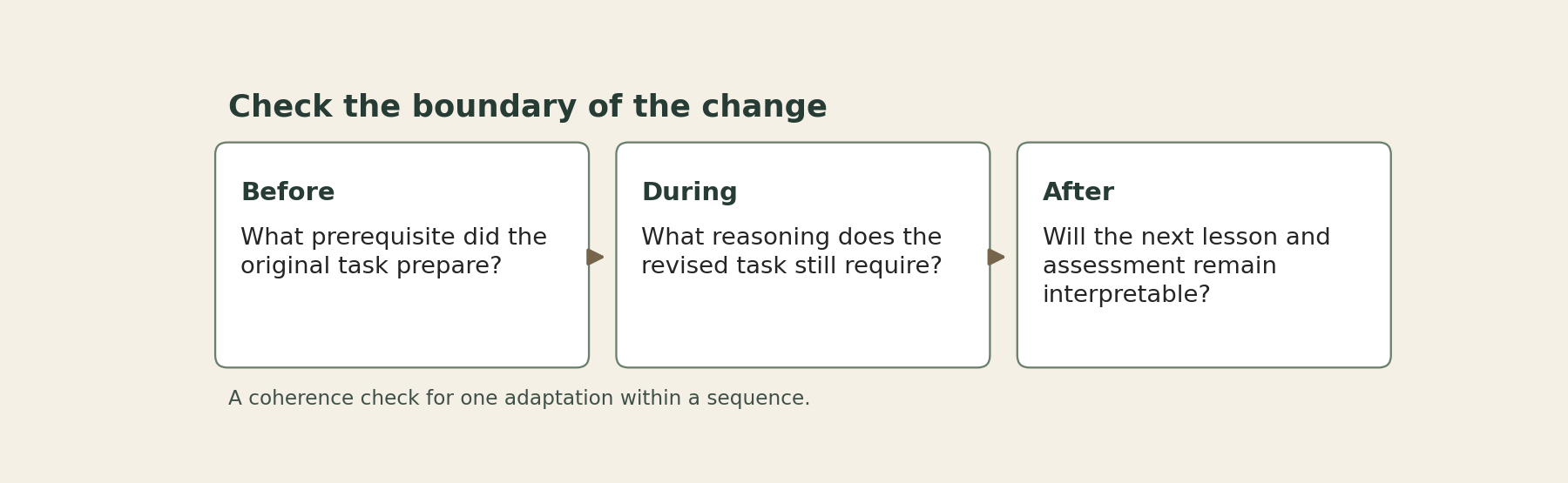
An adaptation sits inside a sequence. Before removing a representation, ask whether the next lesson assumes learners have used it. Before adding a shortcut, ask whether it hides the relationship a later task will build on. Before substituting a new context, check that it does not introduce unfamiliar knowledge that overwhelms the intended focus.
These questions do not require a full curriculum rewrite every time a teacher adjusts a page. For a small change, a short look backward and forward may be enough. Larger changes, especially changes to the sequence or assessment, deserve a broader conversation with colleagues.
Sometimes the appropriate decision is to change the sequence. A resource may genuinely be mismatched to the learners' current knowledge or to the intended curriculum. In that case, make the new progression explicit rather than maintaining a fiction that nothing important changed.
There is a cost to both rigidity and fragmentation. A prescribed lesson that learners cannot meaningfully access is a problem. So is a collection of attractive activities whose mathematical ideas do not connect. The task is to preserve purposeful progression while making justified adjustments.
Give teachers a useful way to share adaptations
Ask for a short change record with four fields: the barrier, the change, the learning demand retained and the response to inspect. Keep the record brief enough to use during ordinary planning. A documentation process that takes longer than the adaptation will not earn much affection.
For the ratio example, the response to inspect might be an explanation of why doubling both quantities preserves the mixture. A correct table entry without an explanation may be insufficient for that particular goal. If the new layout helps learners reach the intended comparison but explanations remain weak, the next response is teaching, not another cosmetic redesign.
When sharing the adaptation, include the conditions under which it may help. “Combined directions for this comparison task” is a more honest label than “version for low learners.” The former describes a design move. The latter risks turning a temporary need into a fixed identity.
Curriculum leaders can then look for recurring barriers across change records. Repeated navigation repairs may suggest a material problem. Repeated removal of a crucial explanation may suggest a need for professional learning about the task's purpose. Both are more informative than a count of deviations.
Start with one adapted lesson at the next planning conversation. Ask what changed, why it changed and what evidence would support keeping it. That is a stronger basis for curriculum improvement than treating fidelity and adaptation as opposing loyalties.
Sources
Doan and colleagues (2025), Teachers’ Use of Instructional Materials from 2019–2024. Primary RAND survey report covering U.S. K–12 ELA, mathematics and science teachers.
