
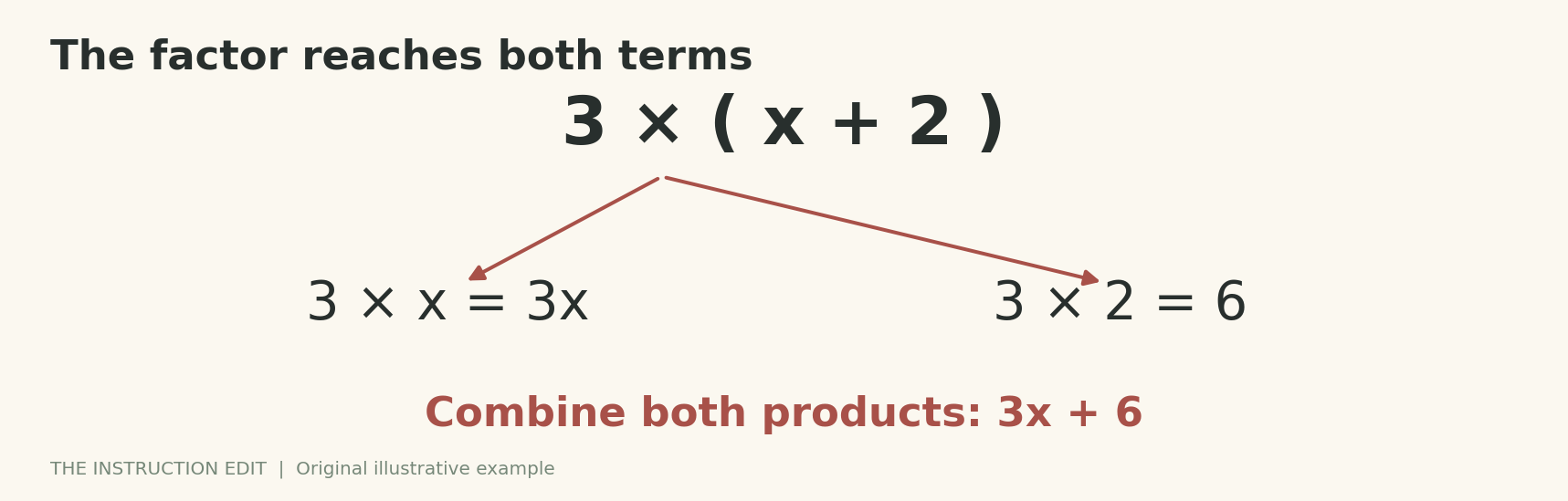
Sort learner responses by the reasoning they appear to show, then check that interpretation before selecting a follow-up. A correct-or-incorrect pile tells you how many answers matched the key. It does not tell you whether the same explanation will help everyone in the incorrect pile.
The sorting process should stay provisional. A response can suggest a misconception, but it can also reflect a slip, incomplete writing, an unfamiliar term or a misunderstood instruction. Keep the work itself visible so that your categories remain connected to evidence rather than becoming labels attached to learners.
Collect enough reasoning to make sorting possible
Use an illustrative algebra prompt: “Expand 3(x + 2). Show or explain what the 3 multiplies.” The expected expression is 3x + 6. Asking for a brief explanation matters because a final expression alone may leave several interpretations open.
The EEF’s feedback guidance links formative assessment with identifying the gap feedback should address. The response-sorting method here is an original classroom routine, not a validated diagnostic test. All responses in this article are fictional.
Before collecting work, decide what evidence would change your teaching. You might need to distinguish incomplete distribution, confusion between addition and multiplication, an arithmetic slip and a secure explanation. You do not need a category for every variation in handwriting or phrasing.
Sort the response rather than the person
Begin with the written work. Response A says “3x + 2” and draws a line from 3 only to x. Response B says “3x + 5” and explains, “3 times x, then 3 plus 2.” Response C says “3x + 6” with no explanation. Response D says “3x + 6 because there are three groups of x plus two.”
A and B are both incorrect, but their working suggests different issues. C is correct but leaves the reasoning uncertain. D gives more direct evidence of the distributive relationship. These are interpretations of the responses, not complete descriptions of the learners’ understanding.
Illustrative response-sorting map. Use a fresh question to test each interpretation.
Response: A 3x + 2; arrow only to x
Provisional interpretation: Multiplication may be applied to only the first term
Separating question: “What is in each of the three groups?”
Possible follow-up: Represent three groups of x + 2 and combine corresponding parts
Response: B 3x + 5; “3 plus 2”
Provisional interpretation: May switch from multiplication to addition for the constant
Separating question: “What does three groups of two contribute?”
Possible follow-up: Connect repeated groups to the product 3 × 2
Response: C 3x + 6; no explanation
Provisional interpretation: Correct result, reasoning not yet visible
Separating question: “Expand 2(y + 4) and explain each product.”
Possible follow-up: Collect explanation before deciding on reteaching or extension
Response: D Correct expression and group explanation
Provisional interpretation: Evidence supports the intended relationship on this task
Separating question: “Would the same reasoning work for 3(x − 2)?”
Possible follow-up: Extend to a nearby variation and check the explanation
Leave a fifth space for “unclear or mixed.” A learner who starts correctly and changes the answer may not fit a clean category. That is a reason to ask a question, not a reason to invent a more elaborate label.

Look for competing explanations
If a learner writes 3x + 5 but can accurately explain three groups of two as six, the written answer may be an arithmetic or transcription slip. If they consistently describe the second operation as addition, a conceptual explanation becomes more plausible. The follow-up distinguishes these possibilities.
Similarly, an empty explanation does not prove absence of understanding. The learner may need more time, may not understand what counts as an explanation, or may express the relationship more clearly with objects or speech. Choose an accessible response mode that still reveals the target reasoning.
Do not use this routine to diagnose a disability or infer a fixed ability level. Repeated difficulty may warrant broader assessment through the school’s established processes, but one exit response cannot supply that conclusion.
Match a short response to the pattern
For incomplete distribution, draw or build three groups, each containing x and two units. Ask the learner to identify every part that appears three times. Then connect the representation to 3x + 6. Avoid giving only the instruction “multiply everything,” which may produce compliance without clarifying the relationship.
For switching operations, focus on the constant contribution: three groups of two are six, not five. Connect that product back to the entire expression. For a likely slip, ask the learner to check and correct the work rather than automatically assigning a full reteaching sequence.
For a secure response, use a variation that tests the boundary of the explanation. With 3(x − 2), the corresponding expanded form is 3x − 6. Make sure the learner can account for the sign rather than only copying the earlier pattern.
Keep grouping flexible and the evidence private
If several responses suggest the same need, a short temporary group may be practical. State the task they are working on, not a label such as “the misconception group.” Let learners move when new evidence changes the picture.
Do not display named response piles or rankings. A de-identified composite can support whole-class discussion without exposing individual work. Keep any notes proportionate and consistent with school policy. The purpose is to choose instruction, not create a permanent record of every wrong answer.
A whole-class model may be more efficient when the same missing relationship is widespread. If the issue appears in only a few responses, a targeted follow-up may avoid repeating material for everyone. Those are instructional judgments, not automatic thresholds supplied by the sorting table.
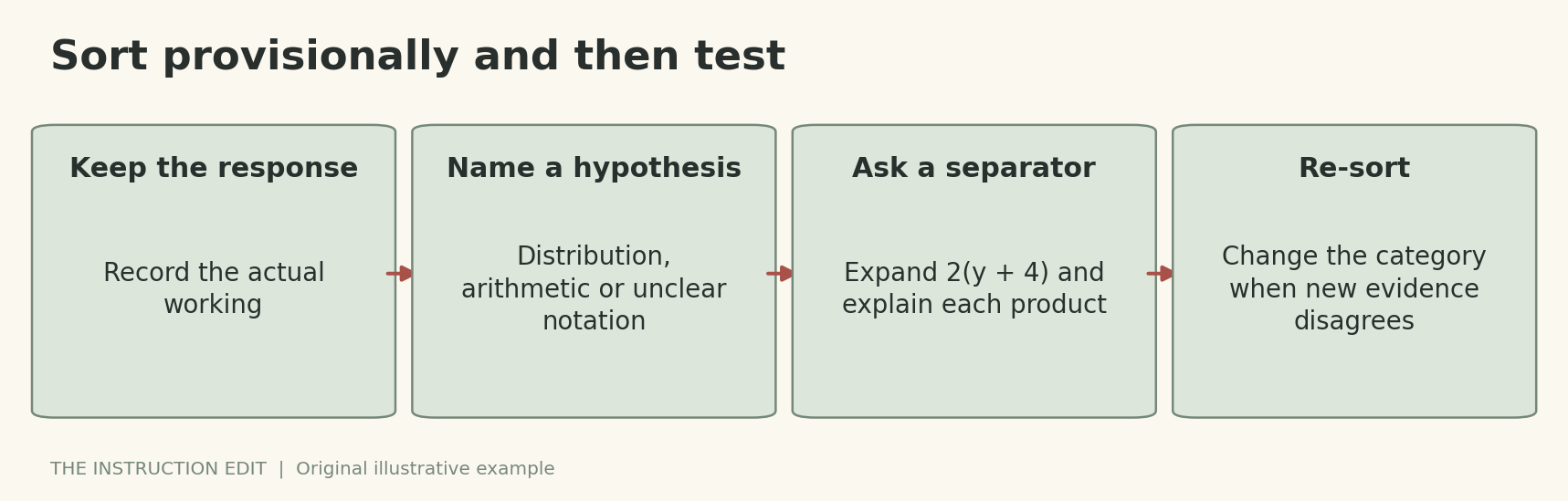
Re-sort after the next attempt
Use a fresh expression, such as 4(a + 3), and ask what each product represents. The expected result is 4a + 12. Compare the explanation with the earlier one, noting any prompt or model that was available.
An immediate improvement is useful evidence, but check again later before concluding the understanding is secure. If the pattern persists, revisit your explanation of the error and the prerequisite knowledge involved.
For your next response check, prepare three provisional categories and an unclear space. Keep one actual piece of reasoning with each placement. Choose a follow-up question before choosing a teaching activity. That small discipline makes the sorting useful.
