
Personalisation becomes unmanageable when it is interpreted as creating a different lesson for every person, every day. It becomes superficial when it means changing the font or adding a name while leaving the same barrier intact.
A more useful starting point is a common intellectual goal, a clear account of the barriers learners may encounter and a limited set of purposeful supports. Learners may reach the goal through different routes without being assigned unrelated work.
This does not mean every learner must have an identical goal in every circumstance. Individual plans and accommodations may require specific decisions. It means that difference should be intentional, rather than the accidental result of making one version easier until the important thinking disappears.
Use a barrier-focused framework carefully
CAST's Universal Design for Learning Guidelines 3.0, released in July 2024, organise design considerations around engagement, representation, and action and expression. The framework directs attention to barriers and options rather than matching instruction to supposed learning styles. It is design guidance, not a guarantee that a standard menu of options will meet every need. Explore the guidelines.
For planning, use the framework to ask where a learner might lose access to the intended work. Keep required individual accommodations and specialist input in place. Proactive design and individual support are complementary responsibilities.
The practical question is not how many versions a teacher can produce. It is which differences are necessary for learners to participate in the same worthwhile thinking.
Define what must stay the same
Consider an illustrative middle-school lesson comparing two claims about a local environmental issue. Learners need to decide which claim is better supported by the supplied evidence and explain why.
The intellectual goal is the relationship between claim and evidence. Reading every sentence aloud without support may not be the target. Producing a decorative poster may not be the target. Working alone without an organiser may not be the target.
Write the non-negotiable demand plainly: “Select a claim, identify relevant evidence and explain how that evidence supports the choice.” Now proposed supports can be judged against something more specific than “make the task accessible.”
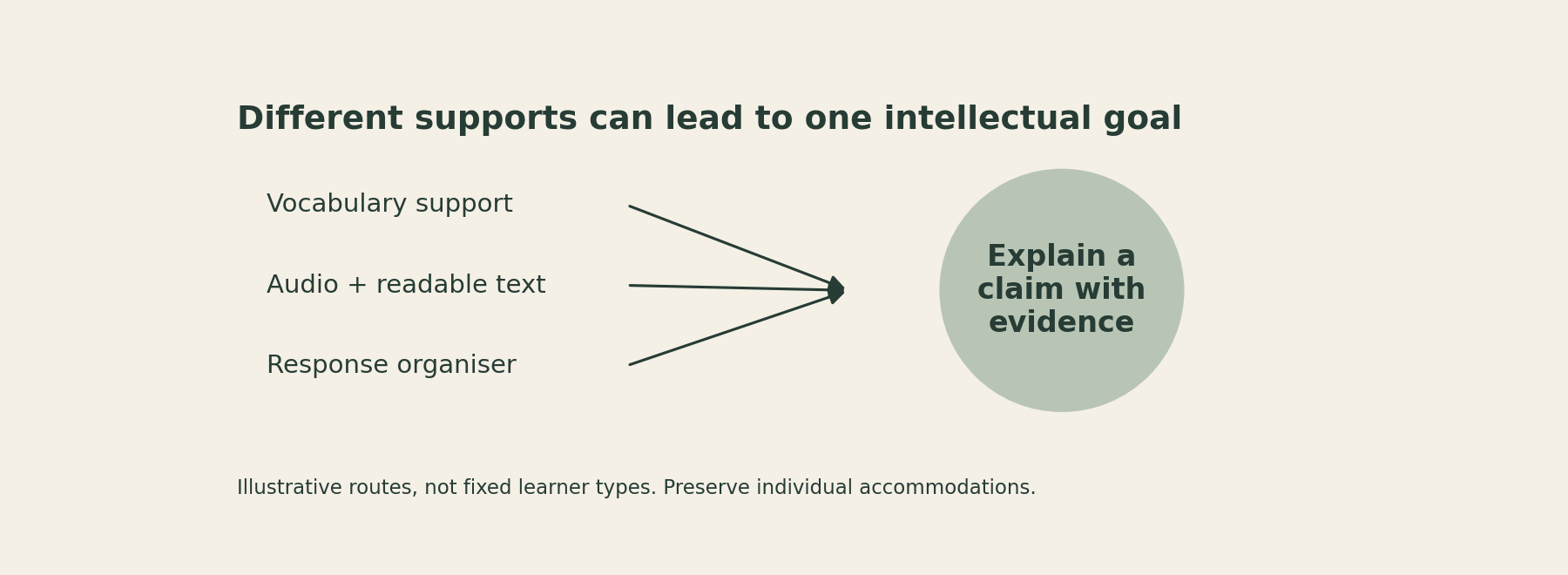
A vocabulary explanation may help learners reach the evidence. An audio version may offer another way to encounter the same content. A response organiser may help structure the explanation. A sheet that already selects the claim and supplies the justification changes the work much more substantially.
If independent reading is itself the learning goal, the decision changes. Some supports may alter what the assessment can show. The appropriate choice depends on the target and the learner's agreed supports, not on a universal rule that one format is always equivalent to another.
Choose supports by the barrier they address
Start with a small set of likely barriers. Is the vocabulary unfamiliar? Is the source layout hard to navigate? Is the response requirement unclear? Does the learner understand the evidence but need a different way to express the explanation?
Match a support to the barrier and preserve the intellectual demand where possible. Do not assign a permanent “audio learner” or “visual learner” identity from a preference or a single successful task.
Barrier in the task: Unfamiliar key terms
Possible support: Brief definitions beside the source
Demand to preserve: Decide which evidence is relevant
Barrier in the task: Difficult access to text
Possible support: Accessible text and an appropriate audio route
Demand to preserve: Compare the same substantive claims
Barrier in the task: Losing place between sources
Possible support: Labelled excerpts in a consistent layout
Demand to preserve: Notice agreement and contradiction
Barrier in the task: Unclear explanation structure
Possible support: Claim-evidence-reasoning organiser
Demand to preserve: Supply the actual reasoning
Barrier in the task: Difficulty producing the required response format
Possible support: An appropriate alternative response route
Demand to preserve: Make the claim and justification inspectable
This table is an original planning example. It is not an accommodation plan or a prescription for an individual learner. The support should be checked with the learner and relevant colleagues, particularly where an established plan applies.
Notice how few separate content pathways are needed. The teacher can often preserve the same source set and discussion while changing how learners access information or organise a response. That is different from writing thirty disconnected assignments.
Make choice purposeful rather than decorative
Choice can support agency, but every choice has a design cost. If learners can select a poster, podcast or slide deck, ask whether each format can reveal the required reasoning and whether learners have the tools and instruction to use it.
A technically elaborate format may consume the time intended for analysis. A simpler written or spoken explanation may reveal more of the target understanding. Offer options because they serve a purpose, not because a large choice board looks personalised.
Explain the common criteria before the format choice: the claim must be clear, evidence must be relevant and the connection must be explained. These criteria help learners choose a route without mistaking production polish for the learning goal.
It can also be reasonable to offer fewer options at first. Learners may need a model of how to choose and use a support. Independence includes recognising when assistance is useful, not merely completing a task without any visible help.
Keep the support plan manageable
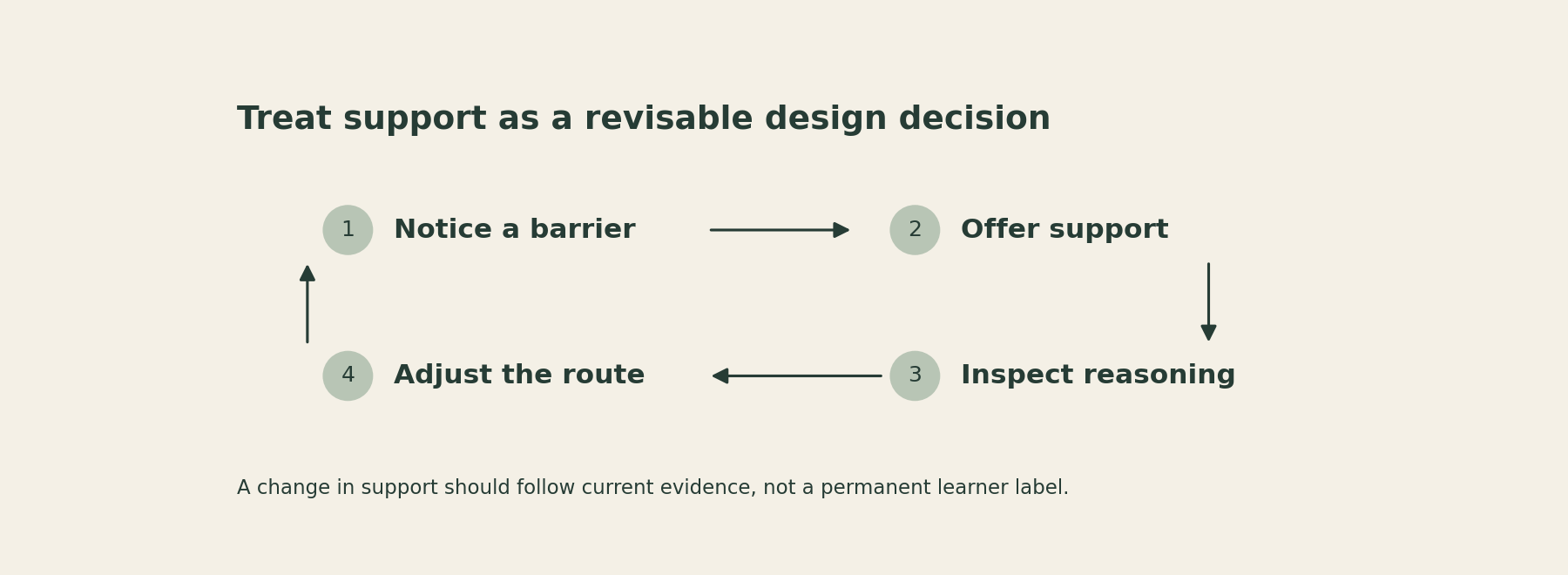
Use a simple shared plan: the goal, the likely barrier, the available support and the response to inspect. Make the supports easy to find and available without an unnecessarily public request where feasible.
After the task, inspect whether the support helped the learner reach the intended reasoning. If a vocabulary aid removes a language obstacle but the explanation still confuses evidence with opinion, the next need may be instruction about evidence rather than more vocabulary cards.
Do not withdraw a required accommodation because a learner succeeded once. For optional instructional scaffolds, any fading should be based on the task, current performance and appropriate professional judgment. Some access supports remain useful because the barrier remains.
Keep a reusable support only if it earns its place. An organiser that learners cannot interpret may need teaching or redesign. A menu that nobody can navigate is another barrier, not a personalisation strategy.
Begin with one shared task
Choose a task already in the sequence. State its intellectual demand, identify two likely barriers and prepare a small set of supports. Check that every response route can reveal the target reasoning.
Then ask learners what helped and inspect the work itself. Their feedback can identify access problems; their explanations can help you judge whether the learning demand remained visible. Neither source of information should replace the other.
Personalisation is not measured by the number of files in the folder. It is the quality of the fit between the learner, the task and the support, while keeping worthwhile learning within reach.
Sources
CAST, Universal Design for Learning Guidelines 3.0. Framework released July 30, 2024.
