
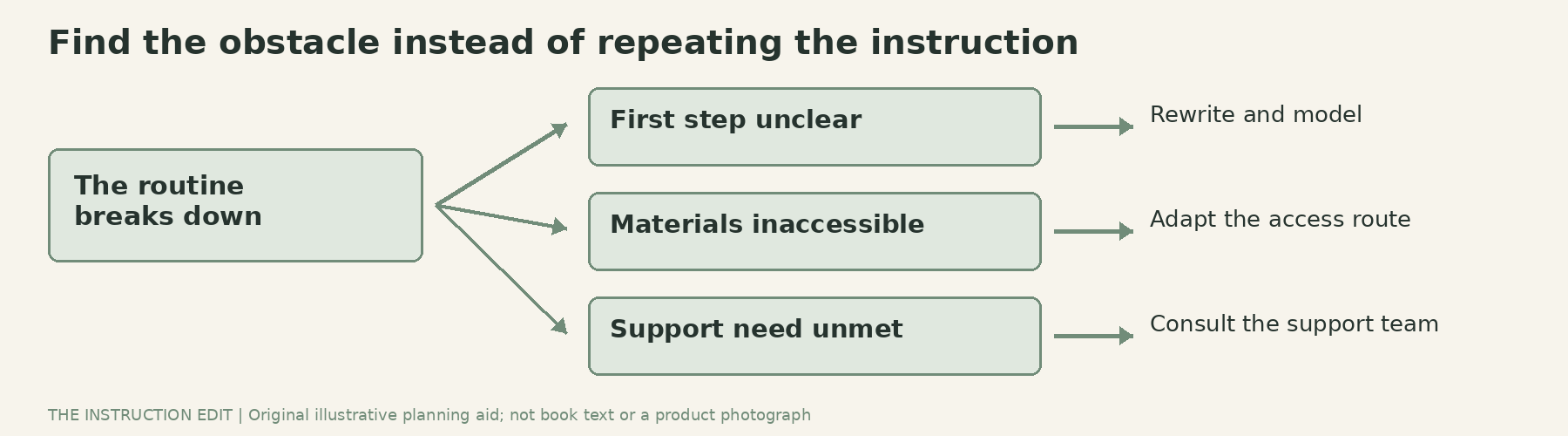
When instructions keep breaking down, do not begin by assuming learners need stricter compliance or teachers need another book. Identify where the process fails. The first step may be unclear, materials may be inaccessible, the routine may never have been demonstrated, or a learner may need support the routine does not provide.
Start with existing school guidance and a colleague's workable routine. Watch the transition or task start closely, then change one part. A book is useful when it helps you design and teach that process more clearly, not when it promises to fix every classroom difficulty.
Separate the routine from the support need
Describe the required action in observable, task-relevant terms. Starting the first example is clearer than being ready to learn. Finding the needed materials is clearer than showing a good attitude. The description should help you see where an instruction or environment needs changing.
Do not use eye contact, stillness or a particular posture as universal proof of attention. Adapt for sensory, communication and mobility needs. Follow individual plans and consult the responsible support team where the difficulty goes beyond the routine itself.
The free Responsive Classroom printable resources include separate elementary and middle-school modeling planners. Those can support a small no-purchase trial before you decide whether a larger reference would add value.
A broad reference: THE Classroom Management Book
This article contains affiliate links. The Instruction Edit may earn a commission if you purchase through them. As an Amazon Associate I earn from qualifying purchases.
THE Classroom Management Book, second edition, on Amazon, affiliate link, by Harry K. Wong and Rosemary T. Wong, with Sarah F. Jondahl and Oretha F. Ferguson, is the broader procedures reference in this comparison. The identified edition is ISBN 9780976423393.

THE Classroom Management Book, 2nd edition, by Harry K. Wong and Rosemary T. Wong with Sarah F. Jondahl and Oretha F. Ferguson. Cover source: Open Library; publisher: Harry K. Wong Publications.
The publisher's detailed contents cover opening assignments, attendance, materials, movement and first-day planning, including middle- and high-school contexts. This breadth makes it a plausible reference when a teacher needs to select a few recurring procedures to clarify.
The limitation is that a procedure list does not establish fit for your learners or setting. The detailed contents were inspected, not the entire book. Do not treat every recommendation as a universal rule, repeat dated disability language, or assume that smoother movement around a room necessarily demonstrates learning.
A narrower choice: Interactive Modeling
Margaret Berry Wilson's Interactive Modeling: A Powerful Technique for Teaching Children, published in 2012, is the more focused candidate when the question is how to teach a routine rather than which routines to create. Its ISBN is 9781892989536. This publisher link is not an affiliate link; an exact Amazon listing has not been verified here.
The lawful introduction and sample scripts show a sequence involving demonstration, student noticing, practice and feedback. The samples span K–2, 3–4 and 5–6 contexts, including transitions and working with others.
That provides more specific evidence of the teaching approach than a catalog description alone. It does not make every sample suitable for every age or learner. Adapt language and expectations for older students, and do not reproduce listening examples as rules requiring eye contact or rigid posture.
| Your question | More relevant candidate | Important limit |
|---|---|---|
| Which recurring procedures need clearer design? | THE Classroom Management Book, second edition | Select and adapt; a broad reference is not an individualized support plan |
| How can I teach a routine instead of repeating directions? | Interactive Modeling | Samples lean elementary; adapt age, language and access expectations |
| Why does this learner still encounter a barrier? | Existing support team and school guidance first | A book cannot diagnose or meet an unmet support need by itself |
Teach the task-start routine. Original conceptual illustration.
An illustrative task-start routine
Imagine a middle-school class beginning a short practice activity after discussion. Some learners collect materials while others wait for another explanation. This is an original planning example, not a case reported by either book.
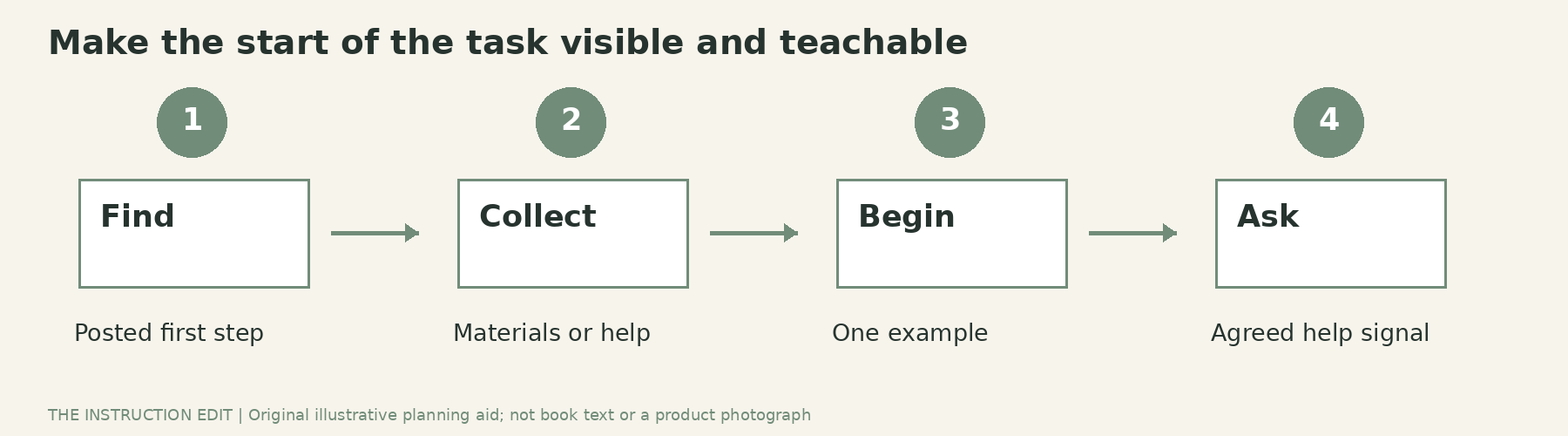
Define the routine as four actions: find the posted first step, obtain the materials or use the agreed help route, begin one example, and ask for help using the available signal. Keep the directions visible. Make sure the materials and signal are accessible before expecting independent use.
Demonstrate the process without adding a long speech about how simple it is. Ask learners what they noticed that made the start possible. Invite practice, then give feedback about the process: the first step was located, the missing material was reported, or the help route was unclear.
If the routine breaks, locate the point of failure. A learner who cannot read the posted instruction needs a different access route, not another reminder to look at it. A missing pencil is a materials problem. A task that depends on untaught knowledge is an instructional problem. The routine should reveal these distinctions rather than hide them.
Choose a small implementation commitment
Before buying, name one routine you will work on and the evidence you will observe. For a transition, that might be whether learners can locate the destination and begin the next task with the necessary support. Do not reduce the evaluation to how quiet the room becomes.
Discuss the plan with a colleague who knows the setting. Ask what might exclude a learner or conflict with existing school guidance. Where a routine crosses classrooms, coordinate expectations rather than making students infer several incompatible versions.
Find the obstacle instead of repeating the instruction. Original conceptual illustration.
Who should not buy
Skip a new routine book if you already have clear school guidance and the immediate problem is inconsistent implementation, inaccessible materials or insufficient support. Also pause if the hoped-for outcome is a quick cure for distress, disability-related needs or a complex relationship problem.
Choose the broad Wong reference when you need to examine several procedures. Choose Wilson when you need a more explicit way to teach one. Borrow first if possible, and keep the commitment small enough to observe and revise. A useful routine serves participation and learning; it is not a performance of obedience.
Sources and selection basis
This comparison uses publisher contents, Wilson's lawful introduction and sample scripts, and free Responsive Classroom planning resources, checked on 25 October 2026. It is not a full-book review or firsthand implementation report. The exact Wong second-edition Amazon identity is verified; price and stock are not asserted.
