
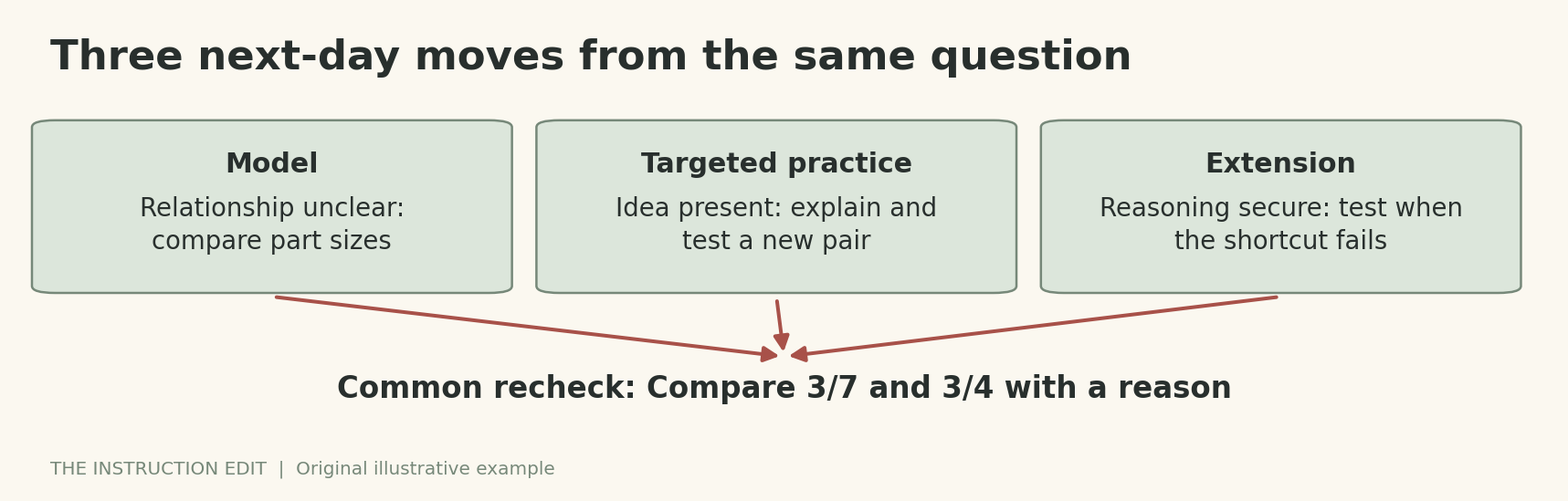
Plan three possible next-day moves before you collect the exit ticket: a model for an unclear relationship, targeted practice for a partly secure explanation, and an extension for learners who can already justify the decision. Connect all three to the same goal and finish with a fresh check.
The aim is not to build three lessons in advance. It is to know what different responses would make you do. An exit ticket becomes more useful when tomorrow’s plan contains a decision that the evidence can change.
Write a prompt that reveals the target relationship
For an illustrative middle-school fraction lesson, ask: “Which is greater, 2/3 or 2/5, when the wholes are the same size? Explain how you know.” The intended reasoning is that thirds are larger than fifths of the same whole, so two thirds is greater than two fifths.
A learner can also justify the comparison with an accurate equivalent-fraction method or another valid representation. Do not classify a correct alternative method as a misconception simply because it differs from the example you modeled. Decide which aspects of understanding the prompt actually lets you observe.
The EEF’s feedback guidance recommends using evidence of learning gaps to guide feedback. The response-to-action map below is an original planning example. It does not supply validated grouping thresholds or claim that one exit ticket establishes mastery.
Prepare the smallest useful version of each move
The modeling move might take the form of two equal strips divided into thirds and fifths. The targeted-practice move might ask learners to explain two new comparisons. The extension might challenge an overgeneralized shortcut by changing the numerators.
Keep the materials compact. One shared display and a few prompts can support all three moves. You do not need color-coded packets, three new slide decks and a printing arrangement worthy of a small publishing house.
Illustrative response-to-action map. All responses are fictional; placement remains provisional.
Exit-ticket evidence: Chooses 2/5 because 5 is larger
Next-day move: Model the size of equal parts
Learner action: Partition equal wholes and compare one part before two parts
Quick check afterward: Compare 3/7 and 3/4 and explain the part-size relationship
Exit-ticket evidence: Chooses 2/3 with a partial or unclear reason
Next-day move: Targeted practice with explanation
Learner action: Compare new pairs and name what stays the same
Quick check afterward: Use the same fresh comparison without the earlier sentence prompt
Exit-ticket evidence: Chooses 2/3 with a defensible explanation
Next-day move: Extension that tests the boundary
Learner action: Explain why a smaller denominator alone cannot settle every fraction comparison
Quick check afterward: Compare 3/7 and 3/4, then contrast 1/2 with 3/4
Exit-ticket evidence: No usable response or mixed evidence
Next-day move: Brief clarification before assigning a move
Learner action: Explain orally, draw or complete a simpler comparison
Quick check afterward: Choose the next move from that additional evidence
The final row is important. Missing evidence is not a low score. It is a reason to collect enough information to make a sensible choice.

Use the model to expose the relationship
For the modeling route, keep the wholes equal and make that condition explicit. Ask learners to predict which single part will be larger before shading two parts. Then connect the model to the written fractions. The denominator tells how many equal parts make the whole; it does not directly state the size of the selected amount.
Invite an explanation at each step. If the learner can compare one third and one fifth but cannot compare two of each, the missing connection differs from a learner who treats fifths as larger pieces. Adjust the prompt accordingly rather than repeating the full model unchanged.
Avoid drawing unequal wholes unless the purpose is explicitly to discuss that complication. An accidental difference in strip length can make a mathematically sound explanation appear inconsistent with the picture.
Make targeted practice more than another answer list
For the middle route, choose two comparisons that preserve the relevant structure, such as 3/8 versus 3/5 and 4/9 versus 4/7. Ask learners to identify the shared numerator and explain how part size determines the comparison.
If a response frame is needed, begin with “The wholes are equal, and each fraction selects __ parts. The larger parts are…” Reduce the frame on the next example. Record whether the explanation depends on the prompt so you can distinguish supported success from independence.
If the learner uses a different correct method, ask for its reasoning rather than forcing the preferred representation. The goal is a defensible comparison. If your lesson specifically targets unit-fraction reasoning, explain that additional goal and collect evidence of it separately.
Use extension to test the limits of the shortcut
A learner may correctly say that the fraction with the smaller denominator is larger in the original pair. Ask whether that statement is always true. Compare 1/2 and 3/4. Three quarters is greater, so the denominator alone is insufficient when the selected number of parts also changes.
The extension should deepen the same concept rather than become unrelated busywork. Ask learners to write the condition under which their earlier comparison strategy is valid. A precise answer refers to equal wholes and equal positive numerators, with the relevant fractions understood in the same way.
Do not use the extension as a reward that removes access to important shared teaching. It is a way to investigate a boundary when the initial relationship is already evident.
Let the second check change the route
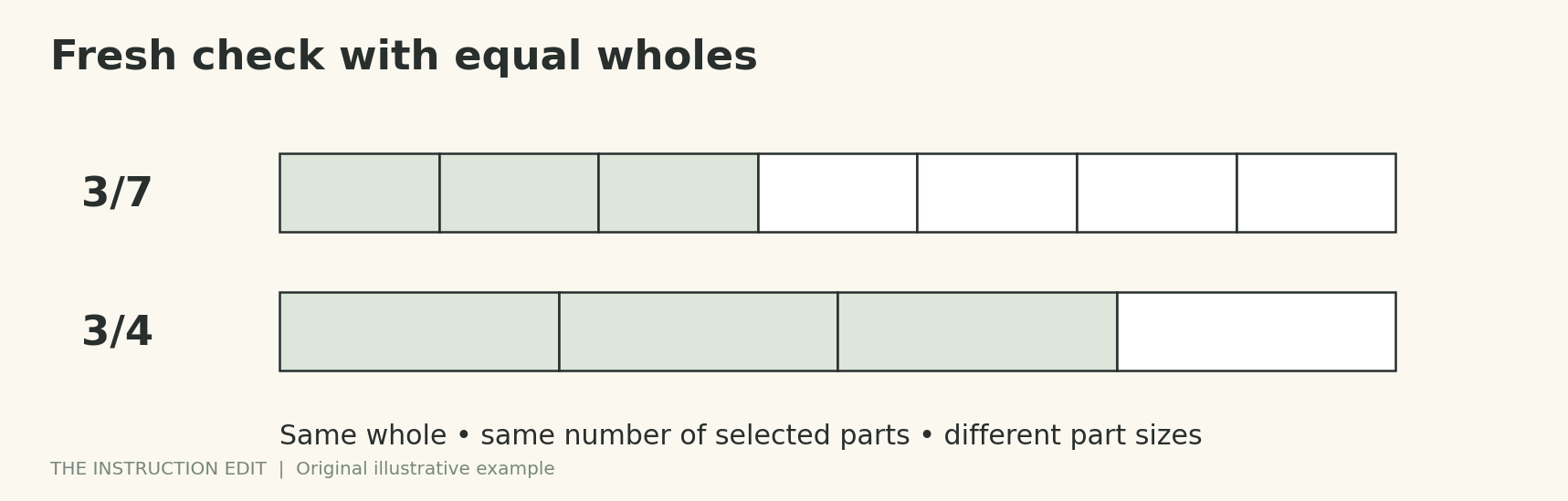
After each move, use 3/7 versus 3/4 with a reason. The expected comparison is 3/4 greater than 3/7. Look for the relationship, not just the symbol. Then decide whether to continue, reduce support or revisit your interpretation of the earlier response.
You may find that a learner initially placed in targeted practice needs a model, or that a learner who gave no written explanation can justify the comparison readily in conversation. Change the plan. The point of formative evidence is that it can alter your judgment.
For your next exit ticket, write one sentence for each possible move before the lesson ends. Add a fresh check that all learners can attempt. Collect only the information you are prepared to use, and leave room for the responses to surprise you.
