

A resource library can grow while a learning sequence becomes harder to follow. There may be more activities, more formats and more possible starting points, yet less clarity about what learners are supposed to understand next.
Instructional coherence is the connection between the goal, the ideas developed across tasks and the evidence used to judge learning. A supplementary resource is valuable when it strengthens that connection. Its value is not established by being attractive, popular or different from yesterday's worksheet.
The aim is not a smaller library for its own sake. A broad collection can be useful when its contents have clear purposes. The problem is asking collection size to stand in for curriculum quality.
What material-use research can and cannot establish
RAND's 2025 report on 2019–2024 surveys of U.S. K–12 ELA, mathematics and science teachers reports averages of two curriculum materials and five supplements. These patterns do not establish the learning effects of resource quantity. Read the report.
The design argument here is therefore a proposal for judgment, not a causal conclusion from the survey: before adding a resource, identify the role it will play in the sequence and the connection it must preserve.
A resource may be excellent in one sequence and poorly placed in another. Quality is not only a property of the file. It also depends on its use.
Map the progression before searching
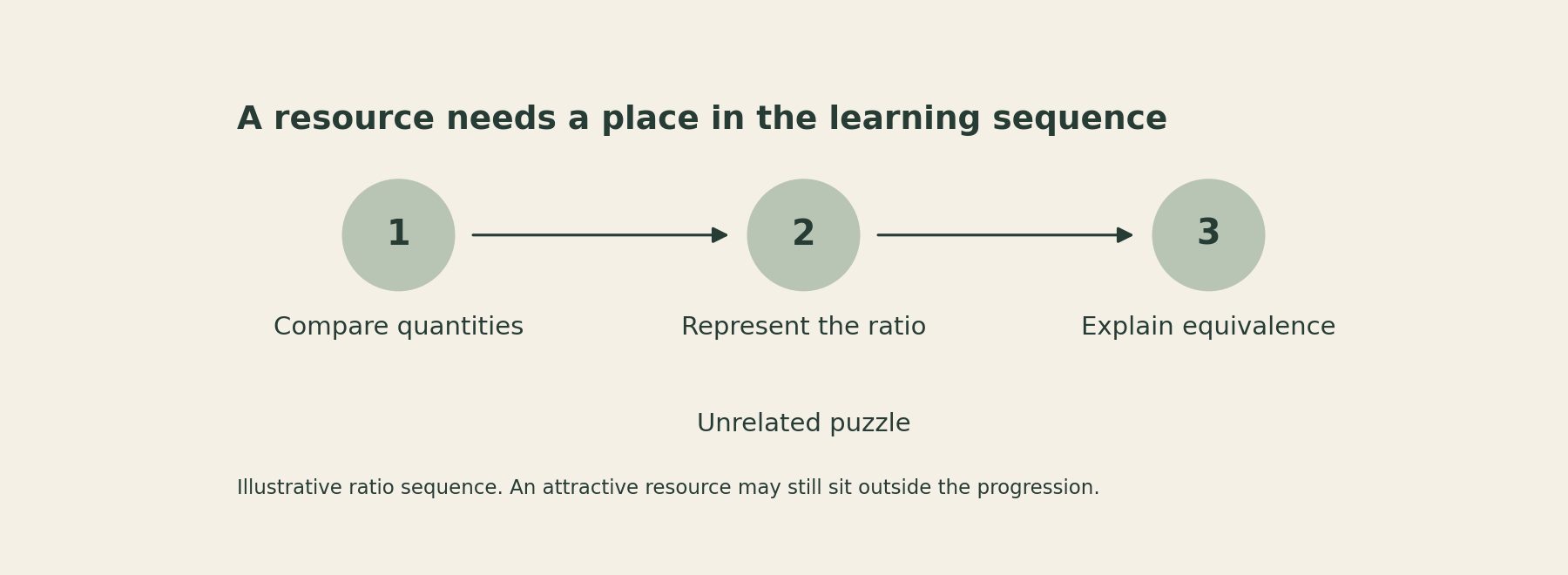
Imagine an illustrative ratio sequence. Learners first compare quantities, then represent ratios in a table, then explain why scaling both quantities preserves a relationship. Later they distinguish equivalent ratios from equal additive differences.
A search for “fun ratio activities” may return resources that address any of those ideas, use unfamiliar notation or assume knowledge the class has not yet developed. Each may be worthwhile. Placing them in an arbitrary order is the risk.
Write the current learning step and the next step in ordinary language. “Learners can describe the two quantities; next they need to explain how both change together.” That statement gives a supplementary resource a job to do.
Then inspect the resource's actual demands. Does it require that explanation, or can learners finish by matching colours and copying numbers? Does it use the representation the next lesson will depend on? Does it introduce a shortcut before the underlying relationship is understood?
This inspection takes longer than admiring the preview image. It can save a more expensive repair after the resource has already shaped the lesson.
Give each resource a job
Useful roles include introducing a representation, providing a contrasting case, offering additional practice, removing an access barrier or checking a misconception. A resource can serve more than one role, but the role should be explicit.
Proposed addition: A ratio table with a worked example
Possible instructional role: Introduce a representation
Coherence check: Does later work use the same relationship and notation?
Proposed addition: Two mixtures with different scale factors
Possible instructional role: Compare equivalent ratios
Coherence check: Must learners explain both quantities changing?
Proposed addition: A plausible additive error
Possible instructional role: Expose a misconception
Coherence check: Can learners explain why the method fails?
Proposed addition: A clearer layout of the same task
Possible instructional role: Remove a navigation barrier
Coherence check: Is the original reasoning still required?
Proposed addition: An unrelated ratio-themed puzzle
Possible instructional role: Possible extension or recreation
Coherence check: What learning step does it actually support?
The final row is not a prohibition. A puzzle may have a legitimate place. The honest decision is to name that place rather than assume that sharing a topic word makes it part of the progression.
For example, a puzzle completed through trial and error might be enjoyable but offer little evidence of proportional reasoning. It could be an optional extension, or it could be revised to require an explanation of the relationship used. The resource's role changes with the demand attached to it.
Check the seams between resources
Fragmentation often appears at the transitions. One resource uses a ratio table, the next uses a double number line and the assessment assumes learners can move between them. If that connection was never taught, the sequence may look aligned by topic while remaining disconnected in practice.
Ask what the second resource assumes from the first. Then ask whether learners had a chance to make that connection explicitly. A short comparison of representations may be more valuable than another full activity.
Language also matters. If one resource uses “part” and “whole” differently from another, learners may encounter a hidden shift in meaning. If a worked example labels quantities consistently but practice items do not, decide whether that change is an intentional challenge or an avoidable obstacle.
An adaptation can improve coherence. A teacher may change an example, add a bridge question or remove an irrelevant context so the materials connect. The goal is not untouched fidelity to every page. It is a defensible progression of ideas.
Use evidence to decide whether an addition earned its place
After the lesson, inspect the response the resource was meant to reveal. If it was intended to expose additive reasoning, did learners have to explain why adding the same amount differs from multiplying both quantities? If it was intended to connect representations, could they describe the connection?
Completion and enjoyment are useful observations but incomplete judgments. A resource can be popular while bypassing the intended idea. It can also feel demanding because it introduces a necessary distinction.
Avoid attributing every improvement or difficulty to the resource alone. Prior teaching, time, support and the specific class all matter. A small local comparison of learner work can inform a revision without becoming a claim that the resource has been proven effective.
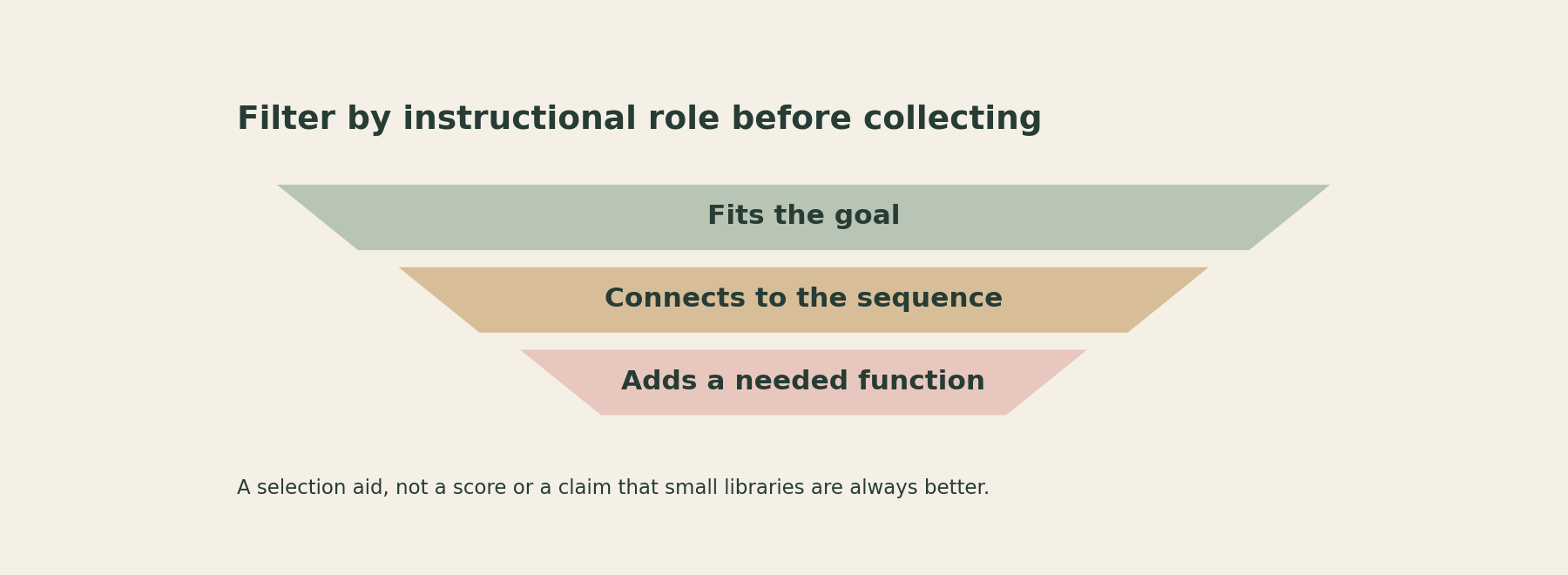
Make the library easier to use
Organise resources by instructional role and sequence position, not only by topic or format. A short label such as “ratio equivalence: contrasting additive error” is more useful than “great activity.” Include prerequisites, the intended response and any important adaptation.
Retire or archive redundant versions when appropriate, while preserving materials needed for different contexts and access routes. The point is to reduce selection friction, not to impose a minimalist aesthetic on a teaching team.
Start with one upcoming sequence. Identify a genuine gap, select one resource for that gap and write the bridge to the next task. If no gap exists, the most useful decision may be to stop searching.
A coherent library helps a teacher answer, “Why this resource, here?” That is a stronger measure of usefulness than the number of files it contains.
Sources
Doan and colleagues (2025), Teachers’ Use of Instructional Materials from 2019–2024. RAND report on U.S. K–12 ELA, mathematics and science teachers’ materials use.
