
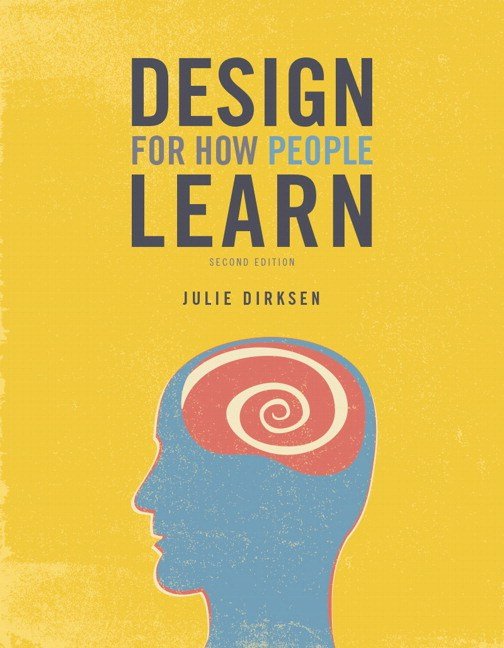
Design for How People Learn, second edition. Cover image courtesy of New Riders / Pearson. Unmodified publisher image; press-use source.
“We need training” describes a proposed solution, not yet a useful design brief. Before buying a professional book, ask what people need to do, what currently happens and what makes the desired action difficult. A missing skill, an unclear process and an impossible workload require different responses.
Cathy Moore's Map It is the more targeted candidate for questioning the request and connecting design to work. Julie Dirksen's Design for How People Learn is the broader introduction to learning-design decisions. Choose the reference that fills the gap in your process, not the one with the most enthusiastic endorsement.
Start with a short diagnostic conversation
Use Moore's free action-mapping introduction before buying anything. Then interview someone who does the work and someone accountable for the result. Ask for a recent, non-sensitive example rather than a general statement that staff lack awareness.
What should the person do at the difficult moment? What information, tools, time and authority do they have? Can a capable person perform the action under the current conditions? What happens when they try? Keep observations separate from explanations. “The handoff lacks an owner” is evidence to investigate; “people do not care” is an interpretation.
A useful outcome may be a clearer form, a job aid, a manager decision or practice with feedback. A course can be part of the answer without becoming the default answer to every problem. Borrow a candidate book if this free diagnostic step already gives you enough structure.
Map It: the more focused needs-analysis choice
This article contains affiliate links. The Instruction Edit may earn a commission if you purchase through them. As an Amazon Associate I earn from qualifying purchases.
Cathy Moore's Map It: The Hands-on Guide to Strategic Training Design on Amazon, affiliate link, is the identified 2017 paperback, ISBN 9780999174500. The author's book page explains its performance-focused purpose and supplies additional resources.
The lawful author-posted chapter excerpt contrasts producing a course with investigating the causes of a work problem and choosing relevant practice. Important boundary: that file is a 2015 prepublication excerpt, not the complete final 2017 book. It supports the scope comparison, not a claim that every final chapter was inspected.
Choose this candidate when stakeholder conversations keep jumping directly to slides, modules or knowledge checks. Its relevance is the design process before and around content production. It is not evidence that an organization will permit process changes, give you access to employees or agree on meaningful outcomes. Those conditions still need negotiation.
Design for How People Learn: the broader design primer
Julie Dirksen's Design for How People Learn, second edition, on Amazon, affiliate link, is the New Riders edition with ISBN 9780134211282. The publisher lists its release in December 2015; its copyright year is 2016. Match the edition rather than using the title alone.
The publisher's contents and actual second-edition sample place the book across a wider set of design questions: goals, learner differences, knowledge, skills, motivation and the environment. The sample gives a concrete view of its explanatory treatment of learning, rather than only promotional copy.
Choose this book when you need a general design foundation and vocabulary for discussing several kinds of learning challenge. It is less narrowly matched to the recurring stakeholder request than Map It. Neither title should be treated as a substitute for current accessibility guidance, subject expertise or evidence from the actual work setting.
Design need: Challenge a premature course request
More relevant starting point: Map It
Important limitation: You still need access to people, workflow and decision-makers
Design need: Build a broad learning-design foundation
More relevant starting point: Design for How People Learn, second edition
Important limitation: General principles still require contextual judgment
Design need: Clarify one immediate performance problem
More relevant starting point: Free diagnostic interview and action-mapping resources
Important limitation: A brief needs evidence, not just neatly filled boxes
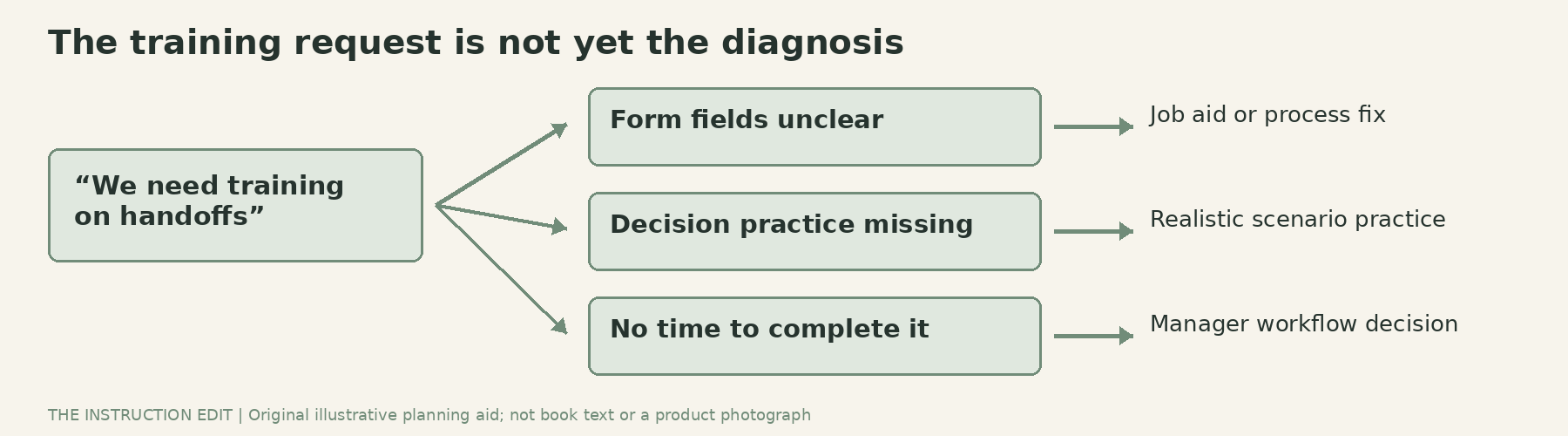
An illustrative handoff problem
Imagine a fictional team says new staff need training on handoffs. A sample of synthetic records shows that some handoffs do not name the person responsible for the next action. This is a design example, not a measured workplace case or a result attributed to either book.
Ask staff to explain the moment of handoff. If the form has no clear owner field, a form or process change may be necessary. If the field exists but the responsibilities are ambiguous, the manager must clarify ownership. If people understand the rule but struggle with unusual cases, realistic practice may help. If there is no time to complete the record, another explanation of the rule does not create time.
Do not choose one cause merely because it makes a convenient training project. Several causes may coexist. Record what you know, what remains uncertain and which person can resolve each uncertainty. That is already a better brief than “make a thirty-minute module.”
Turn the diagnosis into a useful brief
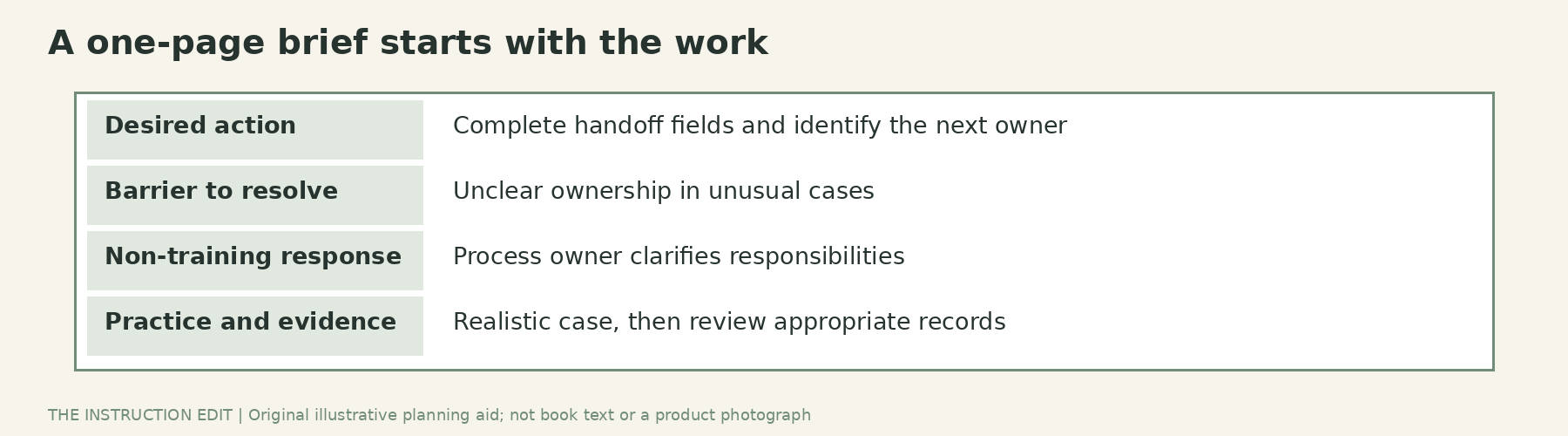
Write the desired action in observable language: complete the required handoff fields and identify the next owner in a realistic case. Name the people and situations involved without importing personal records into an unapproved tool. Describe the obstacle and the evidence supporting that interpretation.
Separate the proposed responses. A process owner clarifies responsibility; a job aid provides an at-work reminder; a practice activity presents an ambiguous handoff and asks the learner to make a decision. Specify who maintains each part. A training designer should not quietly inherit responsibility for a broken operational process.
Choose evidence that relates to the action. A short review of appropriately handled records or a structured debrief may be more relevant than satisfaction with the module. Do not invent a target improvement before establishing what can actually be observed and what other conditions may influence it.
Who should not buy either book yet
Pause if you cannot name the recurring design decision you want help with. Also pause if the organization has already fixed a solution and will not allow even a short investigation: a book cannot supply authority you do not have. A library copy and a carefully framed conversation may be the better first investment.
Choose Map It for a more deliberate response to training requests. Choose Dirksen for a broader learning-design reference. In either case, bring one real problem to the reading and leave with a revised brief, not just highlighted pages.
Sources and selection basis
This is a research-based comparison of documented scope, not a full-book review or a claim of firsthand implementation. Publisher and author contents, the named lawful excerpts and exact Amazon identities were checked on 25 October 2026. Prices, availability and organizational results are not asserted.
