
Tell learners what you noticed in their responses, what you changed as a result and what they will try next. Keep the explanation brief and specific. This makes the purpose of collecting work visible and gives learners a way to use the resulting feedback.
A response check can feel like a dead end when learners submit it and never hear about it again. You do not need to report every mark or narrate your planning. One clear connection between evidence and the next activity is enough to show that their thinking influenced the lesson.
Name a response pattern without naming people
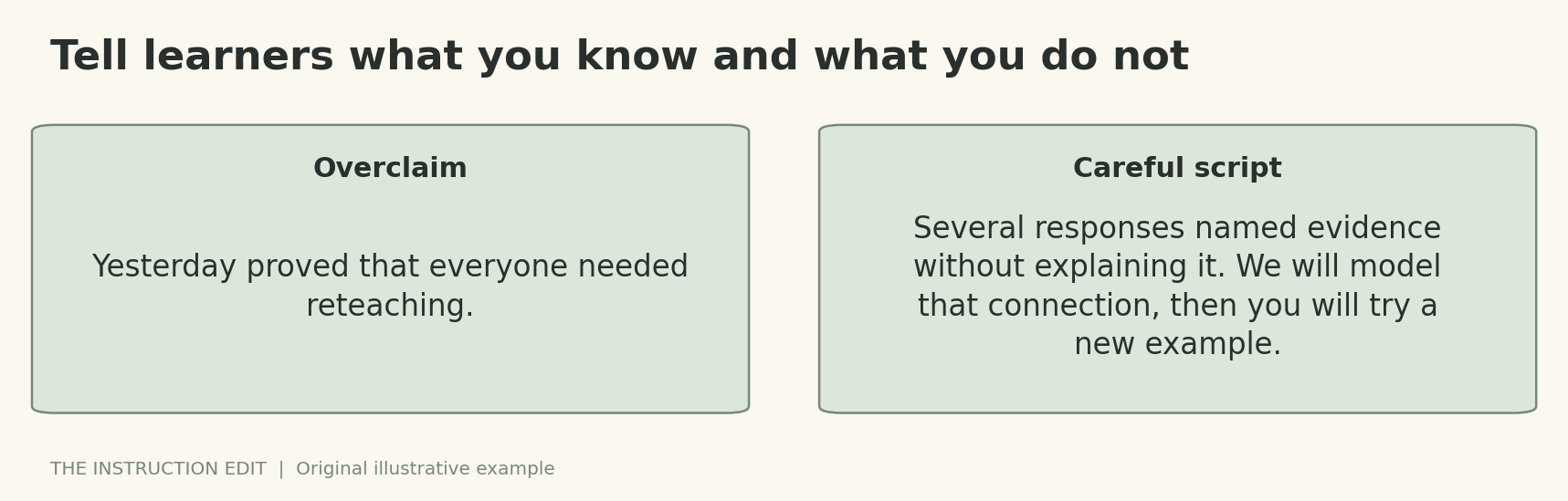
Use a bounded statement: “Several responses named evidence but did not explain how it supported the claim.” That is more precise than “Nobody understood the task.” It also avoids making a claim about learners whose responses showed something different.
For an illustrative history lesson, suppose the task asks which claim a source can support. Fictional responses quote a detail but leave the connection unstated. The next session will model that connection, then offer a new source-and-claim pair. The example is invented; it is not a report of a classroom outcome.
The EEF’s feedback guidance includes planning for pupils to receive and use feedback. The routine here is an original way to make that use visible. It is a practical design proposal, not evidence that announcing a change by itself improves learning.
Explain the change at the level learners can use
Try this opening script: “Yesterday, several responses included a useful quotation but stopped before explaining what it showed. We will look at one example of that connection. Then you will use a different detail to support a claim of your own. If you already made the connection, your task is to test how strongly the evidence supports the claim.”
This tells learners what was observed, what will happen and how the task remains useful for those who were already successful. It does not reveal individual responses or imply that everyone needs identical support.
Avoid vague announcements such as “I changed today’s lesson based on your data.” Learners need the instructional connection, not a demonstration that a data process occurred. Name the actual reasoning you want them to revisit.

Show a small before and after
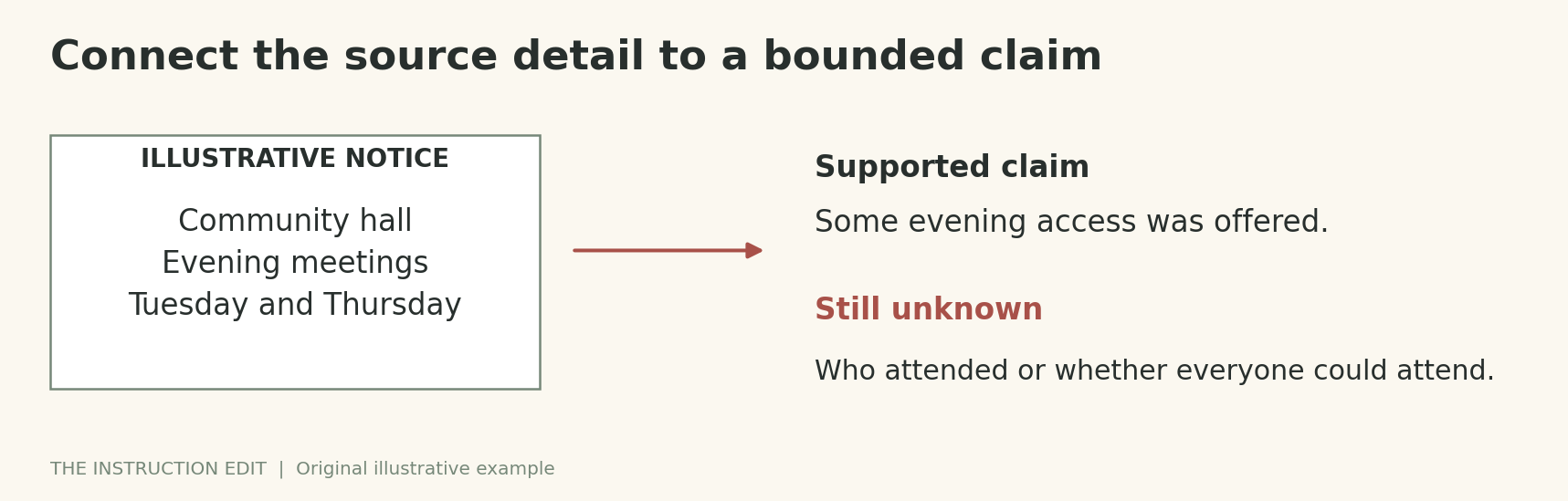
Use a fictional local-history source: a notice states that a community hall opened for evening meetings twice a week. A limited claim might be that the hall offered some evening access. The notice alone cannot establish that everyone in the community could attend or that attendance was high.
A weak response says, “The notice says there were meetings twice a week.” A stronger response says, “The notice supports the claim that some evening access was offered because it lists two evening meeting times. It does not show who attended or whether the times were convenient for everyone.”
Explain the added reasoning. The stronger response links a detail to a limited claim and states what the source cannot establish. The improvement is not simply that the second response is longer.
Illustrative response routine. The source description and learner responses are invented for teaching.
Stage: Return the pattern
What the teacher or trainer does: Names the missing evidence-to-claim connection
What the learner does: Locates that feature in a de-identified example
Stage: Make the adjustment visible
What the teacher or trainer does: Models one connection and a limitation
What the learner does: Explains why the added sentence matters
Stage: Offer another attempt
What the teacher or trainer does: Supplies a different source detail and a bounded claim
What the learner does: Writes or explains a new connection
Stage: Check the response
What the teacher or trainer does: Looks for the connection rather than extra length
What the learner does: Identifies what changed in their reasoning
Stage: Decide what follows
What the teacher or trainer does: Reduces support or selects another focused example
What the learner does: Uses the next opportunity with the appropriate support
Make the new attempt different enough to matter
Give a fresh illustrative source detail: a hall’s equipment list records twelve folding tables. Ask whether this supports the claim that the hall could provide tables for some activities. A reasonable explanation connects the listed equipment to that limited capacity, while noting that an inventory does not show how often the tables were used or how many participants attended.
Do not ask learners merely to replace a few words in the model. If the structure, claim and evidence are identical, a copied pattern may look like improved reasoning. A new detail gives you a better check of whether the learner can make the connection.
Keep the challenge proportionate. If the reading demand rises sharply, a poor response may reflect access to the new source rather than the reasoning you are checking. Provide appropriate support and note what was available.
Return something even when the lesson does not change
Sometimes the responses suggest that the planned next step is appropriate. Say that: “Your explanations showed the comparison we needed, so we are moving to a case where the evidence is less complete.” The loop is still closed because learners can see how their responses informed the decision.
If the evidence is unclear, acknowledge the uncertainty: “I could not tell from the short answers whether the difficulty was the source or the claim, so we will check those separately.” Do not manufacture certainty to make the routine sound decisive.
You may also decide to address a pattern privately with a few learners rather than change the whole session. Explain the shared purpose without exposing the individuals involved. The visible return should support learning, not turn individual needs into public categories.
Keep the routine short and honest
Use only claims supported by the work you reviewed. If you sampled responses, do not say you checked every response. If the adjustment was already planned, do not present it as a direct consequence of learner feedback. Trust depends partly on the connection being real.
In workplace training, the same routine can follow a scenario or practice exercise: name the decision that was unclear, explain the change to practice and provide another attempt. Do not generalize a classroom evidence claim into a guaranteed workplace effect. Check the actual performance and conditions in the setting where the skill will be used.
For the next session, prepare three sentences: “I noticed ___. We will therefore ___. You will show the difference by ___.” Add a fresh attempt and a quick way for learners to identify what changed. That closes the instructional loop without turning the start of class into a presentation about your planning.
