

A class can produce excellent-looking posters about two pricing plans without understanding which plan is cheaper. The activity may be engaging, the display attractive and the learning goal still largely untouched.
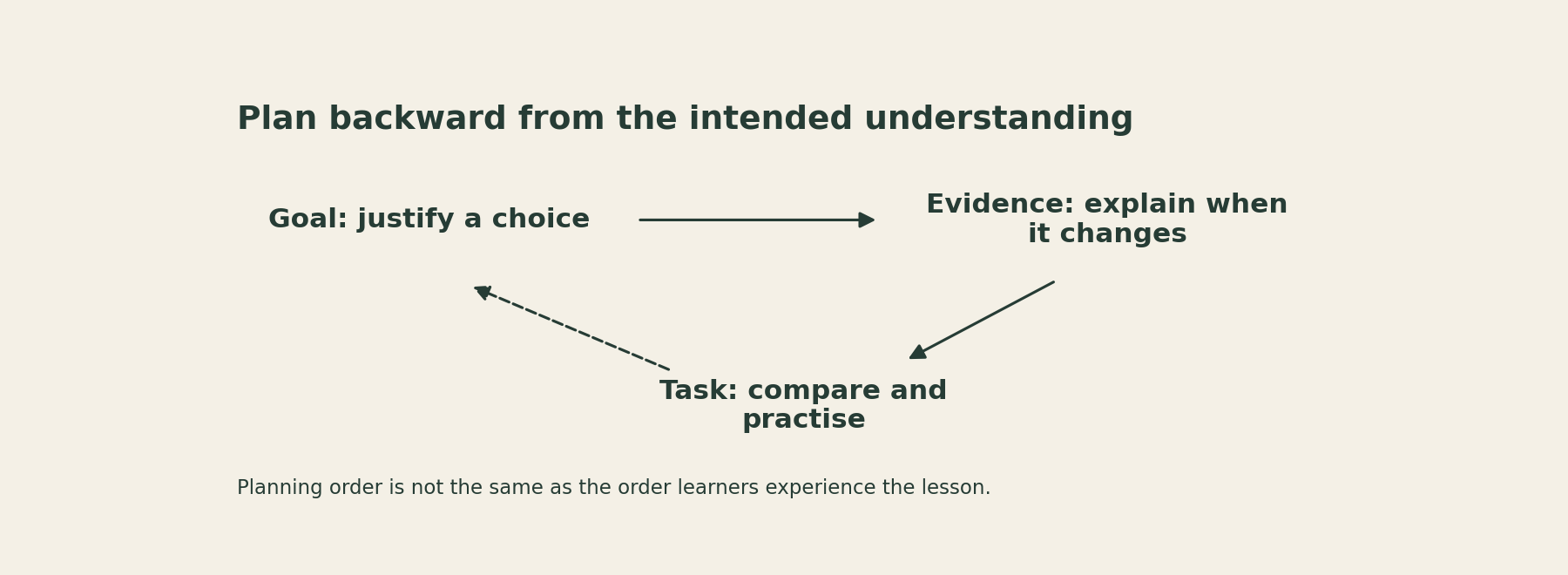
Backward design addresses that gap by asking three connected questions: what should learners understand or be able to do, what evidence would show it and what learning experiences would prepare them to produce that evidence?
The approach is useful because it forces a decision about the intended reasoning before the activity becomes too polished to question. It is not a demand to make every lesson predictable or to reduce understanding to a narrow checklist.
Treat the framework as planning guidance
In their 2012 Understanding by Design white paper, Jay McTighe and Grant Wiggins describe three stages: identify desired results, determine acceptable evidence and plan learning experiences and instruction. They emphasise alignment and the ability to use learning beyond a rehearsed example. This is the creators' design framework, not a controlled trial establishing that one template causes better outcomes. Read the white paper.
The practical value lies in the questions it makes a designer answer. A completed planning form is not evidence of good alignment. The goal, assessment and tasks still need to be inspected together.
Nor must planning become a rigid one-way sequence. Discovering a problem in the evidence task may prompt a revision to the goal or the teaching. Backward design is a way to maintain the connection, not a ban on iteration.
Begin with an understanding worth using
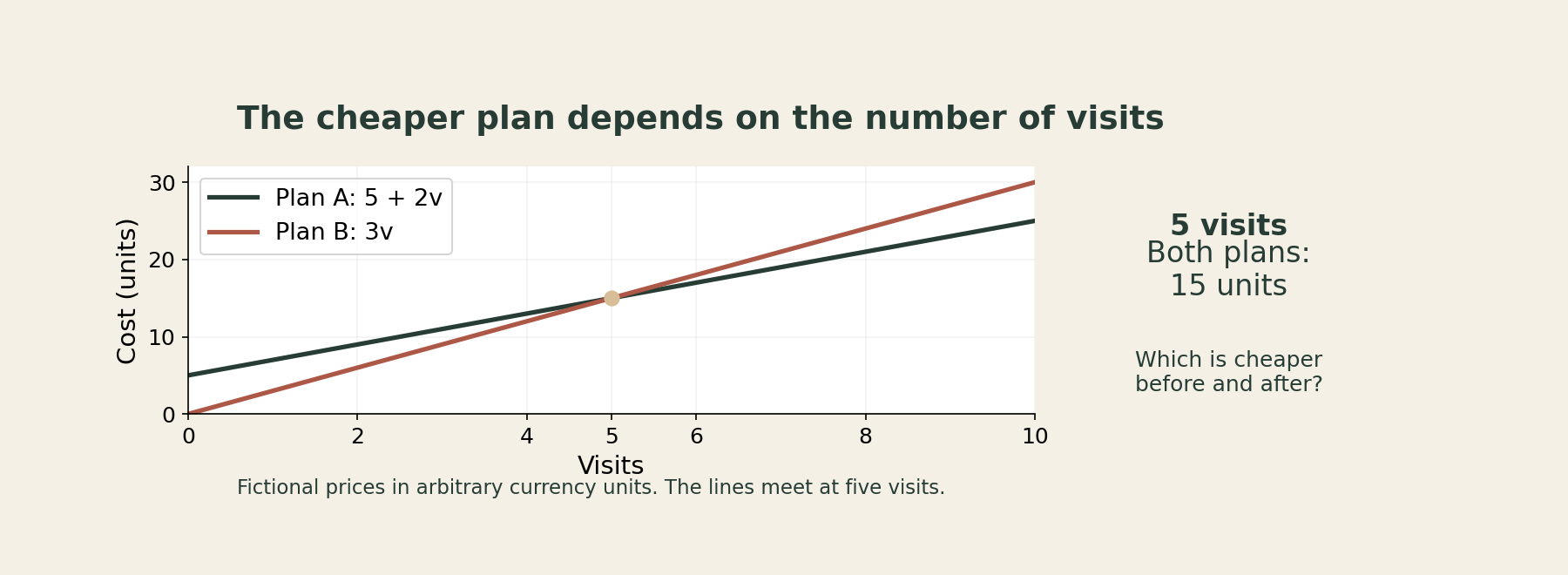
Consider an original illustrative mathematics lesson using two fictional recreation plans. Plan A costs a fixed five units plus two units per visit. Plan B has no fixed fee and costs three units per visit. No real product or purchase is involved.
A weak goal is “complete a pricing-plan poster.” That names an output. A more useful goal is “explain how a fixed fee and a per-visit charge affect which plan costs less at different levels of use.”
The distinction matters. A learner could make a persuasive poster for Plan A by highlighting its lower per-visit charge while ignoring the fixed fee. They could advocate for Plan B because it has no joining cost while ignoring what happens with frequent use.
The intended understanding is conditional: the better choice depends on the number of visits. Learners should be able to justify the choice with a representation and recognise when the choice changes.
Keep the scope realistic. This lesson does not need every complication of a real subscription, such as cancellation rules or taxes. Those could become later extensions. For now, the fictional conditions should remain clear enough to expose the mathematical relationship.
Specify evidence that would distinguish understanding
Ask learners to recommend a plan for someone making three visits and for someone making eight visits, then explain whether one plan is always cheaper. Require a table, calculation or other appropriate representation alongside the explanation.
For three visits, Plan A costs eleven units and Plan B costs nine. For eight visits, Plan A costs twenty-one units and Plan B costs twenty-four. At five visits, both cost fifteen. These values follow from the fictional rules; they are not empirical research data.
A correct recommendation alone is insufficient evidence for the full goal. A learner may have guessed or compared only the per-visit charges. The explanation should connect the fixed fee, the rate and the number of visits.
Add a new case after practice, such as a person whose number of visits is uncertain. Ask what information they would need before recommending a plan. This reveals whether the learner understands why the answer depends on use rather than merely remembering two calculated totals.
Intended understanding: A fixed fee affects the total
Evidence to inspect: Correct total including the fee
Weak substitute to avoid: Comparing only per-visit prices
Intended understanding: Use level changes the comparison
Evidence to inspect: Different justified choices for three and eight visits
Weak substitute to avoid: Declaring one plan always cheapest
Intended understanding: Equal costs occur at a boundary
Evidence to inspect: Explanation of the five-visit case
Weak substitute to avoid: Copying a crossing point without explaining it
Intended understanding: A recommendation depends on assumptions
Evidence to inspect: A question about expected visits
Weak substitute to avoid: A persuasive slogan without conditions
This is an original alignment tool, not a standardised rubric. The level of notation and support should fit the learners and the curriculum.
Plan the learning that makes the evidence possible
Now work backward to preparation. Learners need to interpret the two pricing rules, calculate totals consistently, compare cases and explain the effect of the fixed fee. An attractive final poster cannot teach all of that by itself.
Begin with a worked example of one total. Show where the fixed fee enters and why it is added once. Then have learners complete a partially filled table for a few visit counts, checking a common error such as multiplying the fixed fee by the number of visits.
Compare the totals before introducing a general conclusion. Ask what stays the same in each plan and what changes with each additional visit. Where appropriate, connect the table to a graph or an expression rather than presenting each representation as a separate trick.
Use a contrasting incorrect claim: “Plan A is always cheaper because two is less than three.” Ask learners to find a case that challenges it and explain what the claim overlooked. That task prepares the conditional reasoning the final evidence requires.
The poster can remain. Its job changes: it must present a recommendation with the conditions under which it is valid, supported by the comparison. The decorative work should not consume the time needed for the explanation.
Check access without changing the target silently
If learners struggle to interpret the wording, clarify the fictional rules or provide an accessible version. If calculation is not the main target, decide whether a calculator or a prepared table is appropriate. Make that choice explicit so the evidence can be interpreted correctly.
Do not supply the recommendation and then treat a well-presented explanation as independent judgment. Conversely, do not make handwriting or design skill an accidental barrier to demonstrating mathematical understanding.
Different response formats can be appropriate when they reveal the same target reasoning. A spoken explanation, annotated table or short written recommendation may all be useful, depending on the task and agreed supports.
Revise one connection before redesigning everything
Lay the goal, evidence task and main activity beside one another. Underline the reasoning each requires. If the goal says “justify” but the activity only asks learners to decorate, revise the activity. If the teaching develops comparison but the assessment only checks vocabulary, revise the evidence.
Start with one lesson rather than rewriting an entire unit template. Preserve activities that prepare the intended understanding and change the parts that do not.
Backward design is most useful when it improves that connection. The test is not whether planning happened in the correct boxes. It is whether learners had a fair opportunity to develop and demonstrate the understanding the lesson was meant to build.
Sources
McTighe and Wiggins (2012), Understanding by Design Framework. ASCD white paper describing the creators’ planning framework.
