
A manager reminder to “apply what you learned” is not yet a transfer plan. The employee needs a relevant opportunity, enough support to attempt the action and a way to discuss what happened. Before buying a book about learning transfer, identify which of those conditions is missing.
The Six Disciplines of Breakthrough Learning is the broader organizational-system choice. Emma Weber's Turning Learning into Action is the more focused candidate for follow-up conversations and action planning. Neither removes the need for time, authority and cooperation outside the training team.
Begin with an existing check-in
Use a meeting that already exists. Ask the learner to name one action they intend to try, the next realistic opportunity and the support needed. Ask the manager what they can actually provide. Record an owner and a review point without adding an elaborate reporting system.
For example, “use the new questioning approach” is vague. “Ask a clarifying question before escalating a routine case” is more observable. The point is not to reduce complex work to a simplistic count. It is to make the next attempt and the conversation about it concrete enough to be useful.
If no relevant work opportunity exists, discuss that before assigning more reflection forms. If the manager cannot protect any time or remove an obvious obstacle, a motivational message is unlikely to solve the practical problem. This no-purchase baseline helps identify whether a reference book would add value.
The Six Disciplines: a system around the learning event
This article contains affiliate links. The Instruction Edit may earn a commission if you purchase through them. As an Amazon Associate I earn from qualifying purchases.
The Six Disciplines of Breakthrough Learning, fourth edition, on Amazon, affiliate link, by Roy V. H. Pollock, Andrew McK. Jefferson and Calhoun W. Wick, is the identified Wiley 2025 edition, hardcover ISBN 9781394285396.
The publisher's contents organize the work around outcomes, the full learning experience, application, transfer, support and results. The authors' discussion of the transfer problem also addresses shared ownership beyond the learning-and-development team.
That scope makes it relevant when an organization wants to change the system surrounding training, not merely give managers a better reminder email. It is a selection inference from the current contents and author material; no complete fourth-edition reading is claimed here.
Its breadth is also the limitation. A single facilitator may not control work assignments, manager expectations or operational measures. Buying a system-level book without a sponsor for system-level decisions can leave the most important recommendations outside your reach.
Turning Learning into Action: the conversation-focused alternative
Emma Weber's Turning Learning into Action: A Proven Methodology for Effective Transfer of Learning is the identified first Kogan Page edition from 2014, ISBN 9780749472221. The publisher link is not an affiliate link; an exact Amazon destination has not been verified for this comparison.

Turning Learning into Action, 1st edition (2014), by Emma Weber. Cover image source: Kogan Page.
The contents cover preparation, action planning, follow-up conversations, coaching skills, evaluation and rollout. A lawful author-produced whitepaper gives additional context on preparing people for follow-through and on the demands placed on managers.
This makes Weber the more focused candidate when the problem is how to structure a useful conversation after learning. The author material also raises a practical caution: manager skill, time and workplace power relationships affect how candid that conversation can be. A line manager is not automatically the ideal coach for every issue.
The whitepaper is commercial author material, not independent proof of effectiveness. This guide does not repeat its transfer-rate or return-on-investment marketing figures. “Proven” is part of the book's subtitle, not a guarantee made here.
| Recurring need | More relevant candidate | Check before buying |
|---|---|---|
| Coordinate outcomes, application and support across an organization | Six Disciplines, fourth edition | Sponsor authority and shared ownership |
| Improve post-learning action conversations | Turning Learning into Action | Facilitator skill, time and psychological safety |
| Support one immediate attempt at work | Existing check-in and a one-page agreement | Real opportunity, support and evidence |
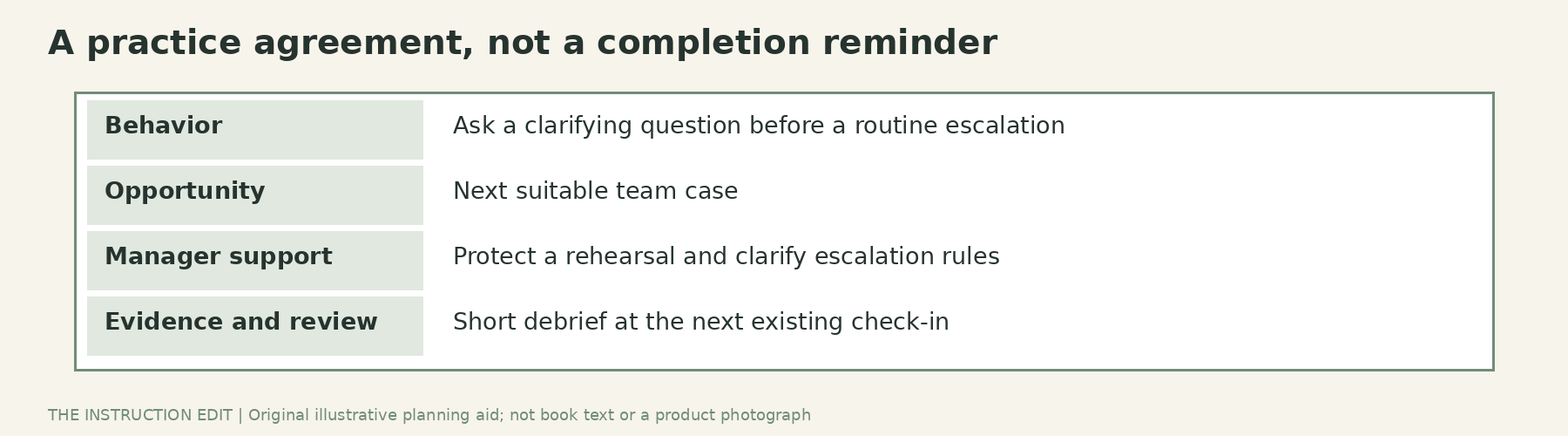
A practice agreement, not a completion reminder. Original conceptual illustration.
A fictional manager-supported practice agreement
Suppose a team has learned a questioning approach for routine escalations. The next step is not to demand that every case stop escalating. Some cases should escalate. The intended action is to ask an appropriate clarifying question before making that decision.
A short agreement might name one suitable upcoming case, a protected rehearsal with a colleague and a brief debrief at the next check-in. The manager helps identify a safe practice opportunity and confirms when escalation is still required. These are illustrative planning choices, not a field-tested intervention.
The learner records what they tried, what response they received and what remains difficult. Avoid requiring confidential case details in an unnecessary shared tracker. Discuss the action and its context, not a performance label attached to the person.
If the attempt fails because the relevant information is unavailable, that is a barrier to address. If the person needs more practice, arrange another appropriate attempt. If the new approach is unsuitable for that case, revise the plan. Transfer is not demonstrated by completing the agreement form.
Give the manager a bounded job
A useful manager role has limits: identify an opportunity, protect agreed practice, provide or arrange feedback, and remove an obstacle within their authority. Specify which responsibilities belong to the learner, the manager, the training team and the process owner.
Do not turn every check-in into surveillance or pretend that a manager can solve structural problems alone. Where the line relationship makes candid reflection difficult, consider an approved peer or facilitator route. Keep any confidential discussion within the organization's agreed boundaries.
Review evidence at a sensible point in the workflow. Course attendance, a completed reflection and an improved work outcome are different kinds of information. None should be silently substituted for another. Other changes at work can also influence outcomes, so avoid attributing every improvement to the training.
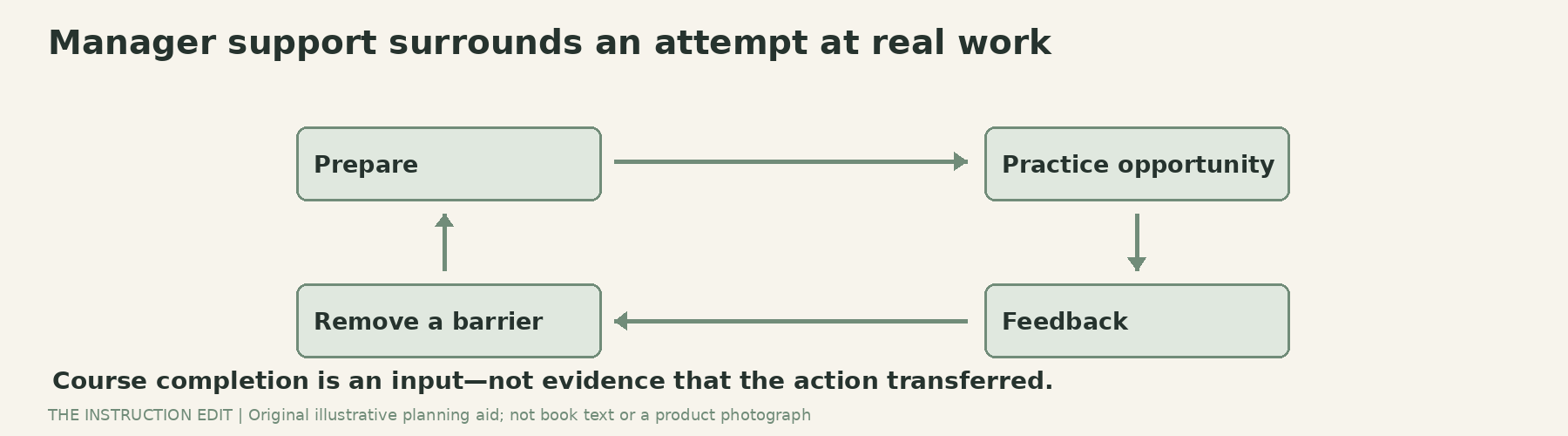
Manager support around real work. Original conceptual illustration.
Who should not buy yet
Wait if no work action has been identified, there is no opportunity to use it or nobody can own the follow-through. Another book is also unnecessary if an existing check-in and simple practice agreement already address the problem.
Choose Six Disciplines when there is authority to improve the surrounding system. Choose Weber when a structured follow-up conversation is the missing component and suitable people can conduct it. Borrow first if you are still deciding which problem you have.
Sources and selection basis
Publisher contents and named author materials were checked on 25 October 2026. The current Six Disciplines contents were inspected, not a full fourth-edition chapter sample; Weber's contents and the lawful whitepaper informed the narrower comparison. No full-book review, firsthand transfer study, price, stock or promised business result is claimed.
