
Write the performance task before choosing the course content. Specify what a learner should produce or do, the conditions under which they will do it and the features that make the response acceptable. Then include instruction that helps learners meet those criteria.
This gives you a practical way to challenge an overloaded content list. If a topic does not help learners make the required decision or produce the intended work, ask why it belongs. Some context may still be necessary, but “the SME mentioned it” is not a sufficient reason to build another section.
Define a realistic demonstration with bounded stakes
Use a fictional internal handover task. A coordinator is finishing a shift and must leave a record that another coordinator can act on. The assessment uses synthetic information in a practice environment, not live customer work. The learner may consult the current handover guide because reference use is expected in the real task.
The intended performance is to select and communicate the information needed for continuity: current status, next action, responsible role and relevant deadline. The task should not require authority the coordinator lacks or knowledge that the case does not provide.
The CDC’s Quality Training Standards call for learner assessment related to objectives and relevant situations. The task below is an original example of that alignment. It is not a validated competency assessment and should not be used for high-stakes employment decisions without appropriate development and review.
Give enough case information to support the response
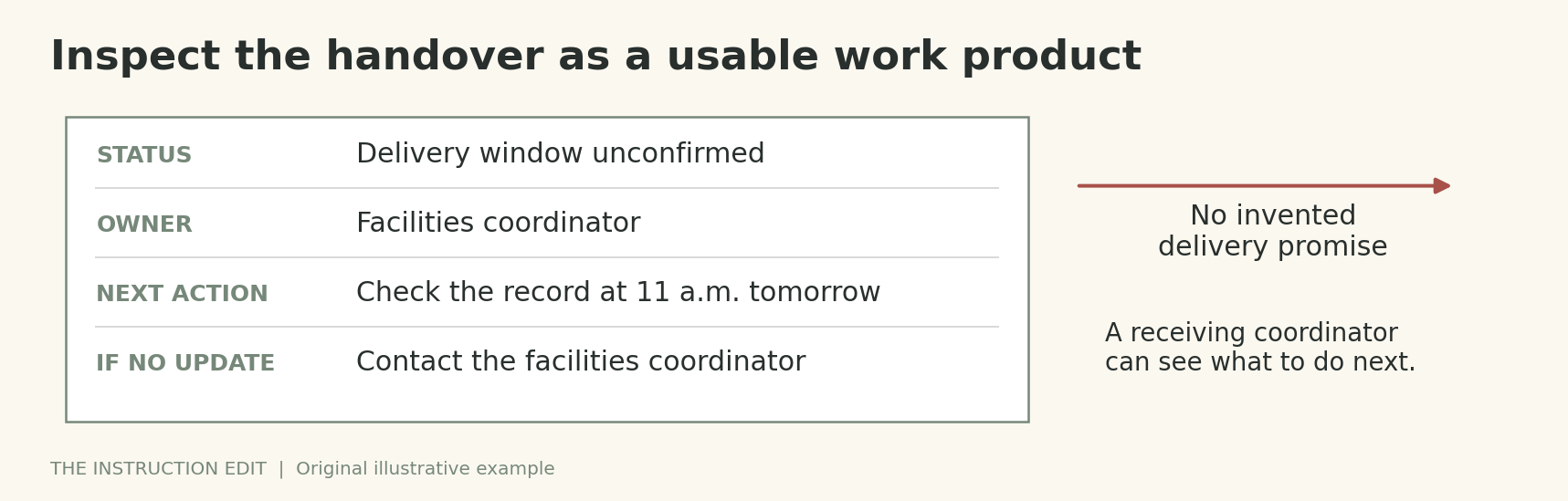
Here is the fictional case: “An internal equipment request is awaiting confirmation of the delivery window. The facilities coordinator owns that confirmation and is due to respond by 11 a.m. tomorrow. The receiving shift should check the request record at 11 a.m. If no update is present, it should contact the facilities coordinator through the approved internal channel. Do not promise a delivery time to the requester before confirmation.”
Ask the learner to prepare a concise handover using the approved fields. The task is to select and organize the supplied information, preserve the unconfirmed status and identify the next action. Do not score the learner on whether they invent a more ambitious solution.
Keep unnecessary detail out of the first version. A long narrative with irrelevant names and dates can test reading endurance more than the target skill. Later variations can add realistic complexity when it matters to the work.

Make the criteria observable
Illustrative task criteria and contrasting responses. The case, roles and responses are fictional.
Criterion: Current status is accurate
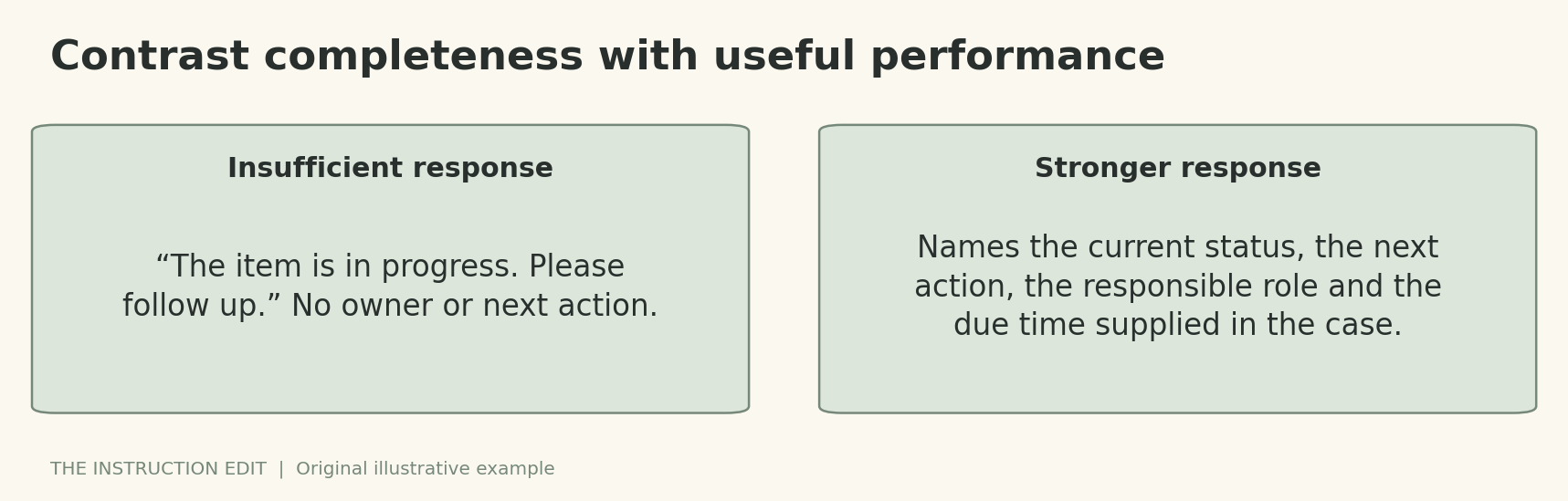
Response that does not yet meet it: “Delivery is arranged”
Response that meets it in this case: “Delivery window is awaiting confirmation”
Criterion: Next action is explicit
Response that does not yet meet it: “Please follow up”
Response that meets it in this case: “Check the request record at 11 a.m. tomorrow”
Criterion: Responsible role is clear
Response that does not yet meet it: “Someone will confirm”
Response that meets it in this case: “Facilities coordinator owns the confirmation”
Criterion: Deadline or trigger is preserved
Response that does not yet meet it: “Check later”
Response that meets it in this case: “If no update is present at 11 a.m., contact the facilities coordinator”
Criterion: Authority boundary is respected
Response that does not yet meet it: Promises a delivery time not supplied in the case
Response that meets it in this case: Keeps the delivery time unconfirmed until the responsible role confirms it
These criteria let you distinguish a vague but polished response from one another coordinator can use. They also make feedback more specific than “add detail.” The missing detail has a function.
Write a complete sample without making it the only acceptable wording
A suitable response might be: “Equipment request: delivery window unconfirmed. Facilities coordinator to respond by 11 a.m. tomorrow. Receiving shift: check the request record at 11 a.m.; if there is no update, contact the facilities coordinator through the approved internal channel. Do not promise a delivery time before confirmation.”
Another response can meet the criteria using different words or a different order. Score the required meaning and action, not resemblance to the sample. If concise writing is part of the goal, define it in relation to usability rather than imposing an arbitrary word count.
A contrasting response might say: “Equipment request is in progress. Please follow up tomorrow.” It is short, but it leaves the status, owner and next action uncertain. The feedback should identify those omissions and ask for a revision using the case facts.
Use the task to select the instruction
Now decide what learners need in order to perform. They may need a model of selecting relevant information, practice distinguishing confirmed from pending status, and a guide to the approved fields. A history of the organization’s communication strategy may not help with this particular task.
Sequence the support. Show a worked handover with the case details annotated. Ask learners to identify why each included detail matters. Then provide a partially completed handover before asking for a new independent response. Record which supports are available at each stage.
If learners fail because the approved fields are unclear or the work process does not assign responsibility, revise the process with its owner. Do not treat a training task as permission to establish new operational rules.
Check whether the task represents the work
Ask an intended learner and the process owner to review the case. Is the required information normally available? Are the actions possible under the role’s permissions? Does the task omit a common exception that changes the decision? Are the criteria clear enough that two reviewers would interpret them similarly?
Try scoring a few sample responses together. If reviewers disagree about whether a response meets a criterion, clarify the criterion or the case. Disagreement may reveal a real ambiguity in the work rather than a weak learner response.
One synthetic task cannot establish competent performance across all conditions. Use additional cases when the work varies and observe real use when appropriate. For consequential tasks, involve the relevant specialists and follow the organization’s assessment requirements.
Build the course around the demonstration
Keep the task visible during design. For each proposed section, ask which criterion it supports and what practice follows it. Remove content that adds no necessary context or support, and add instruction where the task reveals a genuine gap.
For your next project, draft the task, one adequate response and one plausible inadequate response before outlining modules. Compare them against explicit criteria. That small set of artifacts gives the course a clearer destination than a long list of topics.
