
Before buying a UDL book, name one learning-design decision you need help making. Perhaps learners cannot access the source text, the task confuses the goal with a particular response format, or a team offers choices without a clear purpose. Those are more useful starting points than wanting to make lessons more inclusive in general.
Begin with the free, current CAST Guidelines and a lesson you already teach. A book becomes useful when you need a coherent explanation, a shared professional-learning reference or a more sustained implementation discussion. It is not necessary merely to obtain the framework.
Start with the goal and a barrier
The CAST UDL Guidelines organize design considerations across engagement, representation, and action and expression, with learner agency as the goal. They are not a checklist requiring every consideration to appear in every lesson.
Write the intended learning, the barrier in the present design and one change you could make. Ask learners about the barrier rather than assuming that the teacher's preferred option will work for everyone. Keep required individual accommodations and specialist support in place; a general design framework does not replace them.
A no-purchase trial can be very small. Replace an image-only text with a usable version, make oral directions available in writing, or clarify the success criterion before adding more response options. Check whether the change preserves the intended challenge.
Classroom-facing entry point: UDL Now!
This article contains affiliate links. The Instruction Edit may earn a commission if you purchase through them. As an Amazon Associate I earn from qualifying purchases.
Katie Novak's UDL Now!, third edition, on Amazon, affiliate link, is a plausible classroom-facing entry point. The identified CAST 2022 paperback is titled UDL Now! A Teacher's Guide to Applying Universal Design for Learning, ISBN 9781930583825.

UDL Now!, 3rd edition, by Katie Novak. Cover image source: CAST Professional Publishing.
The publisher's actual contents include learner partnership, firm goals, choice and voice, equity, and the relationship between UDL and differentiation. Those topics make it a reasonable candidate for educators who want to connect principles to planning questions. This is an inference from the contents, not a review of the complete book's examples.
The important edition limit is that 2022 predates CAST Guidelines 3.0, released in 2024. Do not purchase this edition expecting every term and emphasis to match the current framework exactly. Pair it with the current free Guidelines and note where the language has evolved.
Current-framework reference: Principles, Framework, and Practice
Anne Meyer and David H. Rose's Universal Design for Learning: Principles, Framework, and Practice, third edition, edited by David Gordon, is the more current framework-oriented comparison. CAST's 2025 paperback is ISBN 9781943085392. The publisher also identifies a separate EPUB edition; check the exact format needed.
The publisher contents include learner variability, design components, accessibility, implementation stories and a Guidelines 3.0 appendix. That scope suggests a better fit for a team building a shared understanding of the updated framework than for someone seeking only a short list of classroom adjustments.
An exact Amazon listing for this edition has not been verified here, so the link goes to the publisher and is not an affiliate link. Do not substitute a previous edition because the titles look similar. The current contents were inspected, not the complete text or every implementation story.
| Your need | Starting point | Check before buying |
|---|---|---|
| A classroom-oriented entry into planning with UDL | UDL Now!, third edition | Use alongside current Guidelines; do not assume 2022 language is fully updated |
| Shared grounding in the updated framework | Principles, Framework, and Practice, third edition | Confirm exact 2025 edition and suitable format |
| One immediate access barrier | Free CAST Guidelines and a focused lesson revision | Test the change with learners and preserve the goal |
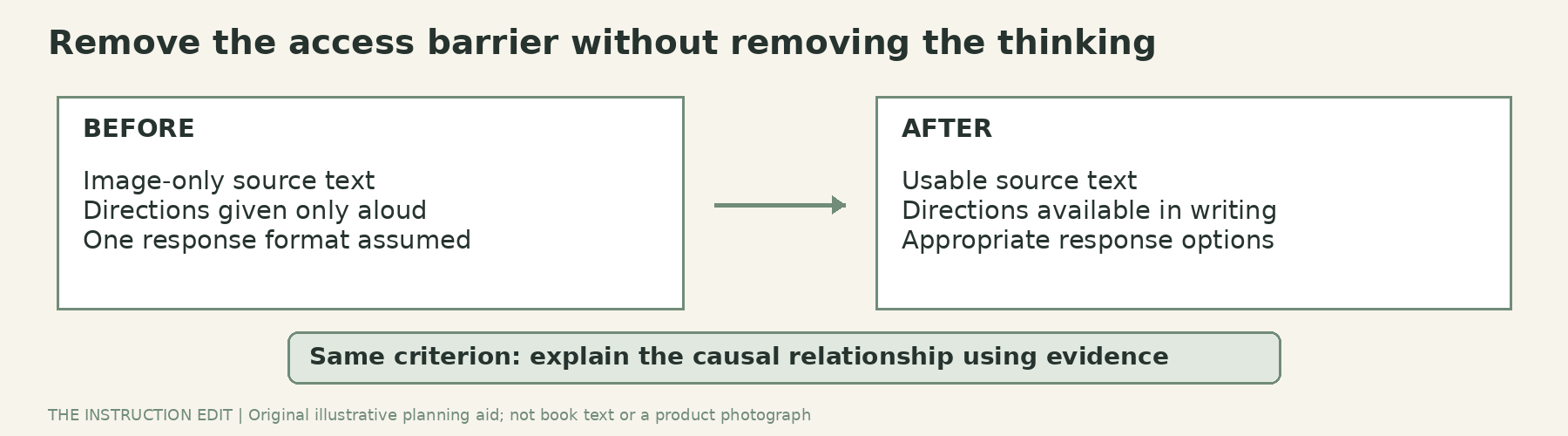
Keep the goal, remove a barrier. Original conceptual illustration.
An illustrative lesson decision
Suppose the goal is to explain a causal relationship in a historical account. The current task supplies an image-only article, gives directions only aloud and requires a handwritten paragraph. This is an original example, not a book excerpt or a tested intervention.
First, separate the goal from the access route. Understanding and explaining the causal relationship is essential. If handwriting itself is not part of the intended assessment, it may be a method rather than the goal. The image-only text and fleeting directions may create avoidable barriers before the thinking begins.
Provide usable text and written directions. Consider appropriate response routes that still require the learner to make the causal relationship explicit. An audio response, for example, should not become an easier task with a different criterion. The same quality of explanation remains necessary.
Then inspect the result. Did learners gain access to the source? Did the response show the intended reasoning? Did an offered option create a new technical or organizational burden? UDL planning includes revising the design, not merely counting choices.
Read for a decision, not a badge
Choose one chapter or section that addresses the named problem, using a lawful preview or borrowed copy where possible. Write a brief application note: what stays, what changes and what evidence will tell you whether the change helped access or learning.
For a team, agree on terms using current CAST materials. Do not turn edition differences into a contest over who owns the newest book. The practical question is whether the shared language helps you identify barriers and make defensible decisions.
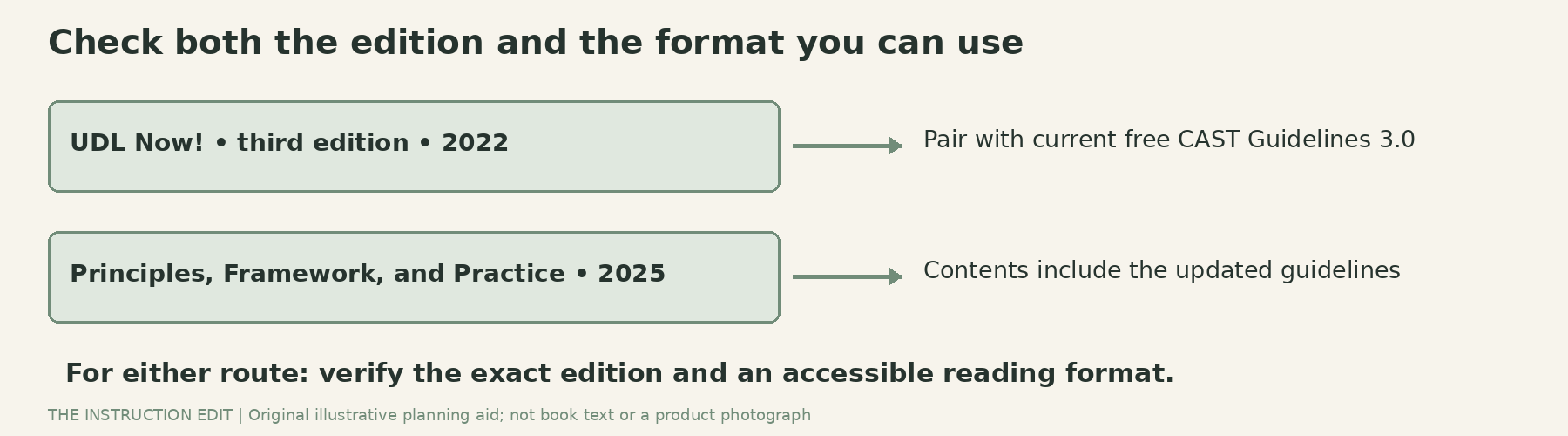
Edition and access check. Original conceptual illustration.
Format is part of the purchase
Before buying, check whether the available print, ebook or accessible format works with the reader's needs and tools. An ebook label alone does not verify navigation, text-to-speech permissions or the accessibility of diagrams. Inspect a lawful sample and ask the publisher or library about the required features if they are not documented.
Who should not buy
Skip both books for now if the free Guidelines already answer the immediate question or the main issue requires an accommodation, accessible source file or institutional decision rather than another framework explanation.
Choose Novak for the documented classroom-facing scope, with an edition caveat. Choose the 2025 CAST reference for updated framework grounding. The next step is one barrier-focused revision and a check with learners, not a shopping list of inclusive-sounding materials.
Sources and selection basis
The linked publisher contents, author listing identity and current CAST Guidelines were checked on 25 October 2026. This is not a full-book review. Only the UDL Now! Amazon destination is verified here. No price, availability or guaranteed accessibility of an uninspected ebook is asserted.
