

A classroom finding can be relevant to workplace learning without being a ready-made business case. The difficulty is not that adults are a different species of learner. It is that the task, prior knowledge, outcome and conditions may differ in ways that matter.
Before importing a method, write the claim you want to make. “This activity may help people remember a rule” is narrower than “this course will reduce operational errors.” The second claim includes several additional steps between learning and performance.
Good evidence use makes those steps visible. It neither dismisses research because the setting is imperfectly matched nor treats an appealing result as a guarantee outside the conditions in which it was obtained.
Separate research evidence from design guidance
CDC's Quality Training Standards for Public Health, updated October 1, 2026, call for needs assessment, aligned objectives, relevant content, engagement, accessibility, evaluation, assessment and follow-up support. The standards also caution that training is not always the solution to a gap. They are development guidance, not a controlled study estimating the effect of one instructional technique. Read the standards.
That distinction helps organise a design conversation. Research may support a particular learning mechanism. Guidance can help a team ask whether the training is needed, usable and evaluated appropriately. Neither relieves the team of defining what success means in the workplace.
Roediger and Karpicke's 2006 experiments tested undergraduates' delayed recall of prose, not employees' operational decisions. That finding supports a question about retention; it does not itself establish improved ticket routing. Read the primary experiments.
A source should be used for the claim it can support. A checklist cannot supply a causal effect size. A memory experiment cannot, on its own, establish a return on investment for a course.
Start with the performance problem
Consider an illustrative support team whose members misroute unfamiliar tickets. A manager requests a short course and proposes frequent quizzes because a learning study found a benefit from retrieval practice.
First ask what causes the misrouting. Do employees not know the categories? Are the categories ambiguous? Is the routing screen difficult to use? Does the approved guide contradict the system? Do staff lack authority to choose the correct destination?
Training may address a knowledge or judgment gap. It cannot by itself repair an unavailable option, conflicting instructions or a policy that rewards speed while penalising careful checks. The same error count can arise from different causes.
Inspect a small, appropriately de-identified sample of tickets and speak with the people doing the work. Define the required decision before choosing the learning activity. “Select the correct routing category and explain the relevant clue” is more useful than “understand ticket routing.”
Also define the permitted tools. If employees should consult a current routing guide during work, the learning task should not silently assume that memorising every category is the whole goal.
Translate the task, not just the activity format
A quiz can test recognition, recall, interpretation or use of a reference. Those demands are not interchangeable. Reusing the word “quiz” does not establish that the new activity reproduces the important feature of the original research.
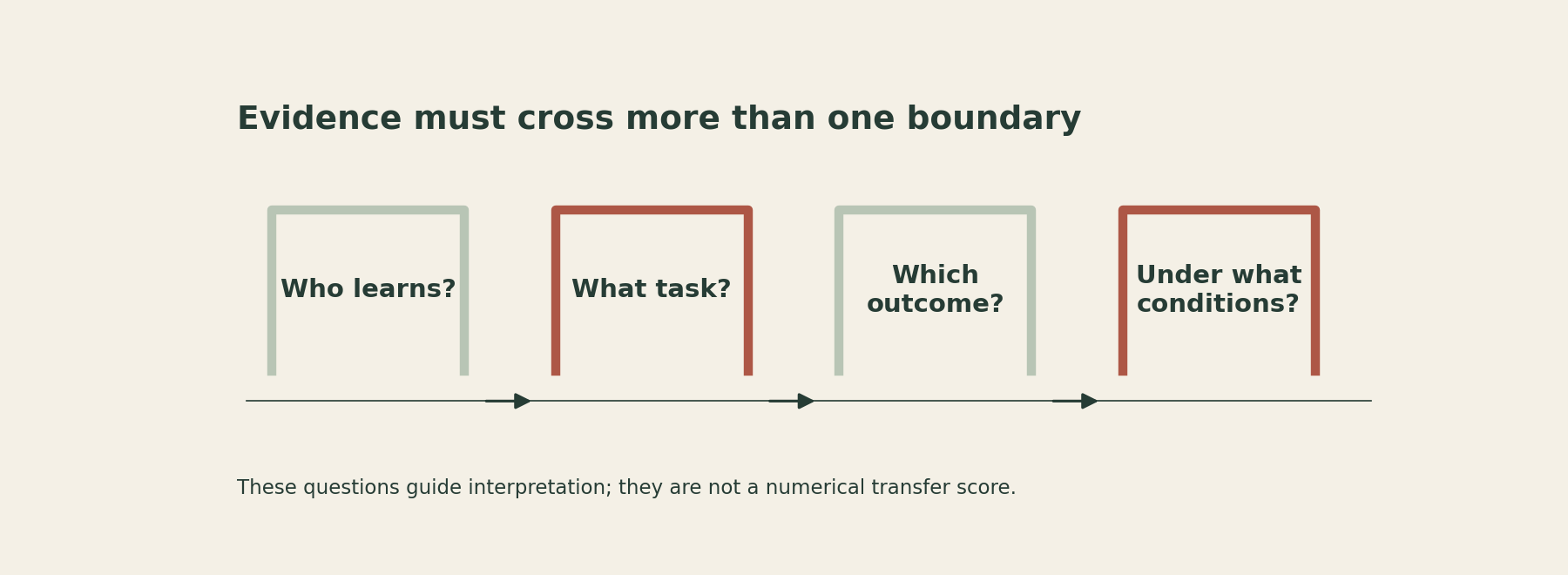
Map the source context against the proposed workplace task. The comparison below is an original planning aid, not a formal evidence-grading instrument.
Dimension: Population
Question about the source: What prior knowledge did participants have?
Question about the workplace: Are staff new, experienced or mixed?
Dimension: Task
Question about the source: What did participants actually practise?
Question about the workplace: What decision must staff make?
Dimension: Outcome
Question about the source: Was recall, accuracy or transfer measured?
Question about the workplace: Is the goal correct routing in real work?
Dimension: Conditions
Question about the source: What time, support and feedback were available?
Question about the workplace: Which tools and constraints apply on shift?
Dimension: Consequences
Question about the source: What happened when a response was wrong?
Question about the workplace: What safeguards must remain during practice?
Some differences may be irrelevant to the proposed mechanism; others may be central. The table is not a demand for identical settings. It is a prompt to explain why the evidence is informative despite the differences and what remains uncertain.
For the routing example, a plausible design might combine brief recall of stable distinctions with supported decisions on varied sample tickets. Learners could explain why a clue matters, consult the approved guide and compare their reasoning with feedback. This is a proposal to evaluate, not a result already established for that organisation.
Choose an outcome that matches the claim
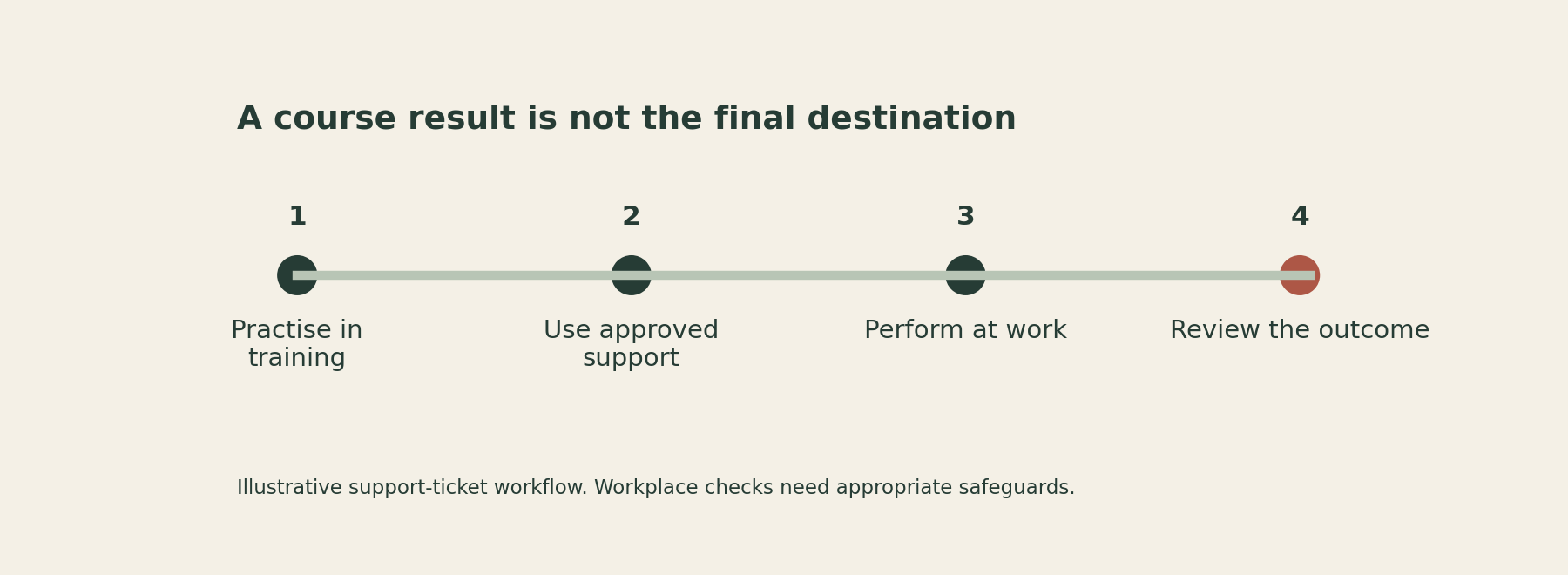
Course completion tells you that a learner reached the end under the platform's rules. A post-course question can show a response in the training setting. Neither automatically shows that the learner will make a sound decision during a busy shift.
If the goal is accurate routing, inspect routing decisions under appropriate conditions. Begin with safe practice cases, then consider a supported workplace check that respects organisational requirements and protects customers and staff.
Keep the measurement proportionate. A small team may not need an elaborate dashboard. It does need a clear distinction between the target outcome and convenient proxies such as clicks, satisfaction or time spent in the module.
Satisfaction can still be useful. If learners report that a guide is impossible to find, that may explain an implementation problem. The mistake is asking satisfaction to stand in for performance rather than using it to understand the conditions around performance.
Run a bounded test with a useful stopping rule
Choose one category distinction, a small set of representative practice cases and a defined review point. Record what changed in the training, which supports were available and what evidence will inform the next decision.
Agree what would lead to revision. If staff can explain the rule but the system still routes tickets incorrectly, investigate the workflow. If they can follow a familiar example but fail a contrasting case, revise the examples and feedback. If the guide is outdated, correct the guide before adding more practice.
A local before-and-after improvement may be encouraging, but it is not automatically a causal estimate. Other changes, case mix or growing experience may contribute. Report the result at the strength the design permits.
The stopping rule should also include unacceptable burdens or risks. A trial that disrupts essential work or exposes sensitive data needs a different design, not a more enthusiastic interpretation.
Keep the evidence chain honest
When presenting the proposal, separate three statements: what the source found, why the team thinks the mechanism may apply and what the local evaluation will establish. This makes uncertainty actionable instead of hiding it in a footnote.
Start with one transfer claim in an existing training plan. Trace the population, task, outcome and conditions. Keep what is well supported, adapt what needs translation and test the part that remains uncertain.
Evidence travels best when its limits travel with it. That is not caution for its own sake. It is how a useful finding becomes a better workplace decision rather than an impressive citation attached to an unrelated course.
Sources
Roediger and Karpicke (2006), Test-Enhanced Learning. Primary memory experiments; Psychological Science, 17(3), 249–255.
CDC, Quality Training Standards for Public Health. Updated October 1, 2026. Guidance for training development.
