
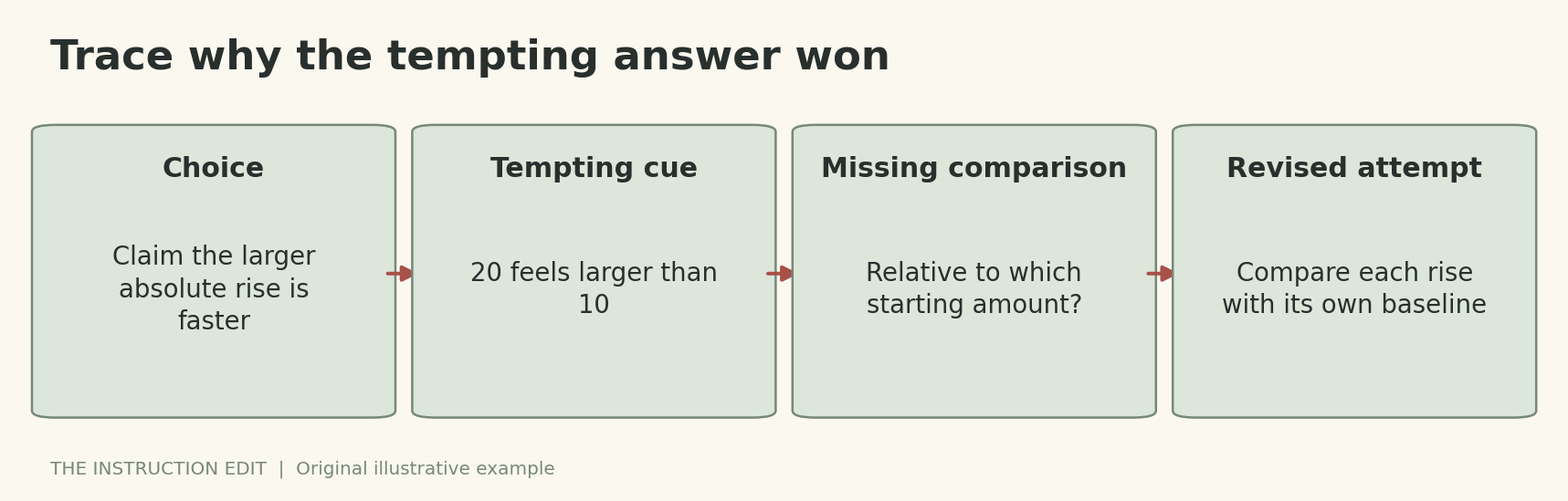
A useful debrief explains why an answer was attractive, what it overlooked and how to make a better decision on the next attempt. Begin with the reasoning, not a public announcement of who was wrong. Then give learners a new case that requires the corrected distinction.
“Incorrect, try again” tells a learner that something failed. It rarely tells you whether the learner has identified the problem. A debrief should make the competing cues visible enough that the next attempt can test a change in reasoning.
Choose a wrong answer with an understandable appeal
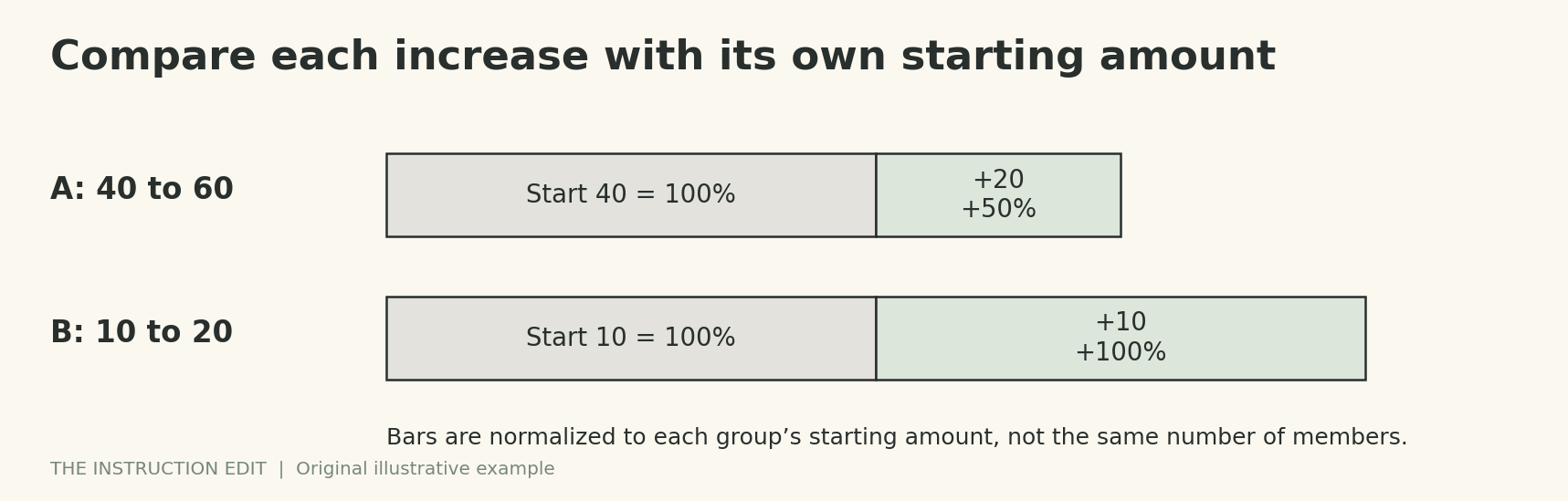
Consider an illustrative mathematics task using invented quantities. Group A grows from 40 to 60 members. Group B grows from 10 to 20. Which group has the greater percentage increase?
A learner might choose A because it gained 20 members while B gained 10. That answer attends to a real feature of the data: the absolute increase is larger. The missing step is comparing each increase with its own starting amount. A useful debrief can acknowledge the relevant observation while showing why it does not answer this particular question.
The EEF’s feedback recommendations emphasize feedback that addresses a specific learning gap and planning for learners to use it. The script below is an original teaching example, not a claim that this wording has been tested or that one debrief guarantees transfer.
Separate the tempting cue from the deciding relationship
Write the two changes where learners can compare them. For A, the increase is 20 out of an initial 40, which is 50 percent. For B, it is 10 out of an initial 10, which is 100 percent. B has the greater percentage increase even though A gained more members.
Ask: “What question would the answer ‘Group A’ correctly answer?” A defensible response is: “Which group gained more members?” That move helps learners distinguish two legitimate comparisons instead of treating the original answer as meaningless.
Then ask: “What does percentage increase compare the change with?” Keep the attention on the starting amount. If the learner divides by the final amount, that is a different issue and needs a different follow-up. Do not force every wrong answer into the same explanation.
Illustrative debrief script. The quantities and learner responses are invented.
Debrief move: Surface the appeal
Teacher or facilitator language: “What feature could make A seem like the answer?”
Evidence to listen for: Learner identifies the larger absolute gain
Debrief move: Name the question
Teacher or facilitator language: “Are we comparing added members or percentage increase?”
Evidence to listen for: Learner distinguishes the two quantities
Debrief move: Examine the relationship
Teacher or facilitator language: “Compare each increase with that group’s starting size.”
Evidence to listen for: Uses 20/40 and 10/10 rather than a shared denominator
Debrief move: State the correction
Teacher or facilitator language: “A grew by 50 percent; B grew by 100 percent.”
Evidence to listen for: Connects the calculations to the original question
Debrief move: Reattempt
Teacher or facilitator language: “Now compare a rise from 20 to 30 with a rise from 50 to 65.”
Evidence to listen for: Uses starting amounts to obtain 50 percent and 30 percent
The final task changes both the values and which comparison is visually tempting. It gives learners a reason to apply the distinction rather than repeat the earlier answer.

Invite explanation without requiring public confession
You can ask why an option might appeal without asking a learner to defend an error in front of the class. Present a fictional response: “Someone says A because 20 is larger than 10. What are they noticing, and what have they not compared yet?”
That wording makes the reasoning available for discussion while reducing the need to identify an individual. If you use actual responses, follow the class’s norms and remove identifying details. Do not turn the debrief into a performance of embarrassment.
Give learners time to think before collecting explanations. A quick show of hands may reveal the selected answer but not the underlying reasoning. A sentence, annotated calculation or brief partner explanation can provide more relevant evidence, depending on the goal and accessibility needs.
Model only the missing connection
If learners can find the absolute change but do not know the baseline relationship, model that relationship directly. “Twenty additional members compared with the original forty means half of the starting group size, so the increase is 50 percent.” Link the calculation and the meaning.
If the arithmetic itself is the obstacle, decide whether to support it separately. A calculator can help isolate reasoning about the denominator when mental calculation is not the objective. Conversely, if percentage calculation fluency is the intended goal, providing every calculation changes the evidence you collect.
Do not add a long lecture on every use of percentages. The debrief should address the distinction exposed by the task. More explanation is useful only when it answers an actual question or prerequisite gap.
Make the revised attempt genuinely informative
Use the new pair from the table: 20 to 30 and 50 to 65. Ask for both percentage increases and a one-sentence comparison. The first is 50 percent; the second is 30 percent. The larger absolute gain is now 15 rather than 10, but it still does not identify the larger percentage increase.
If a learner gets the answer right, ask what would have made the tempting alternative correct. This can reveal whether they understand the distinction or happened to follow the demonstrated calculation. If the explanation remains unclear, use one simpler comparison rather than increasing difficulty immediately.
Check again later with a different context. An immediate successful response demonstrates performance after support. It does not establish that the learner will recognize the relationship independently next week.
End with a change in reasoning
Ask learners to complete: “At first I compared ___. For percentage increase, I need to compare ___.” This is a brief reflection tied to the actual decision, not a generic request to write about how the activity felt.
For the next debrief, choose one plausible wrong answer and write down the cue that makes it attractive. Plan one question that distinguishes that cue from the relationship the task requires. Finish with a fresh attempt. The useful outcome is a more accurate explanation that learners can use, not a longer discussion of the answer key.
