
If differentiation has become three unrelated worksheets, start by writing the learning goal in one sentence. Then ask which parts of the task are essential to that goal and which are merely the route into it. A book can help organize this thinking, but it cannot preserve a goal that has not been made clear.
Two related references offer different entry points. Carol Ann Tomlinson's How to Differentiate Instruction in Academically Diverse Classrooms is the more direct foundation for classroom organization. Tomlinson and Jay McTighe's Integrating Differentiated Instruction & Understanding by Design is more relevant when a curriculum team needs to connect adaptations with intended understanding.
Begin with the curriculum you already have
Use the current curriculum guidance and one task that learners find difficult. Identify the knowledge and thinking required, then list the actual barriers you have observed. A difficult term, an unfamiliar representation and insufficient background knowledge are different problems. They do not all need a new worksheet.
The free CAST UDL Guidelines can help you consider access, representation and expression. Use them alongside the goal, not as a requirement to offer every possible option in every lesson. Borrow a book before buying if the issue is still too broad to name.
Do not assign learners fixed visual, auditory or kinesthetic identities. The buying criterion is useful responsiveness to observed needs and task demands, not a system for matching instruction to supposed learning styles.
A foundation for classroom differentiation
This article contains affiliate links. The Instruction Edit may earn a commission if you purchase through them. As an Amazon Associate I earn from qualifying purchases.
How to Differentiate Instruction in Academically Diverse Classrooms, third edition, on Amazon, affiliate link, by Carol Ann Tomlinson, is the more direct starting point if you want to rethink what differentiation means in daily teaching. The identified ASCD 2017 paperback has ISBN 9781416623304.

How to Differentiate Instruction in Academically Diverse Classrooms, 3rd edition, by Carol Ann Tomlinson. Cover image source: ASCD.
The lawful publisher sample explicitly distinguishes differentiation from preparing an entirely separate assignment for every learner. It describes whole-class, small-group and individual work around meaningful ideas. The publisher contents also foreground the teacher's role and student needs.
That makes it a plausible foundation when the current approach is fragmented or operationally exhausting. It is not a ready-made set of tasks for your exact curriculum, and older terminology should be read critically rather than adopted unexamined. Use evidence of present understanding and access needs, not permanent ability labels.
A reference for keeping curriculum and access connected
Integrating Differentiated Instruction & Understanding by Design: Connecting Content and Kids, on Amazon, affiliate link, by Carol Ann Tomlinson and Jay McTighe, is the original ASCD edition identified by ISBN 9781416602842.
Its publisher contents and description bring backward design and responsive teaching into the same planning conversation. The documented distinction is useful: deciding what understanding matters is related to, but different from, deciding how particular learners will reach and demonstrate it.
Choose this candidate when adaptations drift away from the intended learning or when a team needs a shared planning discussion. The contents were inspected, not the complete text, so this guide does not evaluate unseen examples or promise that the book supplies a particular template. It is also an older reference, not a current educational-technology manual.
| Planning question | More relevant reference | Limitation |
|---|---|---|
| What does manageable differentiation look like? | How to Differentiate Instruction, third edition | You must create subject-specific examples and examine older terminology critically |
| Are our adaptations still teaching the intended understanding? | Integrating Differentiated Instruction & Understanding by Design | Requires curriculum discussion, not simply collecting activity ideas |
| Is the task inaccessible in its current format? | Current curriculum guidance plus CAST, before buying | Access changes still need checking against the actual goal |
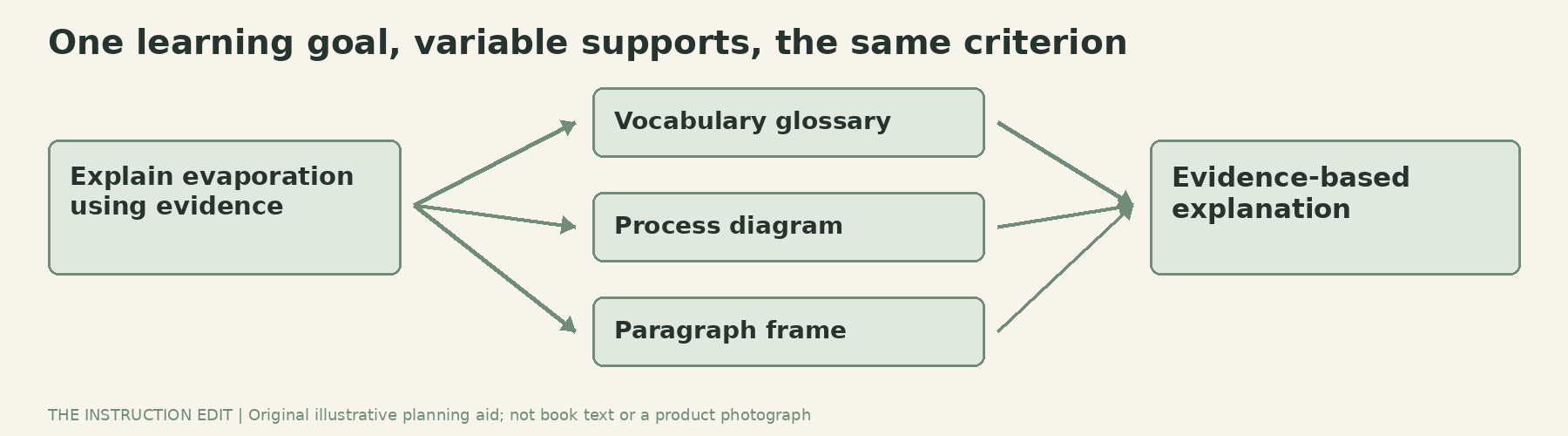
One science goal, variable supports. Original conceptual illustration.
An illustrative science adaptation
Suppose the goal is to explain evaporation using evidence from a simple investigation. The class has the same observations, but some learners are struggling with vocabulary and others with organizing an explanation. This is an original planning example, not an activity reproduced from either book.
Keep the evidence-based explanation as the common destination. Offer a concise glossary for essential terms, a clearly labeled diagram for the process, or a paragraph frame that separates claim, evidence and reasoning. These supports address different barriers without assigning learners to permanent categories.
Then inspect whether a proposed adaptation removes the thinking you meant to teach. A worksheet that asks one group only to copy definitions may no longer assess explanation. A diagram that already supplies every causal connection may turn reasoning into transcription. The label differentiation does not settle that issue.
Plan a later check with a new example and only the support still needed. Do not remove an access accommodation merely to create difficulty. Distinguish temporary instructional scaffolds from supports that make participation possible.
Use the book to improve a planning decision
Bring one existing task to a reading session. Record three things before discussing a technique: the shared goal, the observed barrier and the evidence you will accept. After proposing a change, ask what the learner still has to think about.
For an individual teacher, the first book may supply the more useful conceptual reset. For a team working on assessment and curriculum coherence, the second may fit better. Owning both is not necessary if one focused planning conversation resolves the immediate problem.
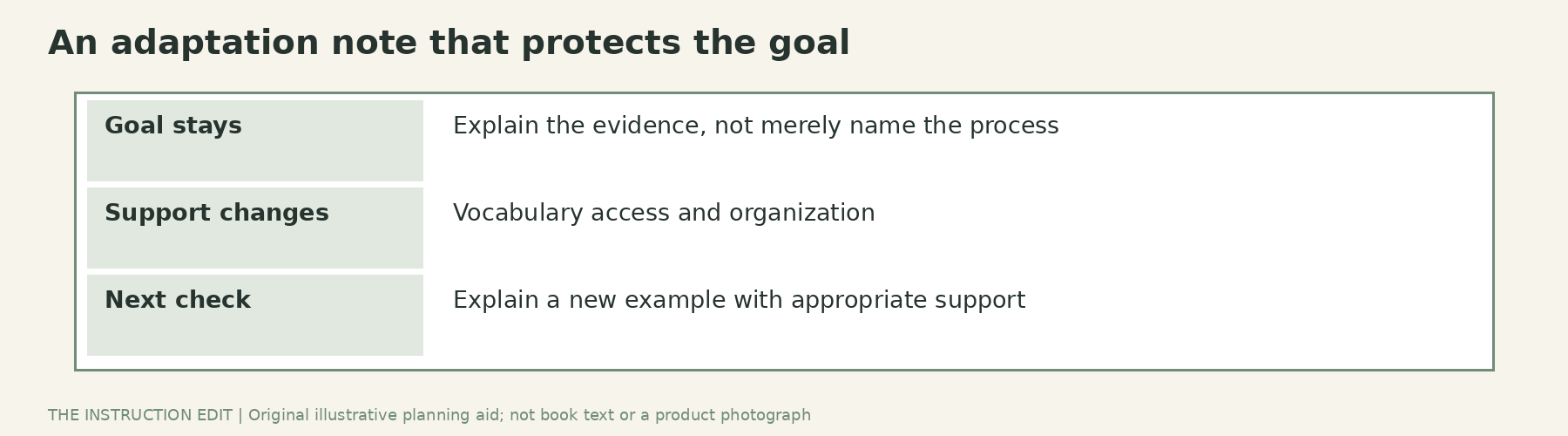
An adaptation note that protects the goal. Original conceptual illustration.
Who should not buy
Pause if the main problem is missing subject knowledge, inadequate planning time or an inaccessible resource that needs a direct fix. A differentiation book should not become a way to ask one teacher to manufacture several complete curricula.
Also skip a new purchase if your current reference already supports flexible grouping, common goals and responsive scaffolding. Apply one idea, inspect learner work and revise. The next useful action is to adapt one task without changing the intended thinking, then explain why each support is there.
Sources and selection basis
This is a scope-based selection guide using the linked ASCD contents and lawful third-edition sample, plus current CAST guidance, checked on 25 October 2026. Full books were not reviewed. Both exact Amazon destinations were verified from publisher links. No learning-styles endorsement, effectiveness guarantee, price or availability claim is made.
