
An answer sheet being marked. Photo: Andy Barbour, Pexels License. Full frame, display-scaled only. Contextual stock photograph, not these original items and not an evaluation of the pictured test or person.
A correct selection can come from the wrong clue
One option repeats the wording of the question. Another is the only choice that fits after “an.” A third contains a careful explanation while its neighbors are two words long. A learner may use those differences without making the subject judgment the question was intended to require. Before interpreting a set of scores, inspect what the items themselves advertise.
The featured photograph shows an answer sheet being marked. It cannot tell us what thinking produced a response—or whether the unseen questions contained clues. The audit in this article happens earlier, in the item wording. It is not an evaluation of the photographed test or person.
The University of Waterloo’s guidance on multiple-choice questions identifies verbal-association cues, grammatical consistency, plausible distractors and similar option length as construction concerns. The five before-and-after items below are independently written teaching examples, not Waterloo questions. They demonstrate an editorial check, not validated items or evidence that a repaired test measures its intended construct well.
Keep the knowledge demand in view
Write the intended decision beside each item before editing it. A stem presents the problem; the key is the best answer; distractors are the alternatives that are not best under the stated conditions. An irrelevant clue helps someone find the key without making that intended decision. A relevant clue is part of the subject evidence: the numbers needed to calculate a median, for example. Removing those numbers would damage the question, not improve it.
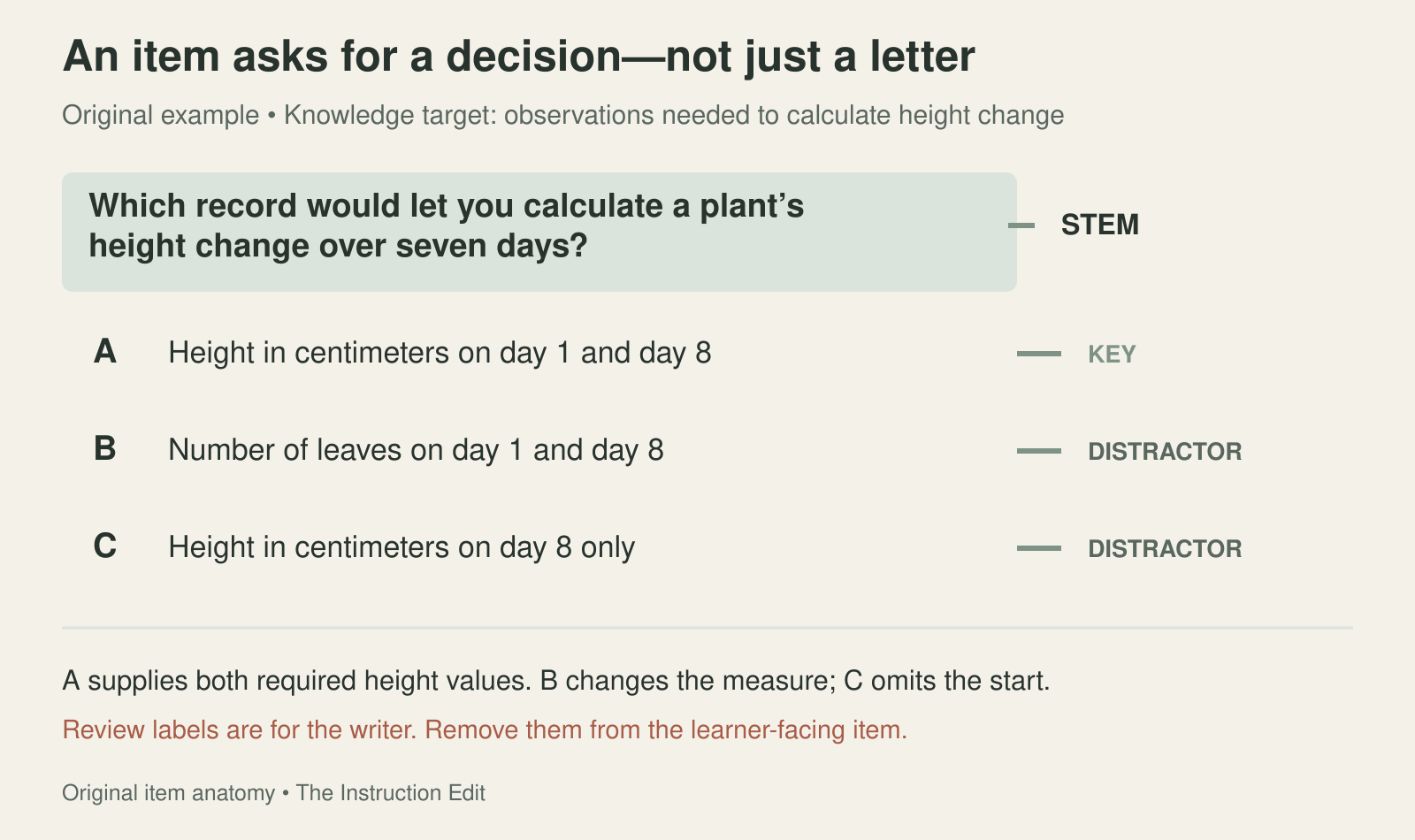
Figure 1. Item anatomy makes the intended decision explicit. Original example and annotation by The Instruction Edit; writer-facing labels are not part of a learner assessment.
Use a two-pass review. First hide the key and look for a choice that stands out through wording alone. Record the cue, not a confident guess about which answer is right. Then reveal the key and check content: does the revision still ask the same question, have one defensible best answer and use alternatives that make sense for the learners? A colleague who knows the subject should perform the second pass.
Five original repairs
1. Repeated wording that points at the key
Target: recognize a sampling approach that avoids letting willingness or convenience determine who is selected. Before: “Which method is most suitable for selecting a representative sample of a school?” A: Invite the first 30 pupils at the gate. B: Select a representative sample from the school register. C: Ask 30 volunteers in the library. Key: B.
The key largely repeats the aim rather than specifying a method. After: “A school wants views from pupils across its full register. Which selection method avoids choosing people because they are available or volunteer?” A: Invite the first 30 pupils at the gate. B: Draw 30 pupil IDs at random from the full register. C: Ask 30 volunteers in the library. Key: B.
Rationale: B specifies random selection from the stated population; A and C use convenience or volunteering. This does not promise that any particular random sample is perfectly representative, or solve nonresponse. The repair replaces a verbal echo with the method the learner must recognize. Keep necessary subject terms; do not replace them with unfamiliar synonyms merely to avoid repetition.
2. Grammar that does the sorting
Target: name the variable deliberately changed by the investigator. Before: “The factor deliberately changed in an investigation is an …” A: independent variable. B: dependent variable. C: controlled variable. Key: A. Only A fits the article “an” in ordinary pronunciation.
After: “Which term names the factor an investigator deliberately changes?” A: dependent variable. B: independent variable. C: controlled variable. Key: B. All three choices now answer the same grammatical question. The knowledge demand remains the distinction between the changed factor, the measured outcome and factors kept constant. Moving the key is not the repair; removing the grammatical cue is.
3. A correct option with its own explanation
Target: identify the median of five ordered values. Before: “What is the median of 4, 6, 7, 8 and 20?” A: 6. B: 7, because it is the middle value when the five values are arranged in order. C: 9. Key: B. The key is much longer and uniquely explains a method.
After: “What is the median of 4, 6, 7, 8 and 20?” A: 6. B: 7. C: 9. Key: B. The third value is 7. The mean is 45 ÷ 5 = 9, making C an interpretable alternative for a learner who confuses the two measures. A is an adjacent value, not a demonstrated common error. These are proposed distractors; actual learner responses would be needed to judge how they function.
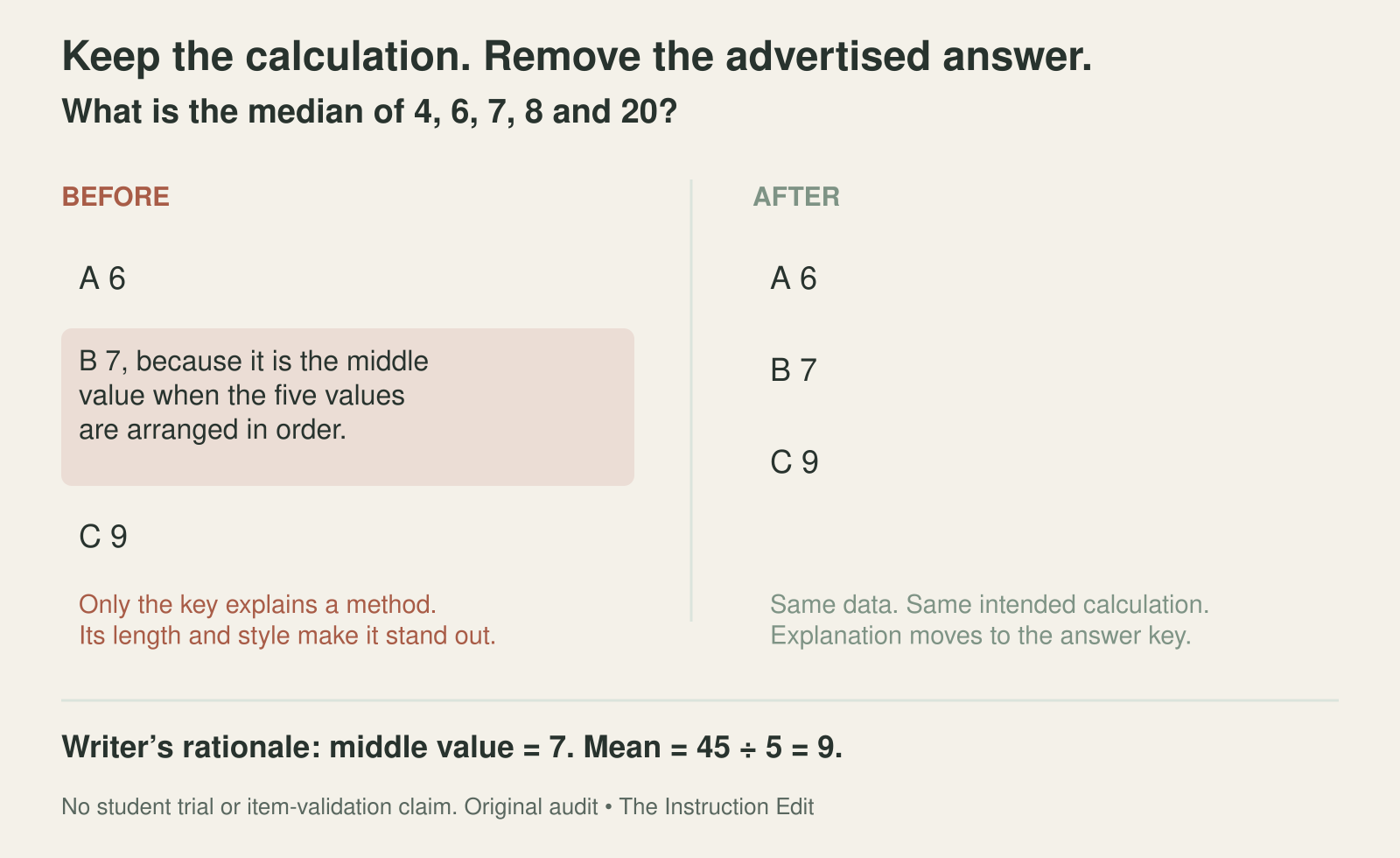
Figure 2. Remove the wording cue without removing the mathematical evidence. Original item pair by The Instruction Edit; no trial or validation claim.
Keep the explanation in the answer-key rationale rather than attaching it only to the key in the question. If explaining the method is the learning target, add a separate explanation prompt and score it explicitly. A multiple-choice selection alone does not show the reasoning used.
4. Alternatives no one needs subject knowledge to reject
Target: choose observations that can establish change in a plant’s height over seven days. Before: “Which record would let you calculate a plant’s height change over seven days?” A: Its height in centimeters on day 1 and day 8. B: The gardener’s favorite film. C: The color of the classroom door. Key: A.
After: “Which record would let you calculate a plant’s height change over seven days?” A: Its height in centimeters on day 1 and day 8. B: Its number of leaves on day 1 and day 8. C: Its height in centimeters on day 8 only. Key: A. Each option is now a plausible plant record, but only A supplies both height measurements needed for the specified change. B measures another feature; C lacks the starting height. The task is still choosing the required evidence, not performing a subtraction.
5. Extreme wording that makes the alternatives disposable
Target: limit an inference to what a voluntary survey supports. Before: “Twenty pupils volunteer for a survey; 14 prefer an earlier lunch. What is justified?” A: Every pupil in the school always wants an earlier lunch. B: No pupil in the school ever wants an earlier lunch. C: Most respondents prefer an earlier lunch, but the school-wide preference is uncertain. Key: C.
After: “Twenty pupils volunteer for a survey; 14 prefer an earlier lunch. Which conclusion is supported about the group named?” A: Most pupils in the school prefer an earlier lunch. B: Most pupils outside the survey prefer an earlier lunch. C: Most pupils who answered prefer an earlier lunch. Key: C. The choice now turns on the population named, not “always” and “ever.” Fourteen of 20 is a majority of respondents. Nothing supplied establishes the preferences of nonrespondents or the school as a whole.
A clue-check card you can reuse
For each item, record: intended decision; suspicious wording feature; whether it points to the key; smallest repair; and what still needs a content check. Read every option with the stem. Compare option length and grammatical form. Ask whether a distractor is wrong for a subject reason or simply absurd. Check whether repeated wording is necessary evidence or a decorative echo. Avoid treating any word—such as “always”—as automatically forbidden when an absolute claim is genuinely the subject of the question.
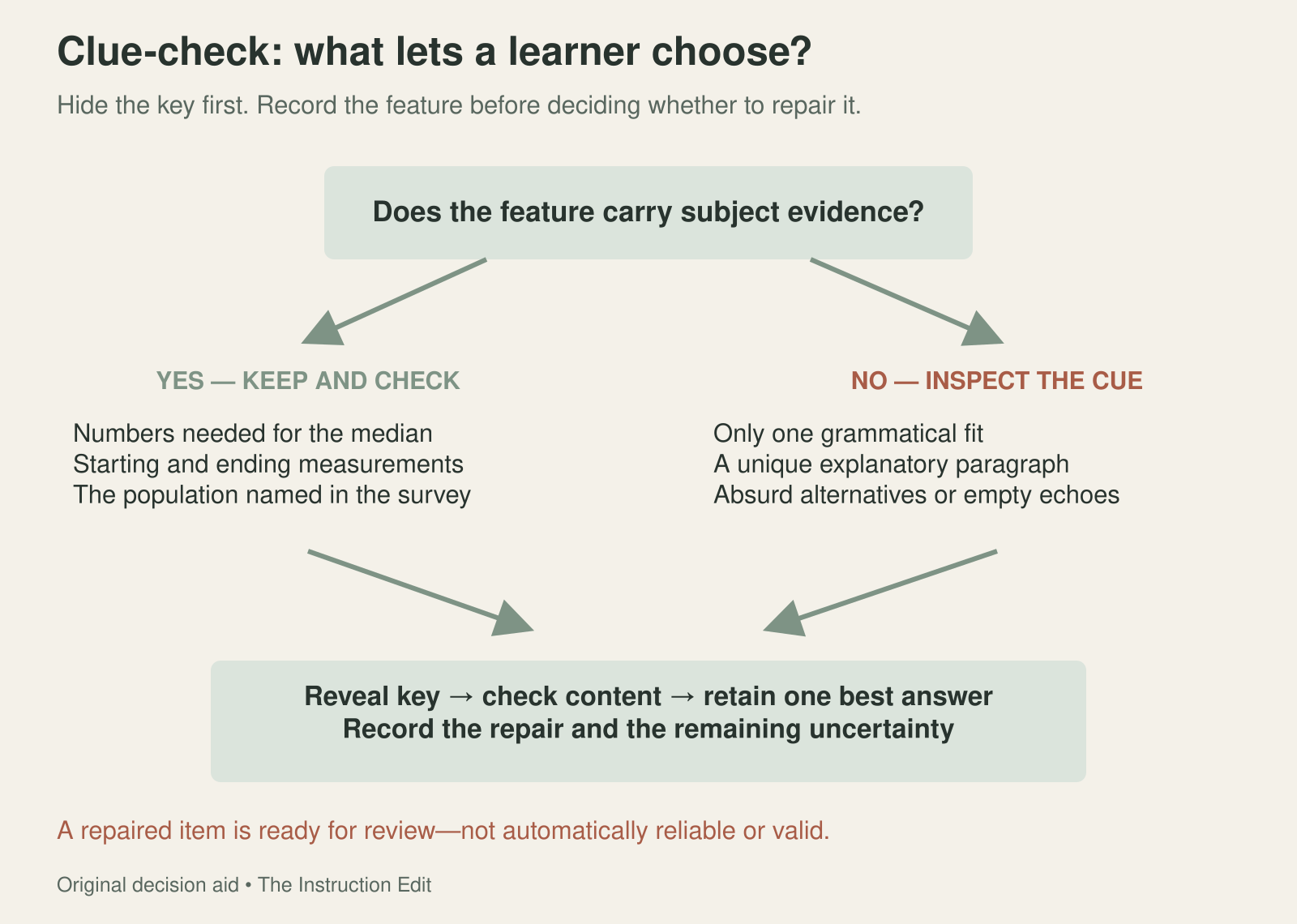
Figure 3. A reusable writer’s clue check. Original decision aid by The Instruction Edit; editing is not psychometric validation.
Finish with a clean learner-facing copy and a separate rationale for every option. Do not leave highlighting, annotations or an asterisk from the review in the assessment. Check the set for accidental answer-position patterns, but do not force a predictable sequence or distort a good item to create one. The five examples here are arranged by defect, not assembled as a balanced scored test.
After use, inspect whether distractors attracted responses and whether explanations reveal the intended distinction. An editorial repair is a reason to review the item again, not a reason to declare it reliable or valid. A subject expert may still find ambiguous wording, an untaught distinction or more than one defensible answer.
Try this with five existing questions: hide the key, find anything that advertises a choice through wording alone, then reveal the key and repair the item without changing its intended decision. Keep the before-and-after record so the next reviewer can see what changed and why.
Source and scope
Designing multiple-choice questions — University of Waterloo Centre for Teaching Excellence. Official construction guidance, checked October 30, 2026. Principles are summarized; source examples are not reproduced. All five item pairs, rationales and audit graphics are original illustrations. No student data, item trial or psychometric validation is claimed.
