
The genuine Met tile beside an original idealized construction. Photo: The Metropolitan Museum of Art, Public Domain. Layout and mathematical model: The Instruction Edit. The model is not a tracing or historical reconstruction.
A patterned tile can prompt a good mathematical question without proving the answer. “That looks symmetric” is a useful beginning, not a finished argument. The teaching decision is where to move from noticing features in a photograph to defining a shape precisely enough to test a claim.
The Met’s public-domain image of Tile with Geometric Design is a useful starting resource. This evaluation pairs the actual object photograph with an original coordinate construction and a reusable reasoning mat. The aim is not to extract exact geometry from pixels or claim to recover the maker’s method. It is to give a conjecture a clearly defined object of study.
Decide what counts as evidence
Use the museum image for observation and context. Use a specified construction for a mathematical argument. Use the catalog for the object’s recorded identity. Keeping those roles separate prevents a successful proof about your drawing from becoming an unsupported claim about the physical tile.
Start with the actual object
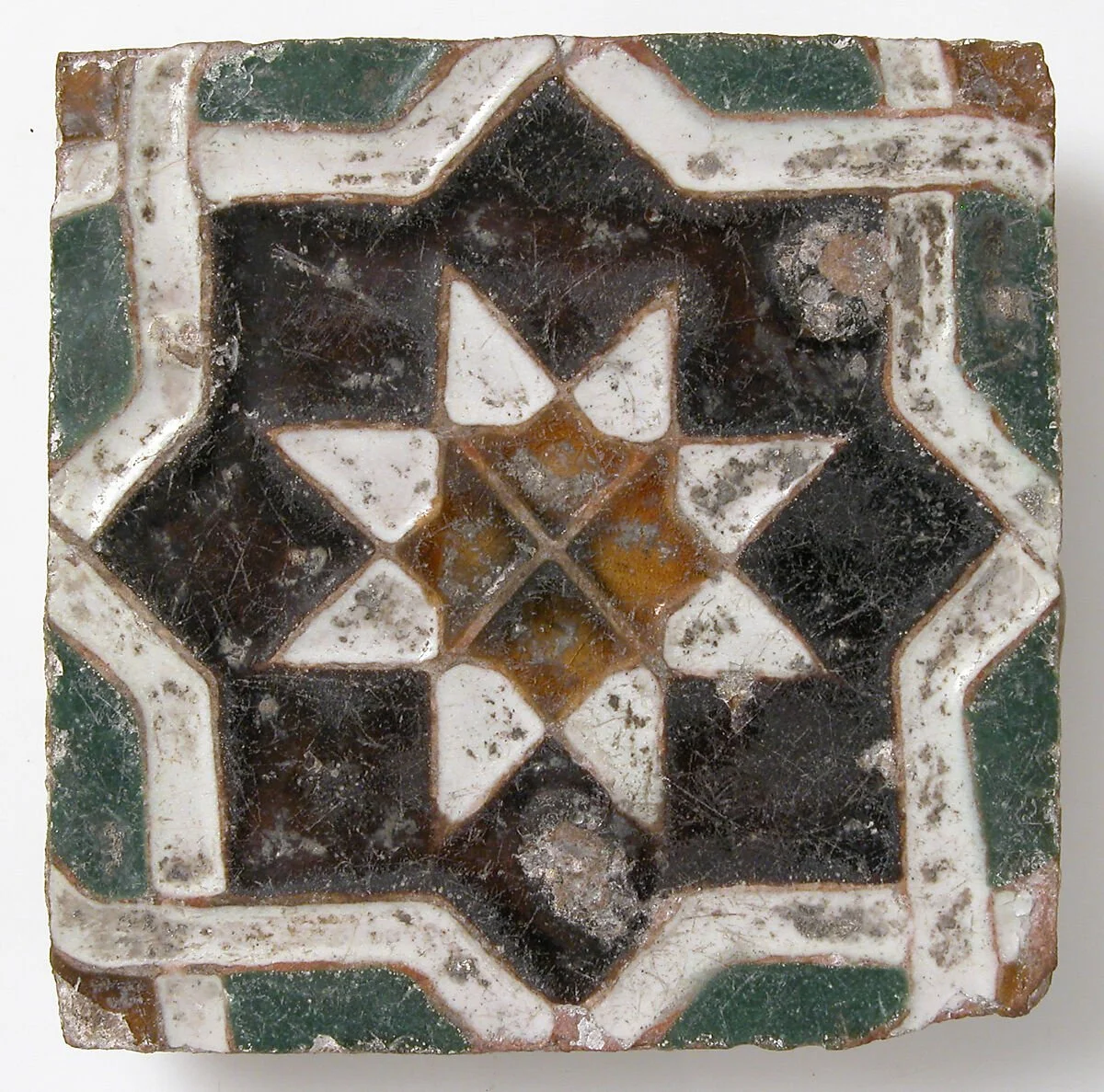
Tile with Geometric Design, Spanish, 16th century; earthenware and glaze. The Metropolitan Museum of Art, Gift of W. L. Hildburgh, 1932, object 32.64.59b. Public Domain. Full source photograph, proportionally displayed.
The official record identifies this as a small ceramic tile, with overall dimensions of 9.2 × 9.2 × 2.1 cm. Those are catalog measurements, not measurements we made from the photograph. Keep the object number with any classroom copy so the source does not become an anonymous “geometric art” image. Open the exact Met record.
Ask students to name visible features: angled boundaries, repeated-looking forms, changes in color and irregularities in the surface. Then ask what they would need to specify before testing a reflection claim. Does “the pattern” mean its outer outline, its interior lines, or its colors as well? Different definitions can produce different answers.
Make the mathematical object explicit
For the worked example, set the photograph aside and define an idealized polygon. Its angular form is inspired by the visual prompt, but it is not a faithful copy. Start at (0, 4), follow the right-hand vertices listed below, and end at (0, −4). Reflect that path across the vertical axis to complete the outline.
Right-hand path: (0, 4), (1, 2), (3, 3), (2, 1), (4, 0), (2, −1), (3, −3), (1, −2), (0, −4). Join consecutive points with straight segments. To return to the start, join (−1, −2), (−3, −3), (−2, −1), (−4, 0), (−2, 1), (−3, 3), (−1, 2), and finally (0, 4).
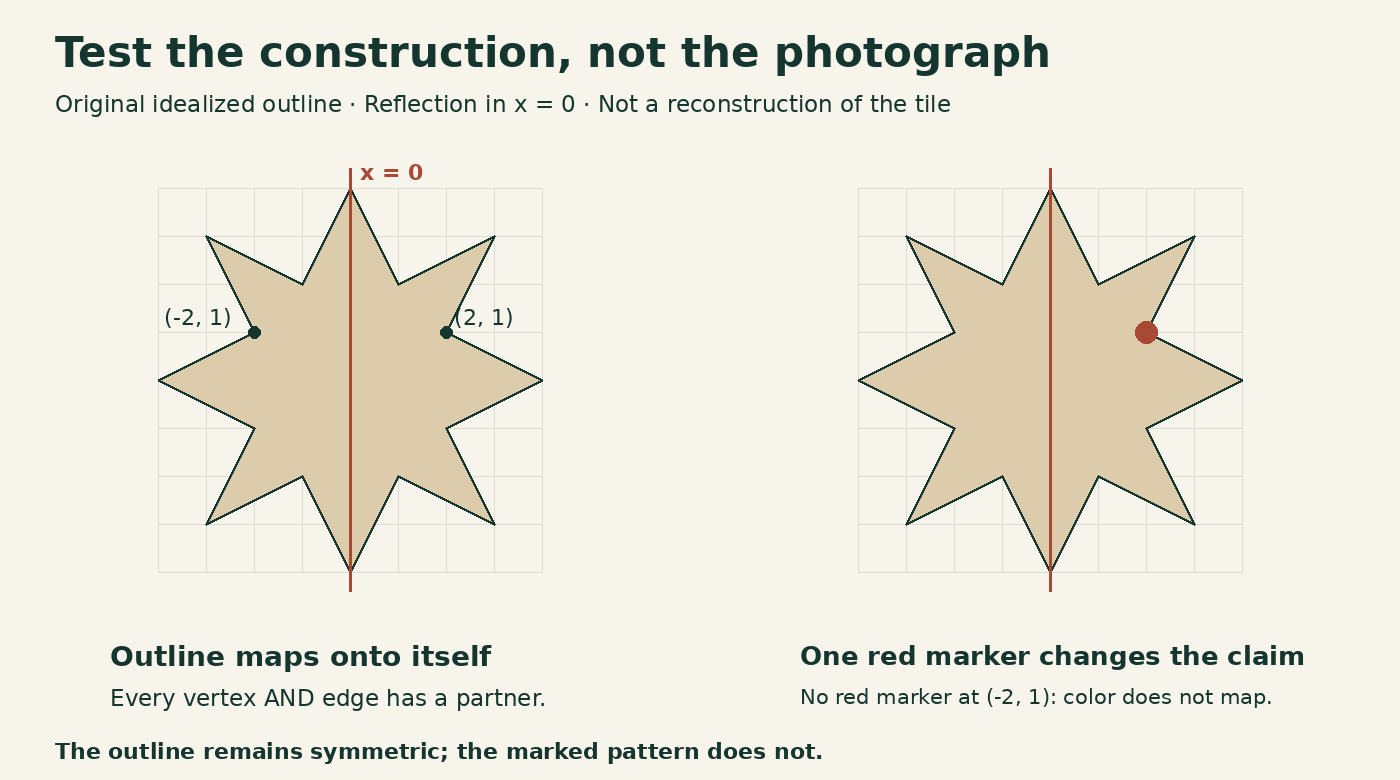
Original construction by The Instruction Edit. Left: a symmetric outline defined by coordinates. Right: the same outline with one red marker at (2, 1). The axis is a testing guide, not part of the pattern being classified.
Our precise conjecture is: “The outline maps onto itself under reflection in x = 0.” The reflection rule sends (x, y) to (−x, y). For example, (2, 1) maps to (−2, 1), and (3, −3) maps to (−3, −3). Points on x = 0 stay fixed. This gives students a rule to use, not just a visual impression.
Turn a check into an argument
Checking one pair of vertices is not enough. The claim concerns the entire outline. In this construction, every right-hand vertex has its reflected left-hand partner, the two axis vertices stay fixed, and each segment joins corresponding partners on the other side. Reflection maps a straight segment to the segment joining the reflected endpoints. Because the complete sequence of edges is preserved, the whole outline maps onto itself.
For learners not yet using coordinates, build the same definition with a grid: place each partner the same perpendicular distance on the opposite side of the vertical axis, then join matching endpoints in the specified order. Folding a paper copy is a useful check of a drawn version. The reason is the pairing rule for the whole construction, not a claim that a roughly drawn fold proves every point is exact.
Now make one small change. Add a red marker at (2, 1), but no matching marker at (−2, 1). If the claim is about the colored pattern, the reflection fails: the red marker would land where there is no red marker. If the claim is only about the polygon’s outline, nothing has changed. A counterexample must address the feature named in the claim.
Compare three hypothetical responses
“It looks the same on both sides” is a conjecture supported by appearance. Ask the learner to name the axis and the features being compared. “These two points match” is a partial check. Ask what happens to the remaining vertices and their connecting edges. “Every defined vertex and segment maps to its partner under (x, y) → (−x, y)” explains why the specified outline has the reflection symmetry.
These are illustrative responses, not classroom observations. Nor does the last response prove anything exact about the museum object. The physical tile, its glaze and its photograph have not been defined by our coordinates. Perspective, surface irregularities and the chosen color rule are all reasons to resist transferring the conclusion back without further evidence.
Use the reasoning mat
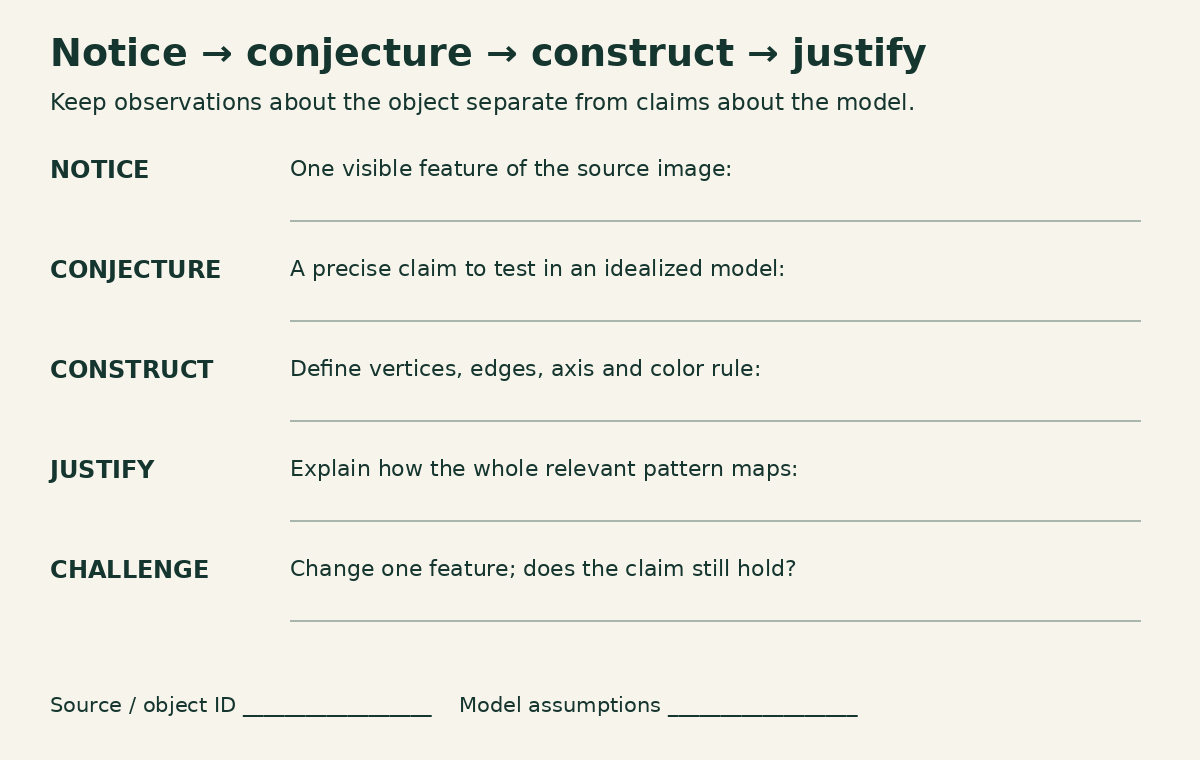
Original reasoning mat by The Instruction Edit. It separates source observation, conjecture, construction, justification and challenge.
Have students record one observation about the actual image, then write one precise claim about a model they will construct. Require the model’s assumptions: which boundaries count, where the axis is, and whether color is part of the pattern. Finish by changing one feature and deciding whether the original claim survives. The counterexample is most useful when students can say exactly what changed and what did not.
The resource’s strengths are a traceable object, a clear reusable image and enough visual complexity to generate questions. Its limit is equally important: a museum photograph is not a specification of exact angles, equal lengths or the maker’s intentions. The lesson’s mathematical justification must come from the defined construction, while its historical context stays anchored to the catalog.
The exact Met record marks this image Public Domain and permits commercial and noncommercial Open Access reuse. Retain the source credit; this original activity is not a Met-authored lesson and implies no museum endorsement.
Choose one conjecture prompted by the tile and justify it on an explicitly defined construction. Then write one sentence explaining why that conclusion does not automatically describe the physical artifact.
Non-affiliate resource evaluation. No classroom trial or learning-outcome claim. Exact source record and image checked October 30, 2026.
