
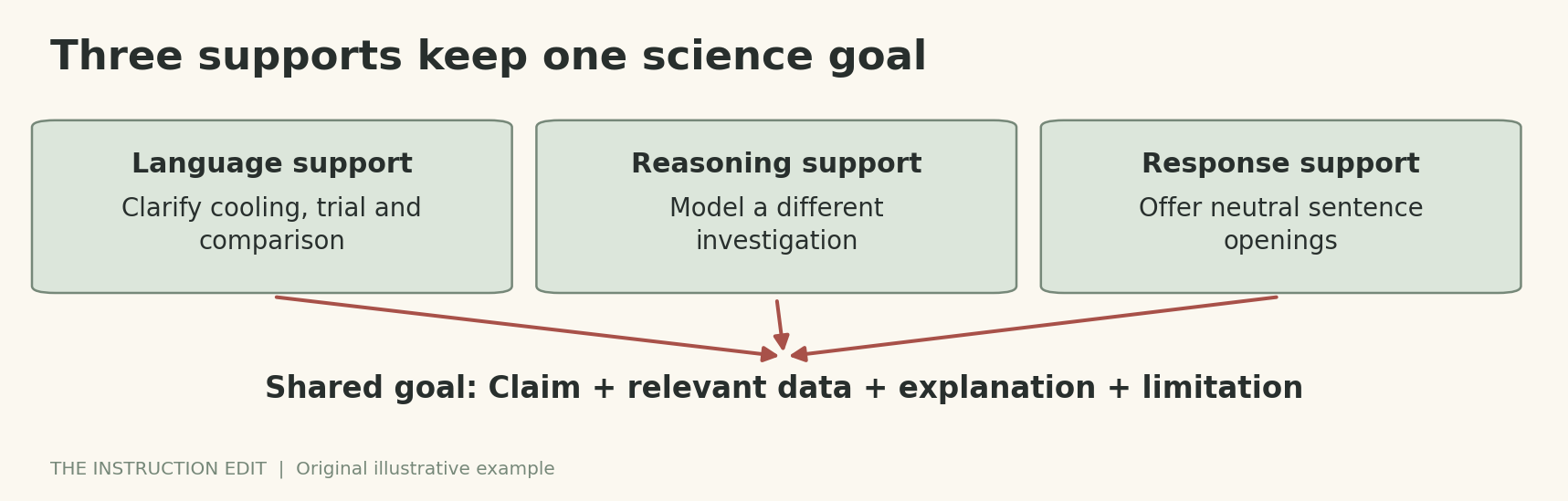
Keep the learning goal constant and vary the support that helps learners reach it. A vocabulary aid, a model of the reasoning, and a response frame can provide different entry points without creating three separate lessons or quietly reducing expectations for one group.
The practical question is what prevents a learner from beginning the intended thinking. If unfamiliar language is the barrier, clarify the language. If the reasoning process is unfamiliar, model a comparable example. If the learner has an idea but cannot organize a response, support the response structure. Those are different problems, even when all three appear as an empty page.
Define what everyone must still do
Here is an illustrative middle-school science task using invented classroom data. Two identical containers hold the same amount of warm water. One has a lid and one does not. Starting temperature, room conditions and measurement intervals are kept the same. After ten minutes, the covered container has cooled by 4 degrees Celsius and the uncovered container by 9 degrees.
The task is to argue whether these results support the claim that a lid reduces cooling in this setup. Every learner must state a claim, select relevant data, and explain how the comparison supports the claim. They should also identify a limitation: one trial does not establish what will happen in every setup.
Those success criteria stay the same across the three routes below. Copying “the lid works” does not meet the goal. A polished paragraph with no comparison does not meet it either. Clear criteria make it possible to change support without mistaking an easier-looking page for an easier intellectual task.
Choose support from evidence rather than labels
The EEF’s guidance on special educational needs in mainstream schools describes scaffolding as support adjusted to learners’ needs and reduced when it is no longer needed. It does not require assigning children permanent learning-style categories. The three-route design here is an original example, not a tested intervention package.
Use a brief opening question to inform the choice: “What difference between these two cooling results would matter to the claim?” Listen for whether the learner can interpret the data, compare conditions and explain a relationship. Offer supports flexibly. A learner who needs a vocabulary prompt today may need no prompt tomorrow, or a different one in another subject.

Prepare three routes to the same response
Illustrative scaffold comparison. The data and responses are fictional. All routes use the same cooling investigation and success criteria.
Entry point: Language access
Support supplied: Brief definitions of cooling, trial and comparison; labels beside the data
Thinking the learner still does: Chooses the relevant difference and explains what it suggests
Check before reducing support: Explains the comparison using the terms or accurate everyday language
Entry point: Reasoning model
Support supplied: Teacher thinks aloud through a different investigation with two conditions
Thinking the learner still does: Transfers the comparison process to the lid investigation
Check before reducing support: Identifies the useful comparison without teacher prompting
Entry point: Response organization
Support supplied: “The results support/do not support… The evidence is… This matters because…”
Thinking the learner still does: Supplies the claim, data, connection and limitation
Check before reducing support: Gives the same explanation with fewer sentence openings
None of these routes needs a separate worksheet. Put a shared data display on the board and keep optional vocabulary and response supports nearby. Model one contrasting investigation aloud. Learners can use more than one support, and you can add a prompt during the task without announcing that someone has changed groups.
Model the reasoning without solving the actual task
For the modeled route, use a different illustrative example: equal-sized samples of two different paper-towel types absorb 12 and 18 milliliters under the same test conditions. Think aloud about comparing the measured amount, checking that the procedure was the same, and avoiding a claim that one observation proves universal superiority. Do not model the lid response word for word and then treat its reproduction as independent reasoning.
For the vocabulary route, pair terms with their use in the task. “Cooling means a decrease in temperature” is more helpful than a long glossary copied from a textbook. Check that the numerical display itself is readable and that learners understand it shows change in temperature, not final temperature. Otherwise, a language scaffold may leave the actual access barrier untouched.
For the response route, avoid completing the important connection. A frame that says “The covered container cooled less, so the lid…” already supplies much of the reasoning. Keep openings neutral enough that learners must decide what the data support. Invite a spoken explanation or an annotated diagram when the goal is scientific reasoning rather than extended writing, while preserving required accommodations and the intended assessment construct.
Reduce help at the point of competence
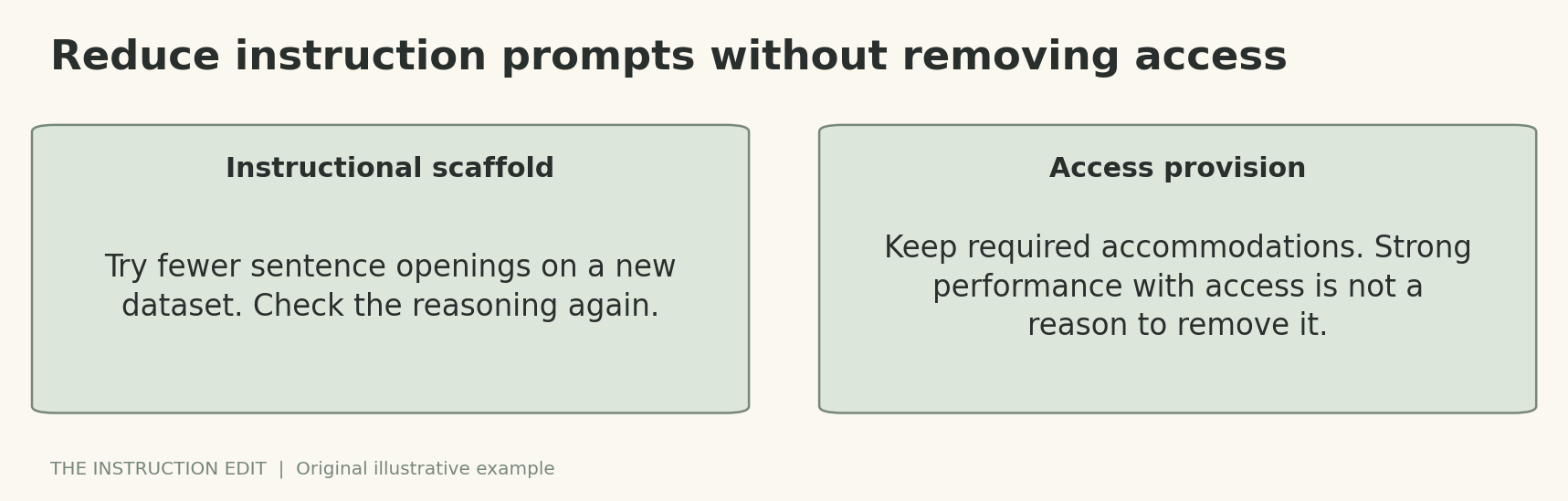
A sensible next step is to remove one prompt, not all support at once. After a learner explains the covered-versus-uncovered comparison accurately, offer a new dataset with only the question and success criteria. If the learner stalls, find out whether the missing support was helping with the reasoning, the terminology or the response format.
Do not remove accessibility accommodations simply because the learner performs well with them. An instructional scaffold intended to teach a process differs from an access provision that lets a learner participate. Follow relevant plans and consult the appropriate school staff when that distinction is uncertain.
Watch also for unnecessary help. A learner who can already interpret the evidence may need a more demanding question: “What additional trial would make the conclusion more convincing?” Giving that learner a detailed frame can turn a reasoning task into sentence filling.
Evaluate the work against the shared goal
Use the same four checks for every response: a defensible claim, relevant data, an explicit connection and a sensible limitation. Record which support was available so you do not confuse supported performance with independence. If an answer meets the criteria only after a teacher supplies the comparison, note that distinction without dismissing the progress.
There is no promise that three routes will cover every learner or every lesson. Background knowledge, task complexity and language demands may require a different adjustment. The value of this approach is its discipline: change the help for a reason, then check what learners can do.
For tomorrow, choose one existing task and write the common success criteria first. Prepare one optional support for the barrier you actually expect. Keep the other two routes as possibilities, not a new production quota.
Sources
EEF’s guidance on special educational needs in mainstream schools
