
Accessibility belongs in the first design conversation, alongside the learning goal and the task. Waiting until a resource is finished makes it easier to mistake a preventable barrier for a learner's problem. It also turns predictable revisions into urgent work.
The practical aim is to offer workable ways to access information, navigate the task and show the intended learning from the beginning. That does not remove the need for individualized accommodations. A thoughtfully designed resource can still fail a particular learner, and the response must be to address that need rather than declare the resource universally accessible.
Use UDL to inspect barriers
CAST's Universal Design for Learning Guidelines 3.0, released in July 2024, organize design considerations around engagement, representation, and action and expression. They direct attention to barriers, access to tools and varied ways of participating. Treat this as a framework for design decisions, not proof that adding more formats will improve every outcome. Explore CAST's guidelines.
For a teacher or designer, the useful question is concrete: what could stop someone from doing the intellectual work this resource is meant to support? That question is more actionable than an instruction to “make it inclusive” at the end of a production schedule.
A resource can be technically available and practically difficult to use. A PDF may open but contain a scanned image of text. An audio explanation may play but offer no usable way to review a crucial term. A submission form may accept a response only after several unexplained navigation steps. Each problem belongs in the design discussion, not solely in a later help request.
Separate the goal from the route
Consider an illustrative middle-school science task: explain how evidence supports a claim about which surface absorbs more heat. The learning goal concerns the relationship between a claim, observations and reasoning. It does not necessarily require decoding a decorative infographic, operating a small touchscreen or making a polished video.
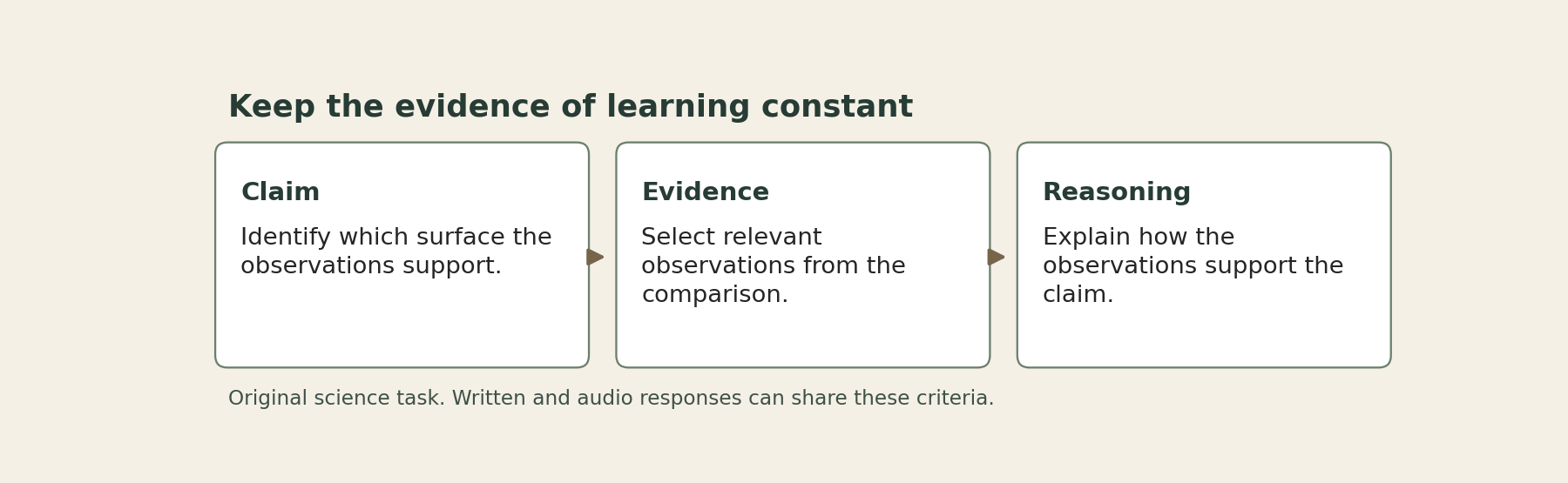
Begin by specifying the evidence you need. A learner should identify the comparison, select relevant observations and explain how those observations support the claim. That evidence can guide decisions about formats and support.
If the goal instead includes reading a particular kind of graph, graph interpretation cannot simply disappear from the task. You might improve labels, provide access through assistive technology or teach how the graph is organized, while retaining the interpretation demand. The goal helps distinguish a barrier you can remove from a skill you need to teach or assess.
This distinction also prevents the familiar design problem of offering several choices that are not actually equivalent. A labeled picture, an unsupported opinion and a reasoned explanation do not demonstrate the same thing merely because all three count as submissions.
Inspect the task before learners meet it
The following comparison is an original planning example. The possible barriers are prompts for inspection, not assumptions about particular students.
Task feature: Temperature graph
Possible barrier: Color is the only way to identify surfaces
Design response to inspect: Add direct labels and distinct line styles; check reading order
Task feature: Written directions
Possible barrier: Key action is buried in a long paragraph
Design response to inspect: Separate the action, evidence requirement and submission step
Task feature: Scientific vocabulary
Possible barrier: An unfamiliar term blocks interpretation
Design response to inspect: Explain the term near its first use without supplying the conclusion
Task feature: Response requirement
Possible barrier: Video production distracts from reasoning
Design response to inspect: Allow a written or recorded explanation using the same evidence criteria
Task feature: Digital navigation
Possible barrier: The next action is hard to find or operate
Design response to inspect: Use clear controls and test the route with relevant access methods
The table does not certify accessibility. It identifies checks that a designer can perform while changes are still cheap. A learner's feedback, assistive-technology testing and specialist input may reveal issues that a document review misses.
Build a small number of usable routes
Choice has a maintenance cost. If a teacher creates five response formats, each with different directions, rubrics and submission steps, the design may become harder to use. Start with the routes that address a clear barrier and that you can support reliably.
For the science task, a written explanation and an audio explanation might share the same three requirements: state a claim, name the relevant observations and explain the connection. Provide the same example of sound reasoning in an accessible form. Make clear that production polish is not part of the judgment unless communication production is itself a learning goal.
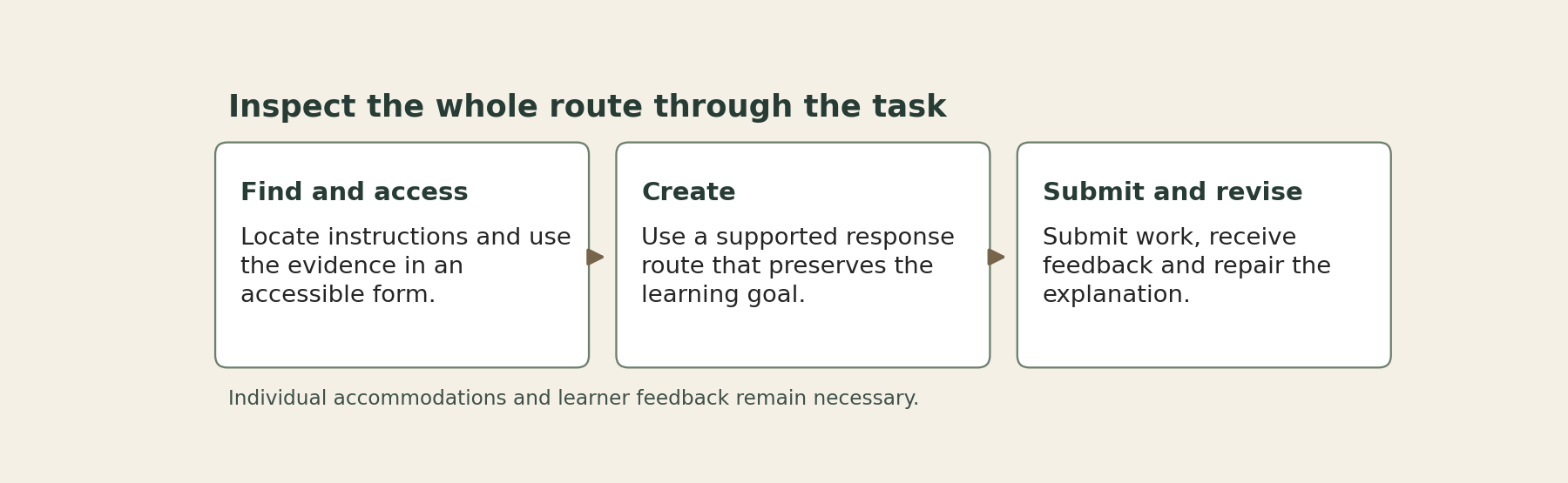
Think through the full route, not just the content file. Can a learner find the instructions, access the evidence, create the response and submit it? If the audio option requires unfamiliar software and a complicated upload, it may introduce the very barrier it was meant to remove.
Check that supports do not accidentally answer the task. A vocabulary explanation can clarify “absorb” without telling the learner which surface performed differently. A response organizer can name the parts of an explanation without preselecting the evidence. Good support makes the intended thinking possible; it does not have to complete that thinking for the learner.
Preserve individual accommodations and conversation
A universal design approach is not a reason to withdraw an accommodation or tell a learner that the available choices should be enough. Continue the applicable individual processes and consult the appropriate people when needs exceed what the shared design provides. This article concerns educational design, not a determination of anyone's legal entitlements or clinical needs.
Avoid requiring a public explanation of why someone uses a particular route. If the options serve the same goal, learners should not have to disclose personal information to justify an ordinary design choice. Where a specific arrangement must be handled individually, use the established confidential process.
After use, ask a focused question rather than a broad satisfaction question. “Where did you lose track of what to do next?” can reveal a navigation issue. “Which information could you not access?” can reveal a format problem. Treat these answers as evidence about the resource, not a test of the learner's willingness.
Make one design change before adding another resource
Choose a resource you already intend to use. Write its learning goal in one sentence. Walk through access, language, navigation and response, then identify one barrier you can remove without weakening the goal.
Test the revised route, including submission. Keep a record of any unresolved issue and who will address it. After learners use the resource, compare the evidence you receive with the evidence you intended to collect.
Accessibility improves when it becomes a continuing design responsibility with a clear place in the workflow. The result should be fewer preventable obstacles and better information about the support still needed, not a claim that one design has finished the work for everyone.
Sources
CAST (2024), Universal Design for Learning Guidelines 3.0. Framework released July 30, 2024; source for barrier-focused design considerations.
