
Fishbowl discussion at the European Youth Congress, 2013. Photo: Stephan Röhl / Heinrich-Böll-Stiftung, CC BY-SA 2.0, via Wikimedia Commons. Full frame, display-scaled only. Actual conference context, not the fictional classroom or evidence of observer learning.
The outer circle needs a task
A fishbowl has an obvious job for the students in the middle: discuss the question. The job of the students outside the circle is easier to leave vague. “Watch carefully” can produce a page of speaker names, a tally of raised hands or a verdict that someone sounded confident. None of those necessarily shows how the argument developed.
Give observers one lens and a small piece of evidence to bring back. Their task is to notice a claim, the evidence used to support it, or a connection between contributions. A useful observation records what happened in the discussion and why it matters for the reasoning. It is not a judgment of a classmate’s personality.
The University of Washington’s fishbowl guidance recommends preparation for the inner group, guiding questions for the observers and a whole-class debrief. The lens card, rotation and fictional example below are original teaching materials built around that structure. They are not a validated scoring instrument, and assigning an observer role does not by itself demonstrate learning.
Start with a small shared evidence packet
Here is a fictional classroom case for a discussion about justified claims. A school wants to report on a bottle-litter campaign. The prompt is: “What can the school responsibly say the supplied records show, and what remains uncertain?” All figures and circumstances below are invented for practice.
D1: A caretaker counted 120 discarded bottles across five school days before a poster campaign, then 75 across five school days afterward. The same outdoor area was counted using the same end-of-day routine.
D2: An extra recycling bin was added to that area during the second five-day period. Two days in that period were rainy, and fewer pupils ate outside. The packet gives no exact outdoor-attendance counts.
D3: No comparison area was monitored, and the packet contains only these two five-day periods. It does not show whether the change continued. The records support a decrease in bottles counted; they do not isolate which change caused it.
Give everyone the packet and prompt in advance where possible. At the start, allow three minutes to reread, underline a useful detail and draft one cautious claim. Keep the packet visible during the discussion. Observers should not have to infer the source from memory while trying to listen.
Three lenses, not a checklist of everything
Claim lens: notice one statement that answers the question. Record whether it describes a pattern, proposes a cause or adds a limit. Ask what the wording commits the group to. “There were fewer bottles” and “the posters caused fewer bottles” are different claims.
Evidence lens: notice one use of D1, D2 or D3. Record the detail and the claim it is being used to support or challenge. If the link is missing, identify the question needed to make it explicit. Do not reward a source label alone.
Connection lens: notice one contribution that responds to an earlier contribution. Record both turns and the relationship: extends, challenges, qualifies or answers. Two comments on the same subject are not automatically a connection; the second must do something with the first.
Give each observer only one lens for a round. Ask for one well-supported record rather than a transcript of every speaker. Provide selectable text and a large-print or digital version of the card when needed; the diagram is a model, not the only usable format.
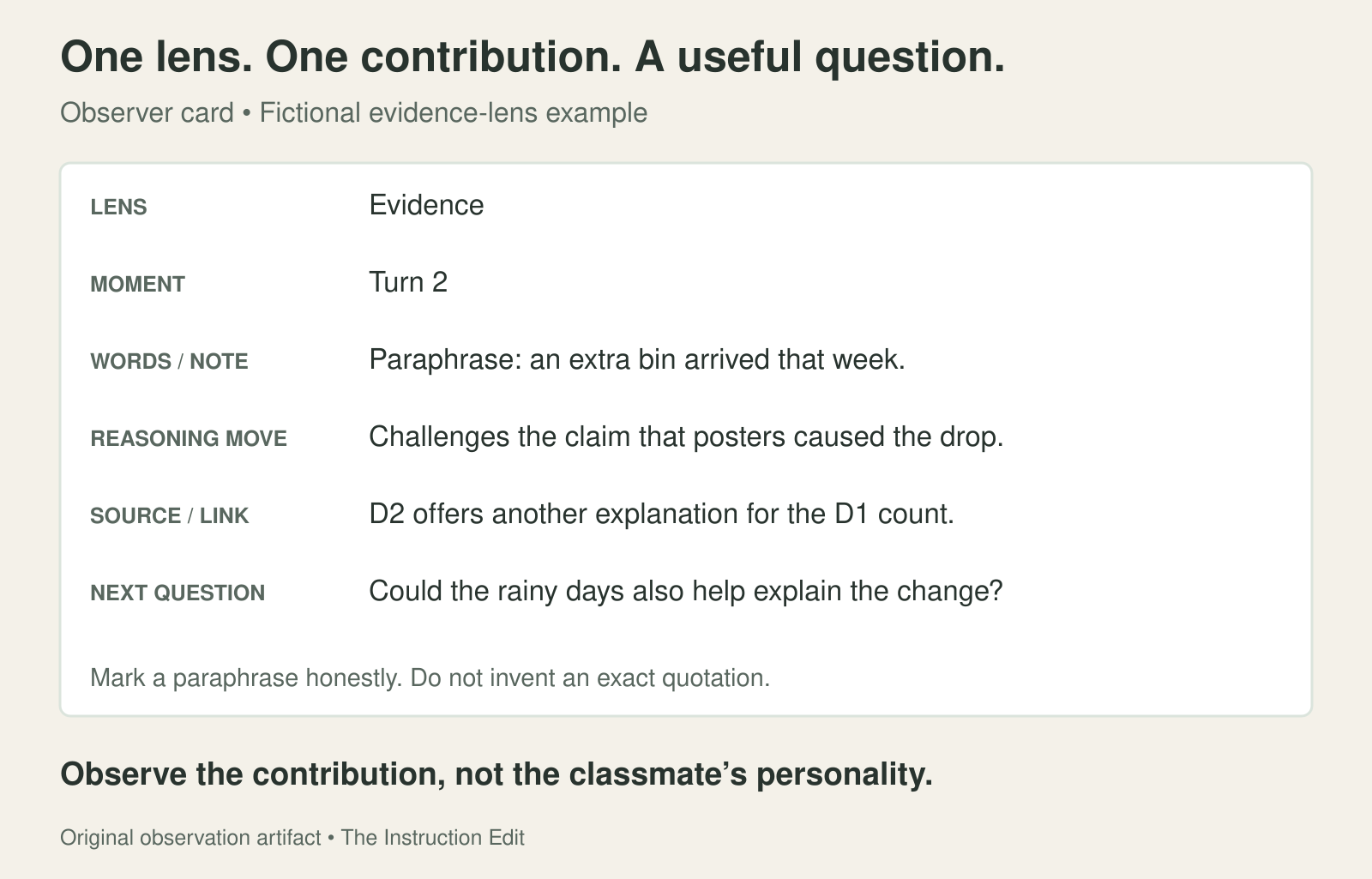
Figure 1. A single observer lens produces a checkable record and a useful next question. Original fictional example by The Instruction Edit.
The observer card, in reusable text
Lens: claim / evidence / connection. Turn or moment: ____. Exact words, or a clearly marked close paraphrase: ____. Reasoning move: ____. Source or earlier turn it uses: ____. Question this leaves for the group: ____.
Explain the difference between a quotation and a note. If an observer did not catch the exact wording, write “paraphrase” rather than inventing quotation marks. Use turn numbers or neutral references when sharing records; the debrief is about the contribution, not publicly ranking its speaker. A learner may leave a field marked “not yet clear” and ask the group to reconstruct it.
Rotate the lens as well as the seat
For a worked 24-student example, make four groups of six: A, B, C and D. Six students discuss while the other 18 observe in three lens groups. Each round contains four minutes of discussion followed by two minutes to hear one concise record from each observer group and name a remaining question. The next inner group starts from that question rather than repeating every previous comment.
Round 1: A discusses; B observes claims; C observes evidence; D observes connections. Round 2: B discusses; C observes claims; D observes evidence; A observes connections. Round 3: C discusses; D observes claims; A observes evidence; B observes connections. Round 4: D discusses; A observes claims; B observes evidence; C observes connections.
Across the four rounds, each group discusses once and uses each observer lens once. The timing is 3 minutes of preparation + 4 × 6-minute rounds + 4 minutes of final synthesis = 31 minutes. These are illustrative timings, not a claim about an optimal lesson length. For a smaller class, reduce the number of groups while preserving an explicit turn in both roles.
Seats need not move if movement creates an access barrier. Change the designated discussion group and lens labels instead. Agree an equivalent way to contribute where speaking in the centre is not accessible. The aim is participation in the reasoning, not compliance with a particular furniture arrangement. Because later groups inherit earlier work, do not treat rounds as interchangeable speaking tests.
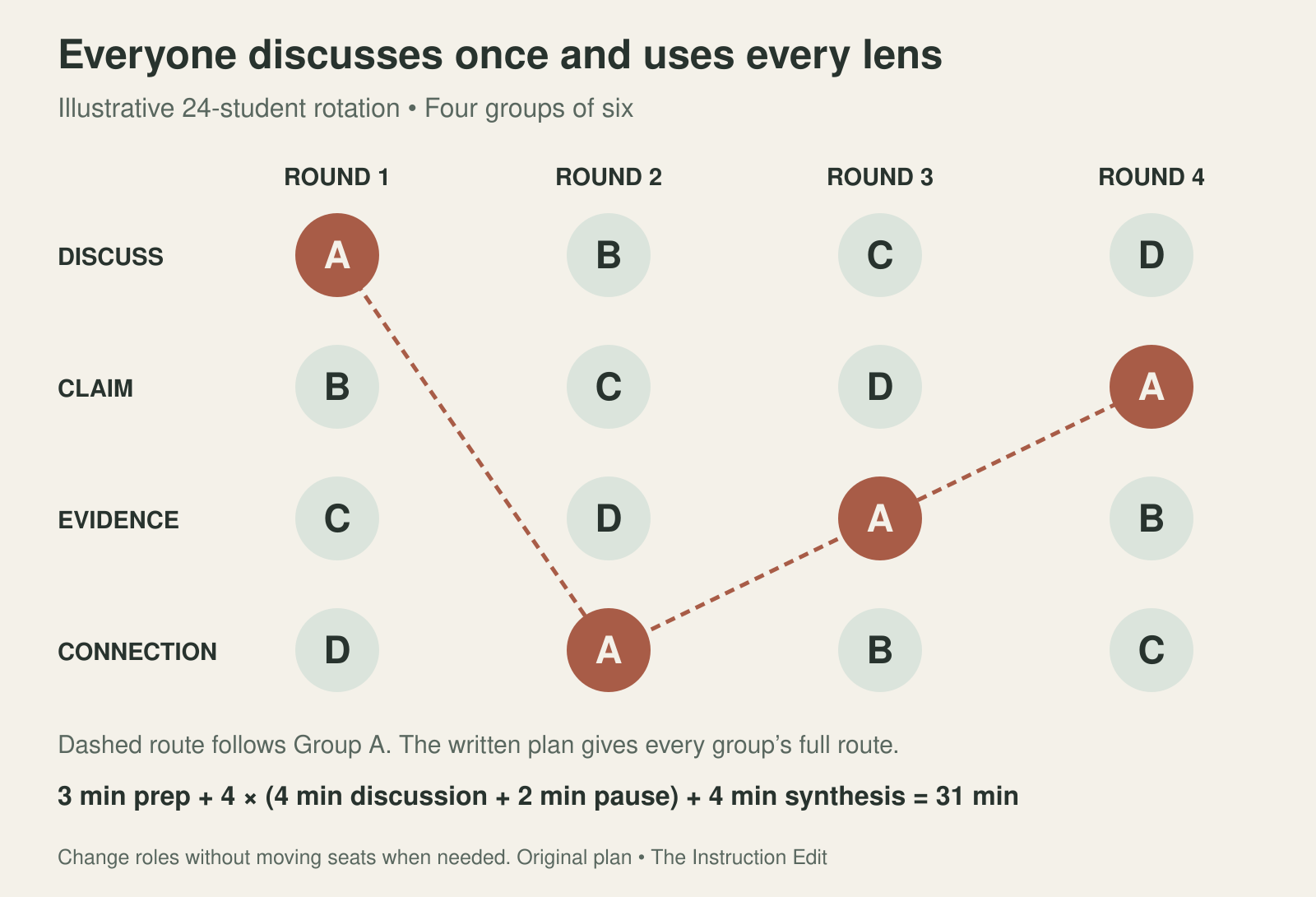
Figure 2. Rotate the reasoning lens as well as the discussion role. Original illustrative plan for 24 students by The Instruction Edit.
What a useful observation looks like
Consider this invented three-turn excerpt. Turn 1: “The count fell from 120 to 75, so the posters caused the drop.” Turn 2: “D2 says an extra bin arrived that week. The count alone cannot separate that change from the posters.” Turn 3: “Then our report should say fewer bottles were counted after the campaign, not that the posters were proven to work.”
A weak record says, “The second speaker was confident and the third speaker agreed.” It substitutes impressions for evidence and misses the change in the claim. A claim-lens record could say: “Turn 3 changes the conclusion from a causal claim to a descriptive one. It keeps the lower count but removes certainty about the posters.”
An evidence-lens record could say: “Turn 2 uses the additional bin in D2 to challenge the causal interpretation of D1. Follow-up: do the rainy days create another possible explanation?” A connection-lens record could say: “Turn 3 answers Turn 2’s objection by narrowing the wording rather than abandoning the observed decrease.”
These notes identify different features of the same exchange. They need not all be written by one observer. During the debrief, combine them into a short reconstruction: the group made a causal claim, encountered an alternative explanation, then qualified the conclusion. That account is more useful than a list of who spoke.
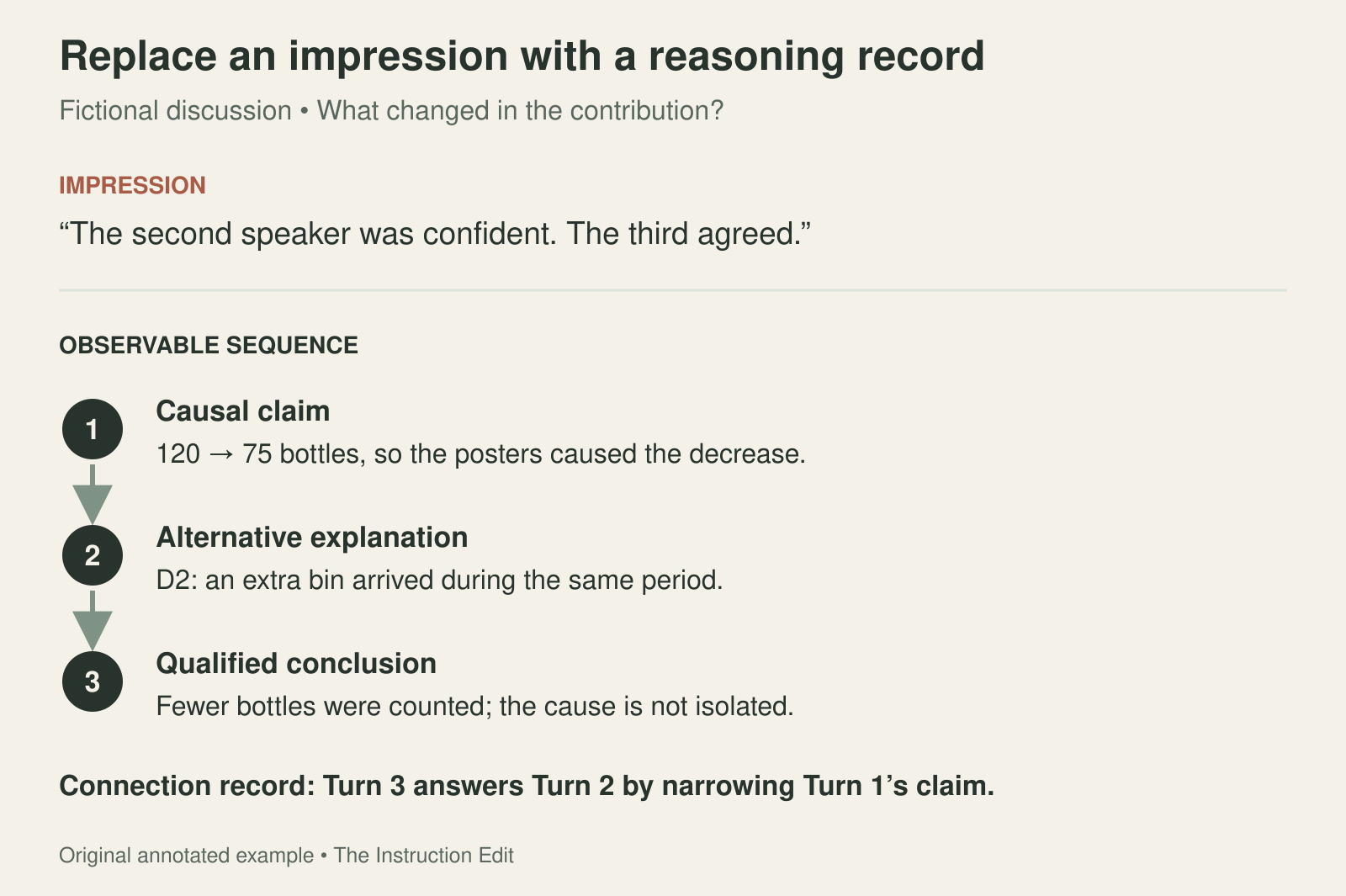
Figure 3. Replace a personality impression with an account of how the reasoning changed. Original fictional observation example by The Instruction Edit.
Debrief the evidence, then let it change the next round
Ask each observer group to offer one record and one open question, within the two-minute pause. If a record judges a person—“dominating,” “shy,” “smart”—ask for the observable contribution relevant to today’s lens. Do not infer motives or diagnose a learner from their discussion style. If a separate participation or safety issue needs attention, address it directly rather than hiding it inside an argument-analysis score.
When observers disagree, return to the words or source. For example: “Did Turn 3 reject the lower count, or reject the causal explanation?” The inner group can clarify what it meant, but the note should still distinguish the spoken contribution from the intention supplied afterward. If nobody noticed a connection, do not require them to invent one; ask the next group to make a response link explicit.
Use the final four minutes for an individual synthesis: write the report’s best-supported sentence and name one observation that changed or clarified it. A possible answer is: “Fewer bottles were counted in the monitored area after the campaign, but the extra bin, changed outdoor use and short observation period mean the records do not isolate the posters’ effect.” This is a model response to fictional evidence, not an environmental finding.
For your next fishbowl, choose one lens before you rearrange the room. Prepare a short sample record, announce the role rotation and reserve time to use what observers noticed. The outer circle has done its job when its evidence helps the discussion become more precise—not when every box on a form is full.
Source
University of Washington — Discussions, “Fishbowl discussion”. Official instructional guidance, accessed October 30, 2026. Supports preparation, guided observation and debriefing. The fictional packet, lenses, 31-minute rotation, sample records and diagrams are original examples, not reported classroom results.

