
PVC Brainstorming Workshop, 2013. Photo: BLM Nevada, CC BY-SA 2.0, via Wikimedia Commons. Full frame, display-scaled only. Actual workshop context; not the fictional team or evidence of this ranking method.
A wall of ideas is not yet a decision
The brainstorm has produced plenty of possibilities. Then somebody asks which one the group should choose. Without a stated method, the next ten minutes can become a second brainstorm, a debate led by the quickest speaker or a vote whose meaning nobody agreed beforehand.
Separate four jobs: generate options, share them, clarify them, then rank and record. The distinction matters because a group can understand an option without supporting it, and can rank an option highest while still seeing a serious limitation. Keep those judgments visible instead of treating the final number as proof that the winning idea is correct.
Health Canada’s 2000 public-involvement toolkit describes a nominal group process with silent idea generation, round-robin sharing, clarification, point-based prioritization, reassessment and a final tally. The four-stage run sheet below groups those functions into an original low-stakes training exercise. It is not a verbatim reproduction of the six-step method, current policy advice or evidence that ranking produces better decisions in every setting.
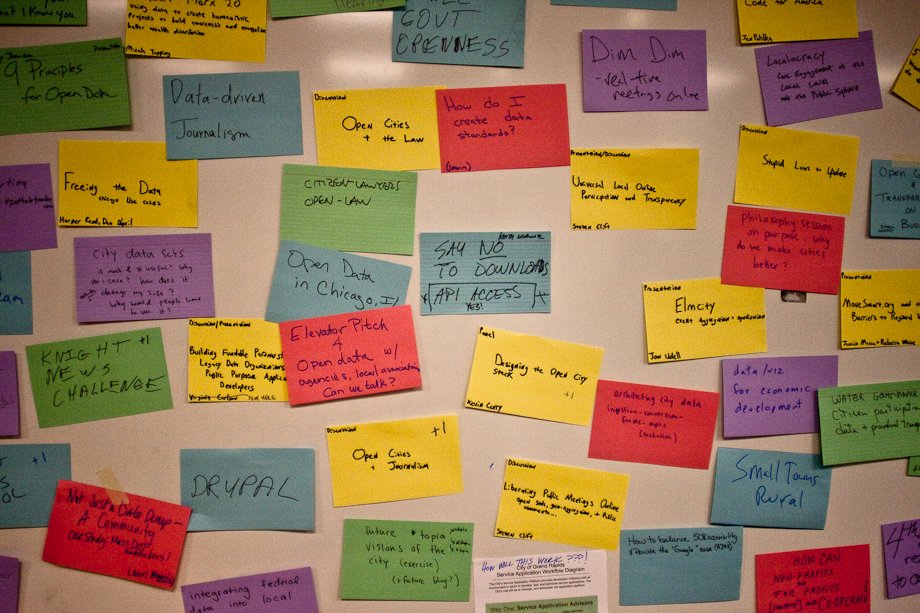
CityCamp idea board, 2010. Photo: Tony Webster, CC BY-SA 3.0, via Wikimedia Commons. Full frame, display-scaled only. The photograph documents displayed ideas, not the fictional options or a completed ranking process.
Use the photograph to separate collection from selection
The CityCamp photograph shows ideas made visible on a shared surface. It does not show the question that generated them, how they were clarified, whether anyone ranked them privately or what was eventually selected. Use that distinction in your workshop: displaying contributions is useful, but a board alone is not a decision record. The photographed event is not the fictional exercise below.
The fictional decision and its boundaries
Eight colleagues are choosing the format of one 30-minute team knowledge-sharing session. Ask: “How should we use the session so colleagues can apply one useful practice the following week?” The session must fit the existing meeting slot, use no paid external resource and require no preparation outside the meeting. The group is practicing a decision process, not committing a real team to a new arrangement.
Before generating ideas, agree what “useful” means for this exercise: participants should encounter a practical example, have a way to contribute and leave with one action they could try. These are shared comparison criteria, not weighted scores. State the decision authority too: the group will recommend a format; a designated session facilitator would check feasibility before any actual booking.
The sample options below are worked examples to use after participants have generated their own ideas, or in a demonstration of the method. Do not present them as the only possible answers before the silent stage.
A — Two short demonstrations: two eight-minute demonstrations followed by fourteen minutes of questions and application planning. B — Paired case clinic: pairs examine a supplied workplace case, compare approaches and share an action. C — Case-card gallery: participants write short case cards during the meeting, inspect one another’s cards and discuss possible applications. D — Round-robin tips: each person offers a short practice tip, followed by discussion and action selection.
Clarify the timing for B, C and D before ranking, rather than assuming the labels guarantee a 30-minute session. For this fictional example, B is 5 minutes to read, 15 in pairs and 10 to compare; C is 10 minutes to write, 10 to review and 10 to discuss; D is 16 minutes for eight two-minute tips and 14 for discussion. No option receives extra preparation time that the others do not have.
A 45-minute facilitation run sheet
This is the time for the options-ranking exercise, not the 30-minute knowledge-sharing session it is designing. The timings are an illustrative plan for eight participants, not a tested optimum.
Stage 1 — Frame and generate: 10 minutes
Use five minutes to state the question, constraints, criteria and decision authority. Then give five quiet minutes for individuals to write options, one per note. Accept an accessible digital or dictated equivalent where needed. Do not fill the silence by announcing your favorite solution. Ask for a format and what participants would actually do, rather than a vague label such as “make it interactive.”
Stage 2 — Share: 8 minutes
Go around the group, taking one idea per person per pass; allow a pass and return if necessary. Record the wording where everyone can access it. Do not count repeated suggestions as votes. If two ideas appear similar, ask their contributors whether they can be combined without losing an important difference. Preserve a distinct option when agreement to merge is absent.
Stage 3 — Clarify: 8 minutes
Ask questions that make the options comparable: what happens, who contributes, what is produced and how it fits the limits. Hold advocacy until everyone understands the options. If a proposal cannot meet a non-negotiable constraint, identify the specific problem and invite a feasible revision before the ballot. Do not remove an idea simply because it seems unpopular.
Stage 4 — Rank, reassess and record: 19 minutes
Allow four minutes for a first private ballot and tally, six to examine the reasons and unresolved concerns, three for a second private ballot, and six to tally and write the recommendation. In the demonstration below there are four clarified options. If your group produces many more, adapt the timing and publish a shortlisting rule before using it; do not silently discard options to make this schedule fit.
The private ballot and a worked tally
For this example, each participant ranks three different options: first choice receives 3 points, second 2 and third 1; the remaining option receives 0. No tied ranks. Each valid ballot allocates 6 points, so eight valid ballots must total 48. Explain that convention before voting. It is one transparent ranking rule, not a uniquely correct way to express preferences.
Use a ballot with these fields: first choice ID [write here] / 3 points; second choice ID [write here] / 2 points; third choice ID [write here] / 1 point; concern to preserve [write here]. Collect it privately without displaying individual choices. Do not promise anonymity merely because names are omitted: handwriting or a distinctive concern may identify someone in a small group. Share the aggregate and summarize concerns without attribution.
The fictional first tally is A = 11, B = 15, C = 14 and D = 8. During reassessment, one participant changes from B–A–C to C–B–A; the other seven keep their rankings. The final tally becomes A = 10, B = 14, C = 16 and D = 8. Both rounds total 48. This synthetic change illustrates the calculation; it is not a reported workshop result.
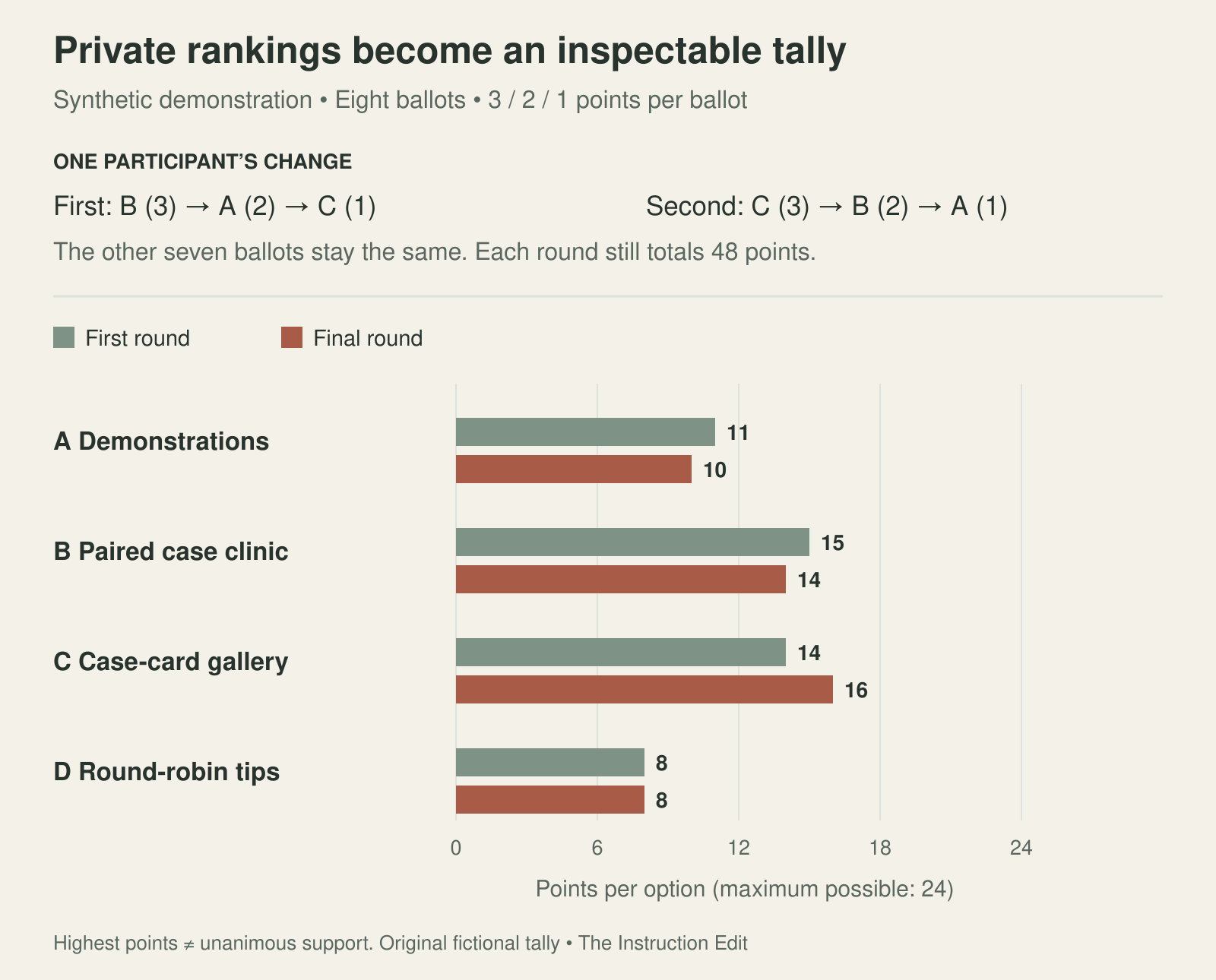
Figure 2. Keep the scoring rule and both tallies visible. Original synthetic ballot example and chart by The Instruction Edit; not observed workshop results.
C now has the highest point total, but 16 points is not 16 people and not evidence of unanimous support. The totals reflect ranked preferences under this scoring rule. Inspect the concerns before turning the result into a recommendation. If there is a tie, use the tie-handling rule announced beforehand—for example, clarify the tied options and re-rank them privately. Do not invent a deciding rule after seeing which option it favors.
Write the decision and the reservations together
Here is a completed fictional record. Recommendation: try C, the case-card gallery, subject to a feasibility check. Basis: C has the highest final total, 16 points; the group sees a way for everyone to contribute within the meeting. Unresolved concern: short cards may become superficial tips rather than useful cases. Access concern: a fast, crowded gallery may be difficult to read or navigate.
Before implementation: the session facilitator would prepare one model card asking for a situation, action and reason; provide readable digital or printed cards; and offer a seated review route. Decision-changing condition: if those arrangements cannot fit the 30-minute session, revisit the format rather than claiming the ballot settled feasibility. Preserve B as the next-ranked option, but do not automatically substitute it without checking the same constraints.
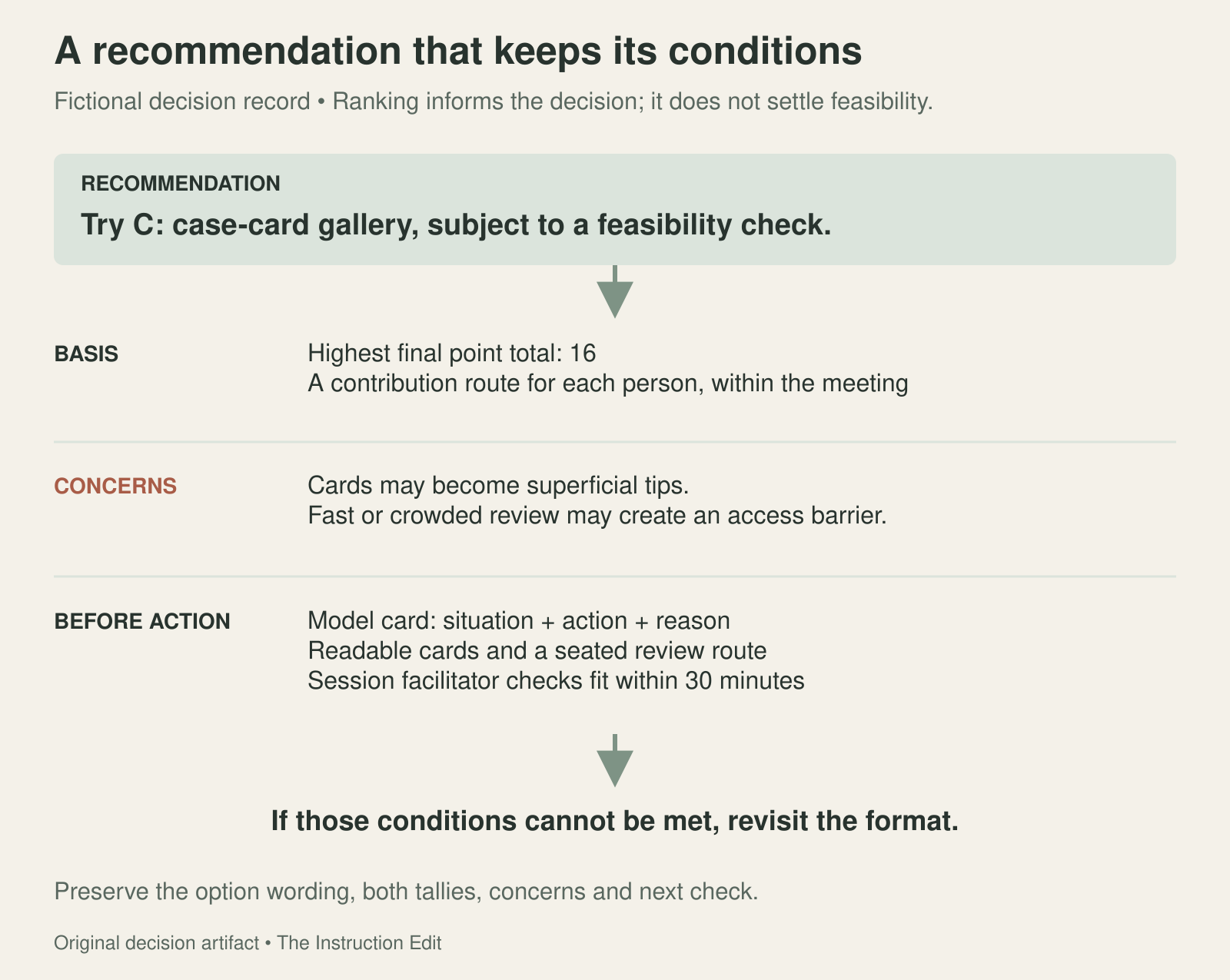
Figure 3. The decision record preserves a recommendation, its basis and unresolved conditions. Original fictional example by The Instruction Edit.
Keep both tallies, the clarified option wording, the concerns and the next check in the record. A point total should not erase a minority objection that reveals an access barrier or an untested assumption. Equally, a concern is not automatically a veto: explain whether it changes the plan, requires a check or remains an accepted limitation within the group’s authority.
Try the process on one low-stakes training choice. Tell participants how the recommendation will be used, and return with the eventual decision and reason if someone outside the room decides. The useful outcome is a recommendation people can inspect: what was compared, how the ranking worked, which concerns survived and what must happen before action.
Source
Health Canada — The Health Canada Policy Toolkit for Public Involvement in Decision Making, “Nominal Group Process”. Published 2000; accessed October 30, 2026. Historical official method documentation. The four-stage run sheet, eight-person training case, ballot arithmetic and decision record here are original illustrative adaptations, not empirical findings or current government policy requirements.


