
A misconception map helps you decide what to change before you replace an activity. Write down the reasoning you want to see, the wrong answers you might encounter, and one question that could distinguish their causes. Then revise the smallest part of the lesson that would make the reasoning visible.
This is useful when a lesson feels unsuccessful but the evidence is vague. “They did not understand fractions” is too broad to guide tomorrow’s teaching. “Several answers treated the denominator as a whole-number size” points toward a more specific check. The map is a planning aid, not a diagnosis of a child or a permanent label.
Start with the decision learners must make
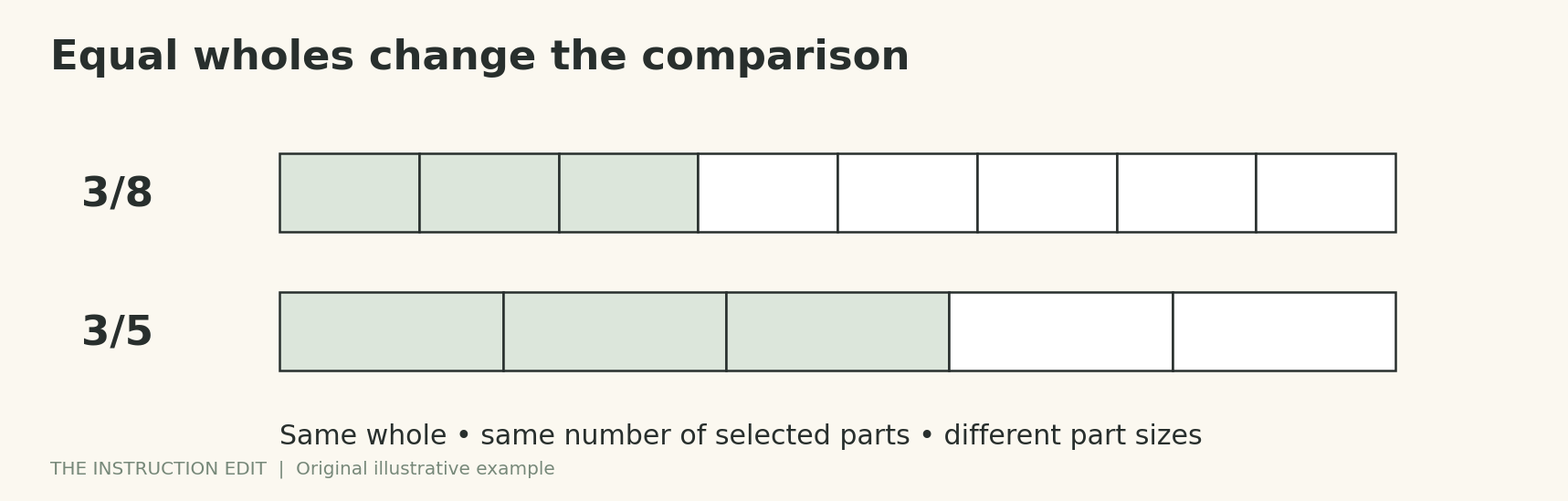
Consider an illustrative middle-school task: compare 3/8 and 3/5 and explain which is greater. The intended reasoning is that, when the whole is the same, fifths are larger than eighths. Taking three of each therefore gives a larger amount with fifths. A correct comparison alone does not show whether a learner used that reasoning, converted accurately, remembered a rule, or guessed.
Before planning a replacement worksheet, write a sentence that describes success: “The learner compares equal wholes and explains how the number of equal parts affects the size of each part.” This gives you something observable to look for. It also keeps the task from turning into a general referendum on fraction ability.
The EEF’s feedback guidance emphasizes establishing learning intentions and using assessment to identify gaps. The map below is an original planning tool consistent with that principle, not an EEF instrument or a validated classification system.
Make plausible explanations compete
A useful map contains more than a wrong answer and a correction. Add a competing explanation. If a learner writes “3/8 is bigger because 8 is bigger,” whole-number reasoning is plausible. But the learner might also have misread the comparison, mixed up the symbols, or interpreted the wholes as different sizes. One written answer cannot settle that.
Illustrative misconception map. All responses are fictional. The fractions refer to equal-sized wholes.
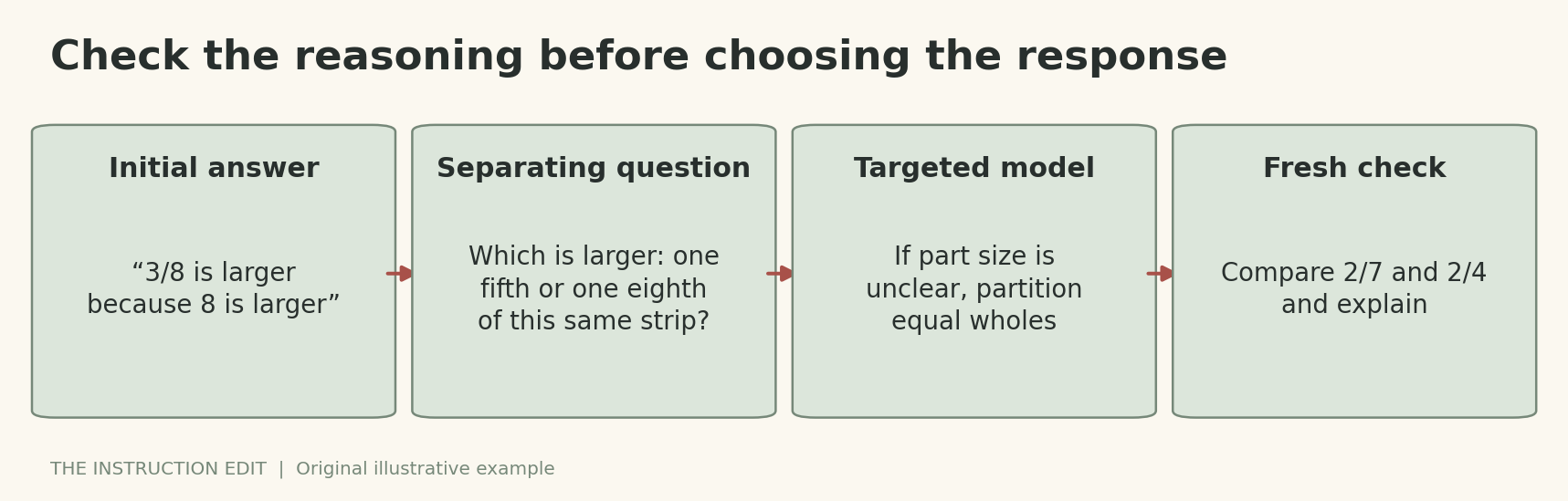
Response you might see: “3/8 is bigger because 8 is bigger”
Possible reasoning: Treats denominator as the amount rather than the number of equal parts
Follow-up that separates explanations: “Which is larger, one fifth or one eighth of this same strip? Show why.”
Small teaching adjustment: Partition equal strips into fifths and eighths before comparing three parts
Response you might see: “They are equal because both have 3”
Possible reasoning: Attends to count of parts but not their size
Follow-up that separates explanations: “Are three small pieces always equal to three large pieces?”
Small teaching adjustment: Label both number and size of parts in a comparison
Response you might see: “3/5 is bigger” with no explanation
Possible reasoning: May understand, remember a rule, or guess
Follow-up that separates explanations: “Would your method also compare 4/7 and 3/7? Explain.”
Small teaching adjustment: Ask for the feature that stays the same in each comparison
Response you might see: A correct picture with the comparison symbol reversed
Possible reasoning: May understand quantity but confuse notation
Follow-up that separates explanations: “Point to the larger amount, then read your sentence aloud.”
Small teaching adjustment: Briefly connect the symbol to the learner’s spoken comparison
Notice that the same answer can lead to different next steps. A symbol error does not require the same teaching as confusion about equal parts. Treating both as “fractions wrong” spends instructional time on the wrong problem.

Revise the prompt before replacing the materials
The original prompt was: “Which is greater, 3/8 or 3/5?” A more revealing version is: “Two strips are the same length. One is divided into eight equal pieces and the other into five. Compare three pieces from each. State which amount is greater and explain how the size of one piece helps you decide.”
The revision exposes the equal-whole condition and asks learners to connect a part to the total selected amount. It does not supply the answer. Use unshaded strips so that drawing and explanation still belong to the learner. If the objective is independent fraction comparison without a model, follow the supported prompt with a new comparison that does not include the strips.
You may discover that the material did not need replacing at all. Perhaps the missing element was an explanation prompt. Alternatively, if learners cannot partition equal wholes, the difficulty may precede the comparison task. A more entertaining activity will not resolve that missing prerequisite by itself.
Use the map without turning it into extra marking
Choose two or three plausible patterns before the lesson. Leave an “unclear” space rather than trying to anticipate every response. During a short check, note only what would change your instruction: whole-number reasoning, part-size reasoning, notation uncertainty, or insufficient evidence. You do not need a spreadsheet with one hundred shades of concern.
Keep names out of any examples displayed to the class. For your own notes, record the response or action that supports the interpretation. “Said eighths are bigger pieces” is more useful than “weak fractions.” If you need an individual follow-up, ask privately and give enough time to respond in an accessible way. An oral explanation or a drawing may clarify reasoning that a hurried written answer conceals.
Revisit the classification after the follow-up. A provisional category should be easy to change. If the learner’s explanation contradicts your first interpretation, update the map rather than trying to make the new evidence fit.
Check whether the change addressed the problem
After modeling equal-sized wholes, use a fresh example such as 2/7 and 2/4. Ask for a comparison and a reason. Then include a different structure, such as 2/7 and 5/7, so you can see whether learners understand which feature controls the decision rather than applying “smaller denominator means larger fraction” everywhere.
Do not claim that one successful answer establishes durable understanding. It shows what the learner could do on that task, under those conditions. A later check and a different representation give you more useful evidence.
For your next lesson, make a four-column map for one question only. Write two plausible wrong responses, one competing explanation for each, and a follow-up you could actually ask. Change the prompt or model only after that follow-up tells you where the reasoning breaks down.
