
Featured photograph: A tree-lined street. Photo: Elina Volkova, Pexels License. Full frame, display-scaled only. Context photograph, not a fictional site, temperature measurement or evidence of an intervention.
Begin with the decision, not the seating plan
Dividing a reading into three pieces creates three jobs. It does not necessarily create a reason to listen. If the final task can be answered from one piece, the other experts may become an audience rather than necessary contributors.
Berkeley’s active-learning guidance describes experts discussing a topic, checking one another’s understanding and preparing to teach it before forming mixed groups. The plan below uses that structure, but the urban-heat case, packet contents and checks are original. They are not a tested intervention or evidence that a jigsaw always works better than another format.
The fictional task is a desk-based planning exercise: choose one site for a two-session follow-up investigation, within six planning tokens and with permission already available. Favor a feasible site that combines a higher supplied surface reading with more observed passers-by, while explaining what the limited evidence cannot establish. This is not a recommendation to conduct fieldwork in heat or a real public-health decision.
Make three complementary packets
Give everyone the same brief, site names and decision rule. Distribute different evidence for expert preparation. All values, locations and permissions below are invented; tokens are not prices. The aim is integrating evidence with limits, not discovering a hidden “correct” heat-safety threshold.
Packet A — the surface snapshot
At 14:00 on one fictional day, one pavement patch at each site is recorded as: Station forecourt, 44°C; Library plaza, 38°C; Park path, 32°C. The packet does not supply repeated readings, an air-temperature measurement, a sampling protocol or a measure of people’s heat exposure. Teach the comparison the supplied values permit, and name a claim they cannot support.
Packet B — the use snapshot
For the same fictional day, the supplied 14:00–14:10 passage counts are: Station forecourt, 18; Library plaza, 42; Park path, 9. These are passages through an observation point, not necessarily unique people. They do not represent a whole day, time spent at the site or the needs of everyone who uses it. Teach why the busiest site in this interval is not automatically the hottest site.
Packet C — the feasibility constraint
The fictional planning allowance is six tokens for one complete two-session investigation. Station forecourt requires eight tokens and permission is pending. Library plaza requires five tokens and permission is available. Park path requires three tokens and permission is available. Costs cannot be split between sites, and unspent tokens do not have to be used. Teach which options meet both constraints, without treating low cost as evidence of low need.
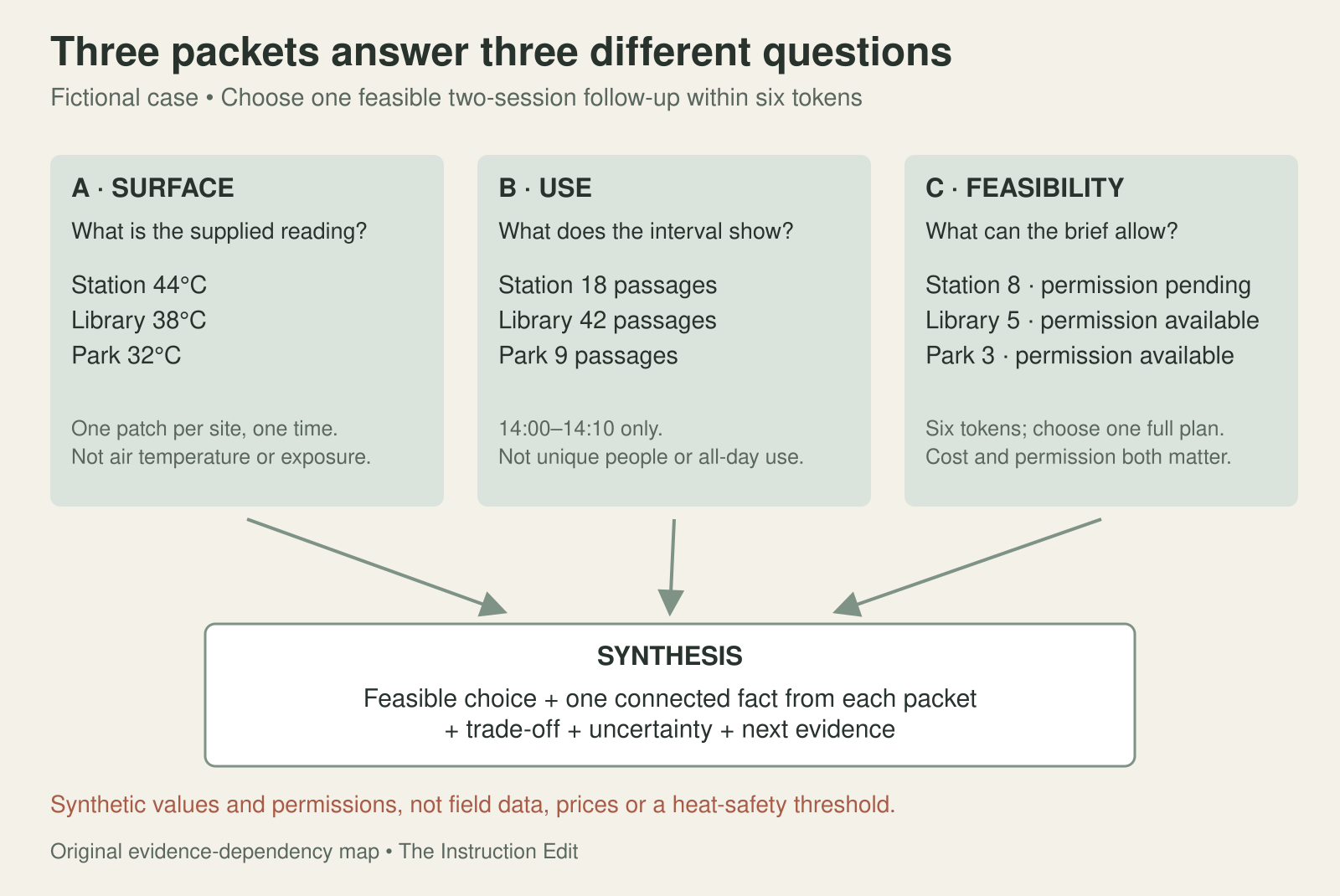
Figure 1. The final decision requires complementary evidence, not three copies of the same reading. Original dependency map by The Instruction Edit; all case data are synthetic.
This distribution gives each expert a consequential contribution. Packet A alone favors the hottest supplied surface patch but cannot establish feasibility or use. Packet B alone favors the highest count without the other conditions. Packet C rules out Station under the brief but cannot choose between Library and Park on the stated evidence preference. The final explanation must combine all three.
Use the photograph to expose a missing measure
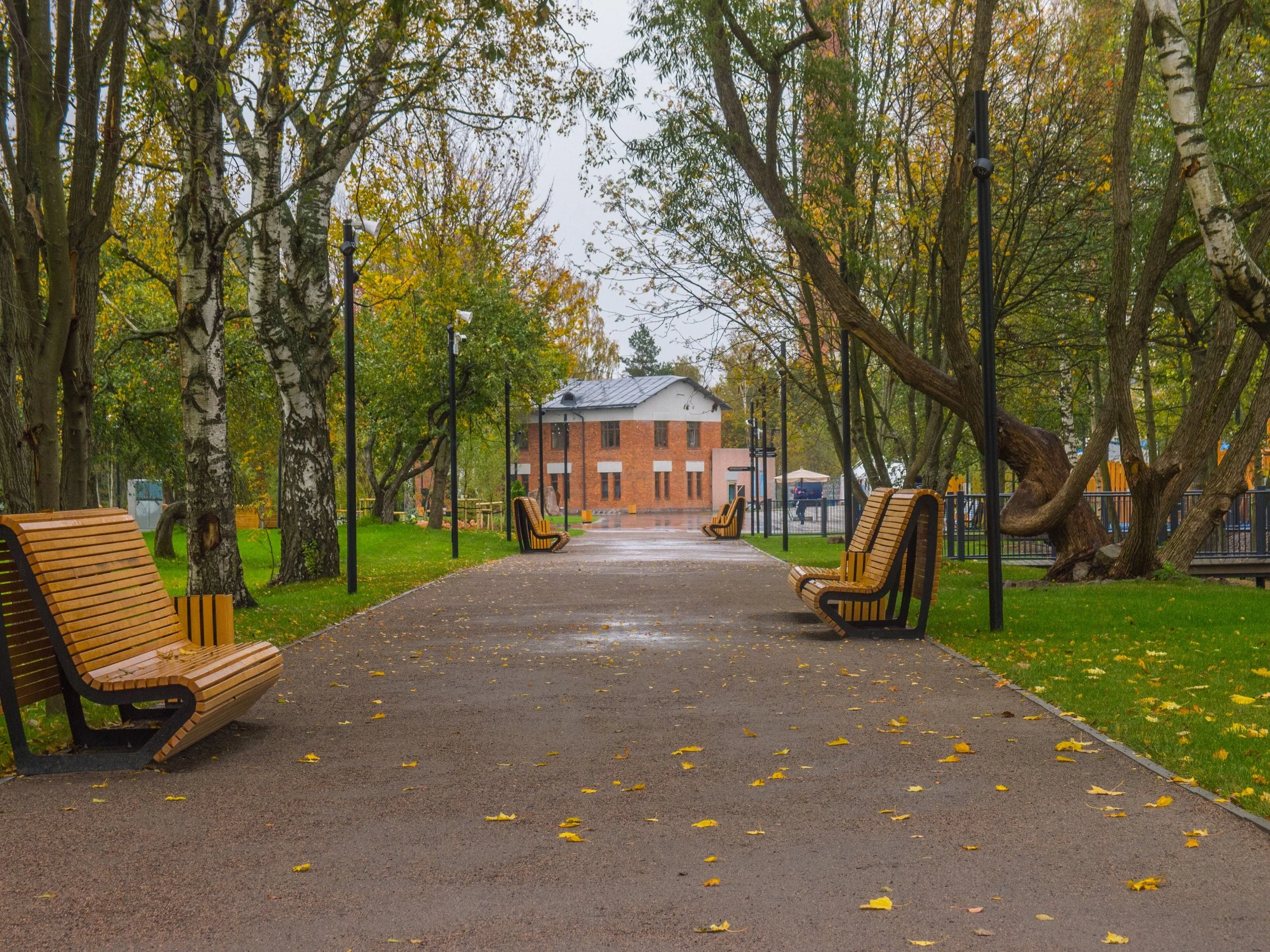
Figure 2. What can this frame tell you—and what would need a measure? Photo: paul, Pexels License. Full frame, display-scaled only. Actual park scene, not the fictional Park path or a ten-minute observation.
Before the packets, ask what this actual park photograph supplies and what it does not. Benches, trees and a path are visible. A daily passage count, surface temperature and permission to investigate are not. An apparently quiet frame is not a ten-minute count. The photograph is not any of the fictional sites and supplies none of their numbers. Keep it as a question about missing information, not a fourth packet of invented measurements.
Map the people before moving them
For 18 learners, prepare six expert triads: two working on A, two on B and two on C. Give the six A learners labels A1–A6, and do the same for B and C. Experts numbered 1–3 meet together; those numbered 4–6 form the second triad for that packet. Then mixed group 1 receives A1, B1 and C1; continue through mixed group 6. Every mixed triad has all three responsibilities.
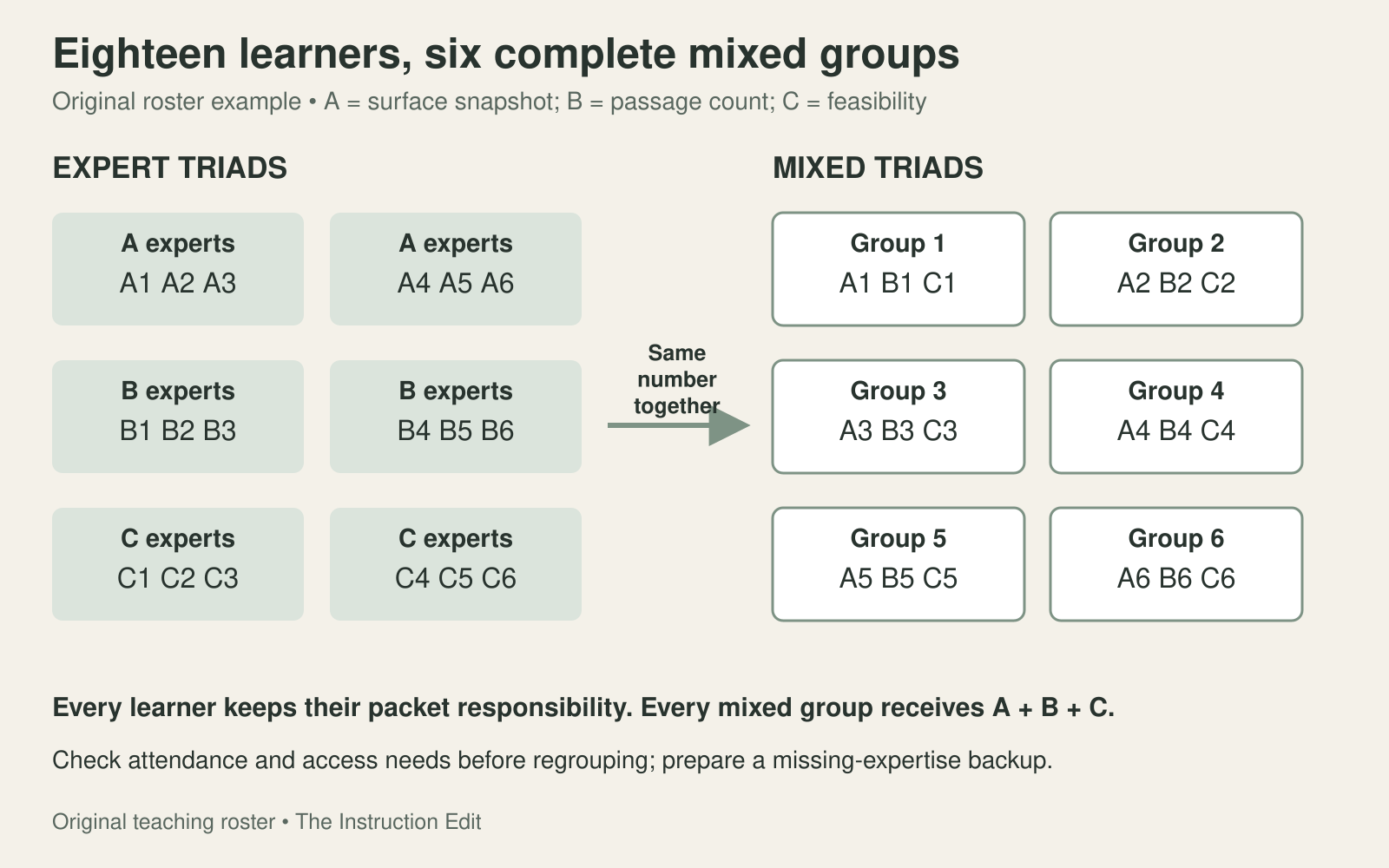
Figure 3. Exact expert-to-mixed-group roster for 18 learners. Original movement plan by The Instruction Edit; letters name packet responsibilities, not ability groups.
For a different class size, check the roster rather than hoping the counts work. Duplicate an expert in a mixed group if necessary, or provide a prepared teaching card for an absent responsibility. Do not leave one group without essential information. Offer accessible copies and an agreed written, spoken or supported teaching route; expertise here is a temporary preparation responsibility, not a permanent ability label.
Prepare an explanation, not a recital
Ask each expert to prepare a small teaching card: key idea; exact supporting detail and units; what the evidence does not establish; a question for the listener; and the expected reasoning in a satisfactory reply. Use the same fields for all packets. A clear sentence with a specific limit is more useful than copying every number onto a smaller page.
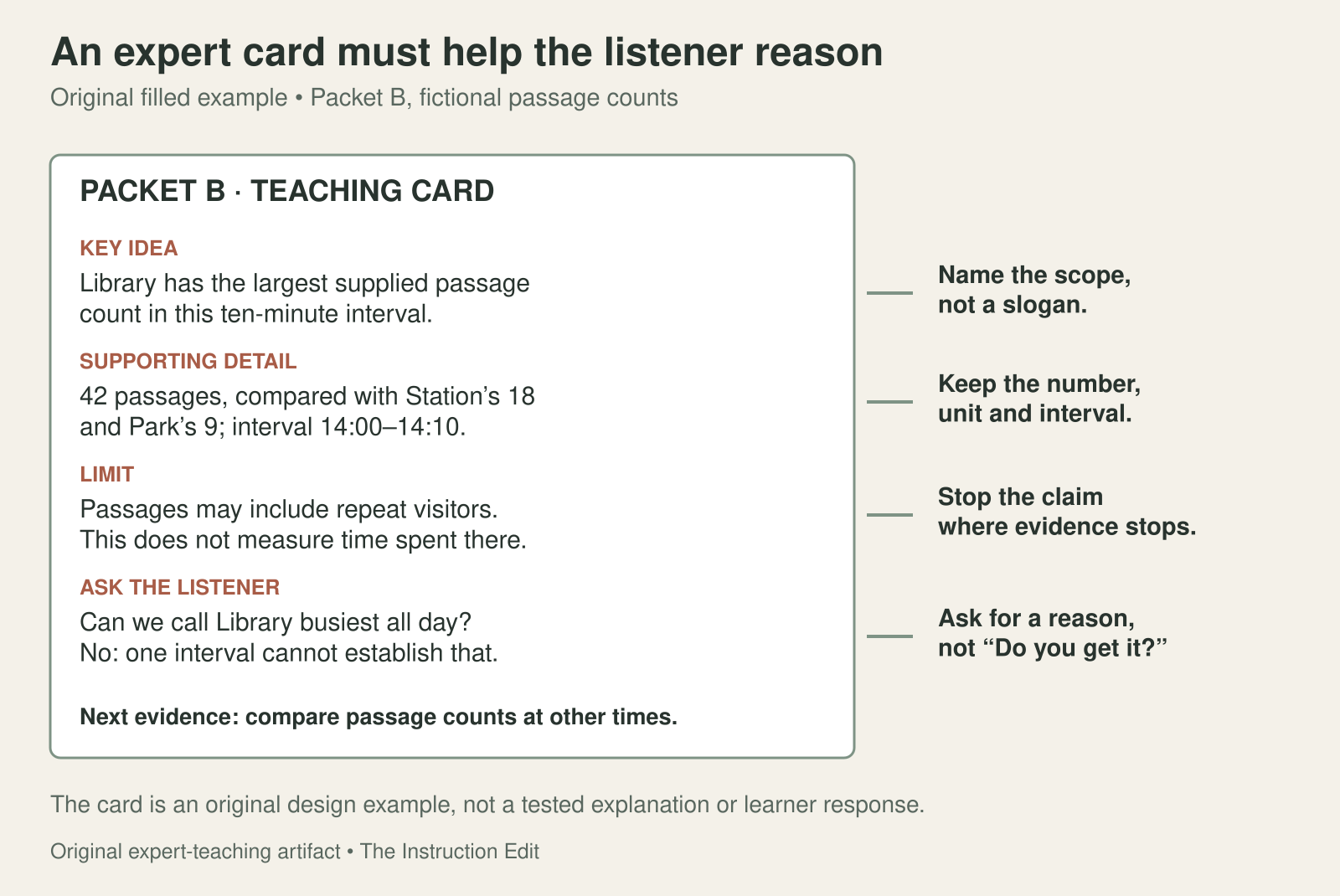
Figure 4. The teaching card includes the evidence limit and a listener reasoning check. Original worked artifact by The Instruction Edit, not a learner response or validated intervention.
For Packet B, the key idea is that Library has the largest supplied passage count in that ten-minute interval. The supporting detail is 42 compared with 18 and 9. The limit is that passages may include repeat visitors and do not measure duration. Ask: “Can we call Library the busiest place all day?” A satisfactory reply is no: one interval cannot establish that claim; other times would need evidence.
During expert preparation, have one learner explain while another checks the packet and a third answers the teaching question; then rotate. Before anyone moves, check one explanation per expert triad for the central distinction: surface versus air temperature, passages versus unique people, or cost versus permission. Correct a shared error now rather than distributing it to six groups.
Make synthesis individual and inspectable
A starting schedule is four minutes for the brief and photograph, seven for expert preparation and checking, two to regroup, nine for reciprocal teaching, six for individual synthesis and four for a whole-class comparison: 32 minutes. These are planning allocations, not tested completion times. Adjust them for reading, communication and access needs. In each three-minute teaching turn, allow explanation, a listener response and clarification—not an uninterrupted speech.
Give the final prompt in advance: “Recommend one feasible site for the two-session follow-up. Use a labeled detail from A, B and C; explain a trade-off; name one uncertainty; and propose information that would reduce it. State why you did not choose another site.” Let learners consult all packets after teaching. The dependency should be in the reasoning, not in denying access to a page.
A worked answer is: “I recommend Library plaza. Its supplied surface reading is 38°C, higher than Park’s 32°C (A), and its interval count is 42 passages versus Park’s 9 (B). Five tokens and available permission meet both constraints (C). Station has the highest reading, 44°C, but its eight-token cost exceeds the allowance and permission is pending. We give up investigating the hottest supplied patch. A single interval does not establish usual use; counts at other times would help test whether the observed pattern persists.”
This answer satisfies the invented brief; it does not prove Library is a real-world priority. Ask learners to show how changing a condition could change their recommendation. For example, a later Station permission approval alone would not remove its eight-token budget problem. That check reveals whether the constraints were understood rather than merely mentioned.
Inspect each learner’s synthesis for three connected contributions, an explicit trade-off and a genuine limit. A page containing three copied facts but no relation among them needs revision. Do not score the confidence of the expert’s delivery as evidence that every listener understood.
Check whether a learner could complete your final task with only one packet. If so, revise the decision or the evidence responsibilities before adding more group instructions. A jigsaw earns its complexity when the pieces change what a learner can reasonably conclude together.
Source
UC Berkeley Center for Teaching & Learning — Active Learning, Jigsaw section, checked October 30, 2026. The three-packet case, roster, teaching card, schedule and worked synthesis are original fictional teaching materials. No classroom trial or comparative learning benefit is claimed.
