
A resource can describe itself as research-based without showing that it improves the outcome you care about for the learners you teach. Before buying another program, activity set or professional book, separate the claim from the evidence and the evidence from your adoption decision.
Daniel T. Willingham's When Can You Trust the Experts? is the more direct candidate for questioning education claims. Understanding How We Learn offers a broader visual introduction to learning science and research-to-practice issues. Neither makes a reader an expert in every research method or replaces careful attention to the original evidence.
Use free evidence resources first
The EEF Teaching and Learning Toolkit and the What Works Clearinghouse provide useful starting points for checking educational evidence. Their coverage and purposes differ. An entry about a broad approach does not automatically validate every branded product using the same label.
Write the exact claim you are being asked to believe. Identify the learner population, comparison, outcome and duration. Is the evidence about remembering the taught material, performing a new task, engagement, attainment or a teacher's preference? Those are not interchangeable outcomes.
Follow the claim back to the relevant report or study where possible. Read enough of the methods and limitations to understand what was actually compared. If the seller offers only a testimonial or an unexplained percentage, record the missing evidence rather than filling the gap with confidence.
Willingham: a focused claim-screening reference
Daniel T. Willingham's When Can You Trust the Experts?: How to Tell Good Science from Bad in Education is the identified first Jossey-Bass edition from 2012; the hardcover ISBN is 9781118130278. This is a publisher link, not an affiliate link. An exact Amazon destination has not been verified here.

When Can You Trust the Experts? How to Tell Good Science from Bad in Education, 1st edition (2012), by Daniel T. Willingham. Cover source: Open Library; publisher: Jossey-Bass/Wiley.
The lawful first-chapter excerpt and the author's explanation of checking research-based claims support its relevance to examining what is promised, where a claim comes from and whether the evidence warrants adoption.
Choose it when the recurring problem is making sense of a persuasive proposal. Its age matters: the evidence-summary landscape has changed since 2012, so pair the book with current institutional resources rather than treating every statement about available services as current. It is a practical reasoning reference, not a certification in research appraisal.
Understanding How We Learn: broader conceptual literacy
This article contains affiliate links. The Instruction Edit may earn a commission if you purchase through them. As an Amazon Associate I earn from qualifying purchases.
Understanding How We Learn: A Visual Guide on Amazon, affiliate link, by Yana Weinstein and Megan Sumeracki, with illustration and design by Oliver Caviglioli, is the Routledge edition published in 2018 with a 2019 copyright date, paperback ISBN 9781138561724. Weinstein now uses the name Jude Weinstein-Jones; the original edition's author name identifies the product.
The publisher contents and actual chapter preview linked from The Learning Scientists' book page cover interpreting research alongside attention, memory and learning strategies. The inspected preview addresses causality, communication of findings and the limits of moving from a laboratory result to classroom practice.
Choose this candidate when a team needs shared vocabulary for discussing learning principles, not only a checklist for one purchasing decision. The visual format is part of the book's presentation; it does not remove the need to read the qualifications or ensure the selected format is accessible to its reader. No preview illustrations are reproduced in this article.
| Your purpose | More relevant starting point | Do not assume |
|---|---|---|
| Examine a persuasive education claim | Willingham's claim-screening reference | Every 2012 reference to available services remains current |
| Build shared learning-science vocabulary | Understanding How We Learn | A general principle validates a particular commercial product |
| Decide on one immediate purchase | Free evidence summaries and original methods | A label or testimonial is a controlled comparison |
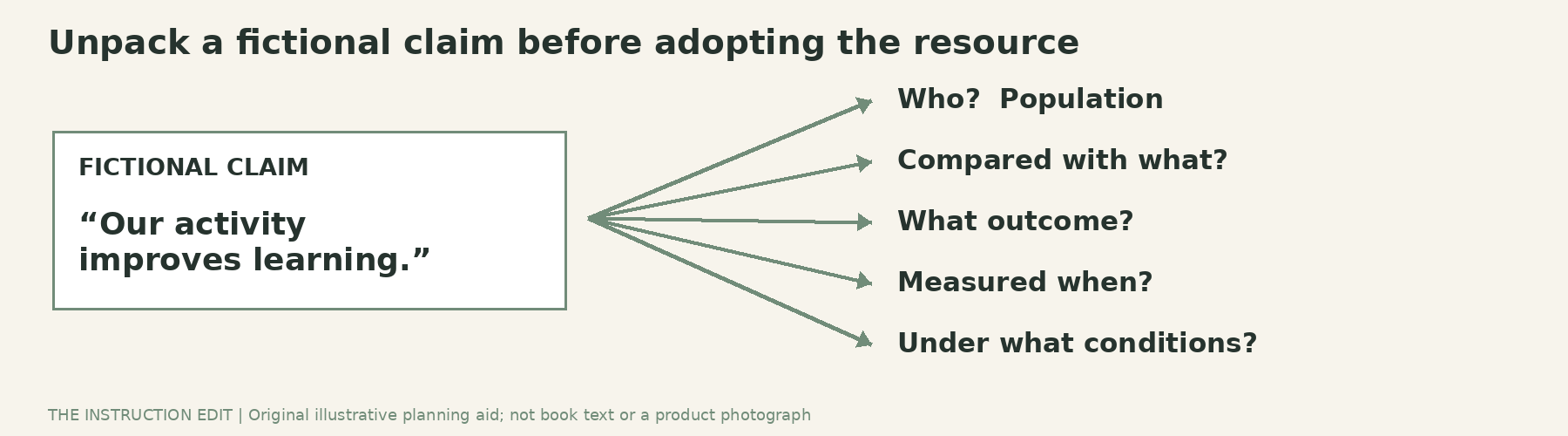
Unpack a learning claim. Original conceptual illustration.
Unpack a fictional claim
Imagine a fictional vendor says, “Our activity improves learning.” This example contains no real product or invented study result. The first useful response is not agreement or dismissal. Ask what activity, which learners and what measured outcome the sentence refers to.
If the evidence compares the activity with doing nothing, it may not answer whether it is better than the teaching you already use. If the outcome is an immediate quiz on the same examples, it may not answer a claim about delayed retention or transfer. If a specialist delivered it under unusually supportive conditions, implementation demands matter.
Also ask who collected the evidence and whether the results have been independently examined. Commercial involvement does not automatically invalidate a study, but it is relevant context. Conversely, an impressive institutional logo does not repair a weak comparison or an outcome unrelated to your goal.
Record uncertainty explicitly. “No directly relevant evidence located in this check” is more accurate than “it does not work.” “A promising result in a different population” is more accurate than “proven for our learners.” Good judgment includes refusing to make either leap.
Write an adoption note, not a verdict on all research
A short adoption note can contain five fields: the exact claim, the most relevant evidence, important limitations, the local implementation burden and the next decision. Include staff time, accessible formats, training and what you would stop doing to make room.
A limited, approved trial may be sensible when the potential value is plausible and the costs and risks are manageable. Define what you will observe before starting. Avoid collecting unnecessary personal data or interpreting a small local trial as definitive causal proof.
No purchase is a legitimate decision. So is postponing a decision while asking for the missing study or borrowing a reference. The aim is not to reject everything new; it is to align confidence and spending with the quality and relevance of the evidence.
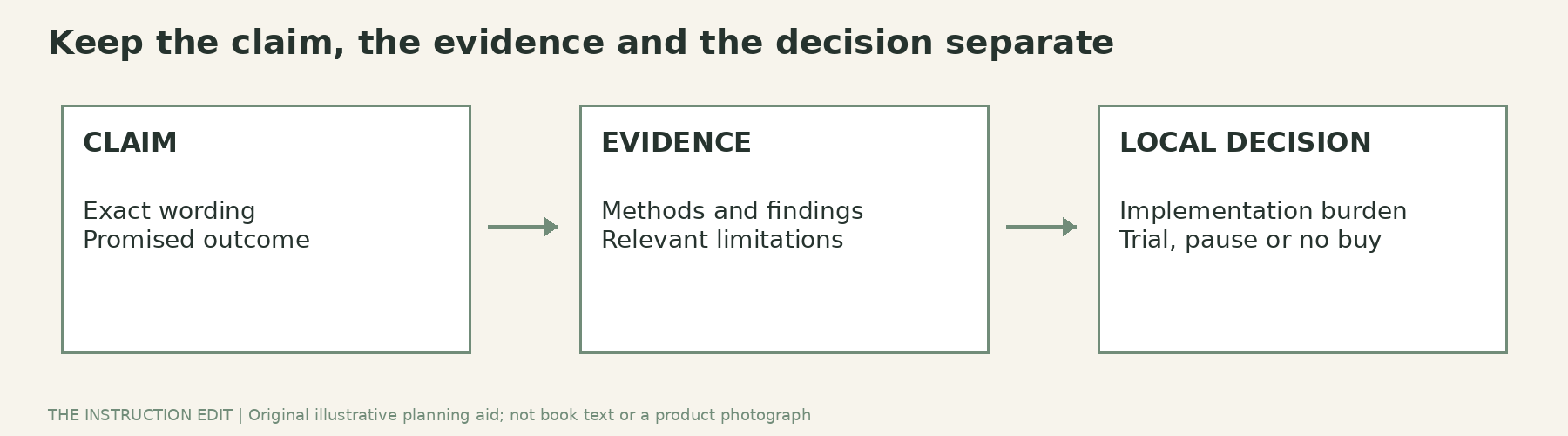
Claim to evidence to decision. Original conceptual illustration.
Who should not buy another research-literacy book
Wait if the immediate obstacle is simply an unavailable source that the vendor should provide, or if a current free summary already answers the question. A book is also not a substitute for specialist advice when a consequential decision requires methods you cannot confidently assess.
Choose Willingham for a more focused claim-checking routine. Choose Understanding How We Learn for a broader shared foundation. Bring an actual proposal to the reading and use the book to improve the questions you ask, not to decorate a decision already made.
Sources and selection basis
The named publisher contents, lawful first-chapter excerpt and Learning Scientists preview were checked on 25 October 2026. These are bounded source-based recommendations, not complete-book reviews or claims that either title guarantees better purchasing. Exact edition identity was verified before the one affiliate link was added. No price or availability is asserted.
