
A learner can replace every important word in a paragraph and still leave its central relationship unexplained. When you ask students to explain a text, decide whether you want a restatement, a new inference or a question about something that does not fit. All can be useful to inspect, but they are not interchangeable evidence of understanding.

What counted as a self-explanation
Chi and colleagues studied 24 eighth graders reading a circulatory-system passage. Fourteen received explanation prompts; ten reread without those prompts. The prompted group showed larger pretest-to-posttest gains. The paper counted inferences beyond the text as self-explanations and excluded paraphrases and monitoring statements from that count. Its high-versus-low explainer comparisons were formed from the explanations students produced, not from randomly assigned explanation quantities. [1]
This was a small study of one text, not evidence that longer answers always help. The procedure included additional function prompts, actual study time differed between groups and students could consult the text during the posttest. Those details matter when interpreting the comparison or adapting it to a short classroom task.
Separate three kinds of response
A paraphrase can show whether a learner has understood the sentence’s vocabulary. An inference connects it to something else and introduces a claim that needs checking. An uncertainty statement identifies a place where the learner cannot yet make that connection. Do not reward the second merely because it is longer, or dismiss the third because it is unfinished.
The distinction also changes feedback. If a learner has misread the sentence, clarify the text before asking for an elaborate explanation. If the learner adds an unsupported cause, examine that cause. If the learner names a specific contradiction, use it to decide what information or model would help. These are original teaching suggestions, not three experimental treatments tested in the paper.
A fictional reading example
Use this deliberately simplified imaginary system to practice the distinction. It is not an anatomical account or a passage from the research study: “A pump moves colored fluid around a closed loop. The fluid passes a delivery station before returning to the pump. A gate in the loop opens in one direction.”
Paraphrase: “The pump sends the fluid around, past the station and back. The gate only opens one way.” This preserves the given information. It does not yet say why the gate’s behavior matters.
Proposed inference: “If the fluid is supposed to travel through the station in a set direction, a one-way gate could help prevent backward flow.” This supplies a functional relationship. It remains a proposal to check against the model; the sentence did not establish how the gate is driven or whether other parts also control flow.
Uncertainty: “The text says the fluid returns to the pump, but I cannot tell what makes it keep moving when the pump is between pushes.” This is a specific monitoring question. It may lead to a better explanation, but it is not already an answer and should not be relabeled as the study’s counted inference.
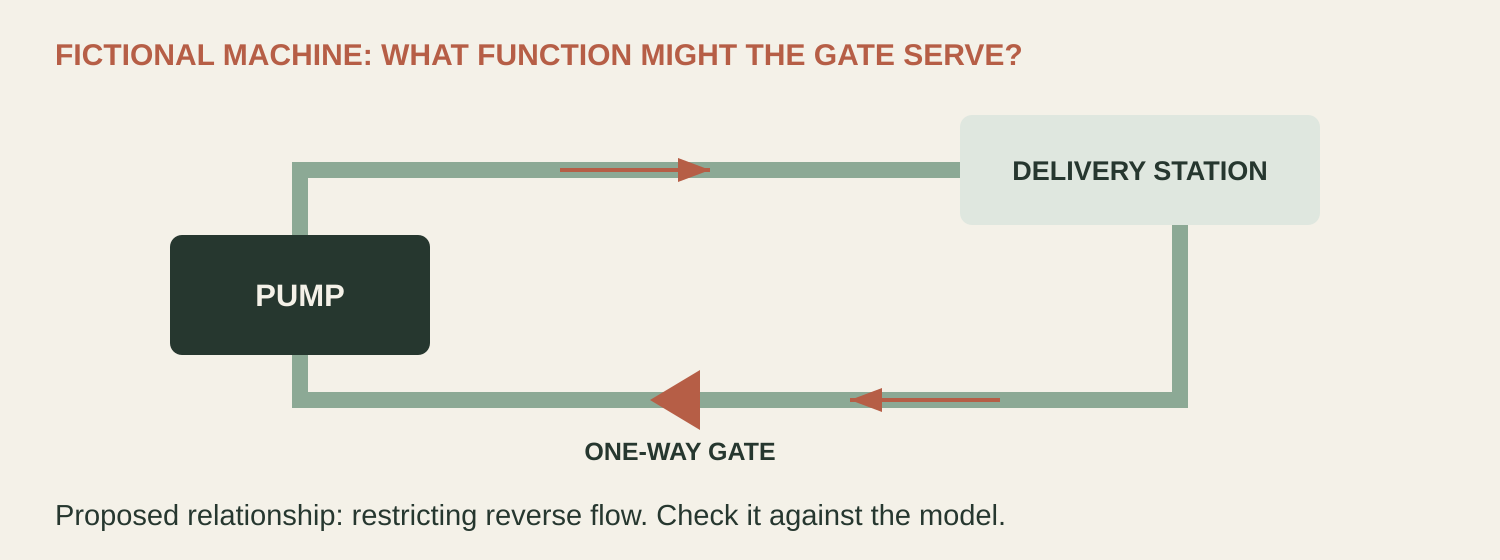
Figure 2. An original closed-loop model highlights a possible relationship between a one-way gate and flow direction. It is a fictional machine, not a clinical circulation diagram.
Ask for the missing relationship
Try two prompts with a short passage: “What would have to be true for this part to do that job?” and “Which sentence or prior idea supports the connection you just made?” The first invites an inference; the second makes its basis inspectable. A learner can respond with a sentence, a labeled sketch or a spoken explanation, provided you can tell which relationship is being proposed.
Then ask learners to mark one connection they are not ready to defend. In the fictional loop, someone might draw fluid returning directly to the pump while also claiming every circuit must pass the delivery station. A question-mark flag at that conflict is a starting point for revision. It is not a failure to produce enough words.
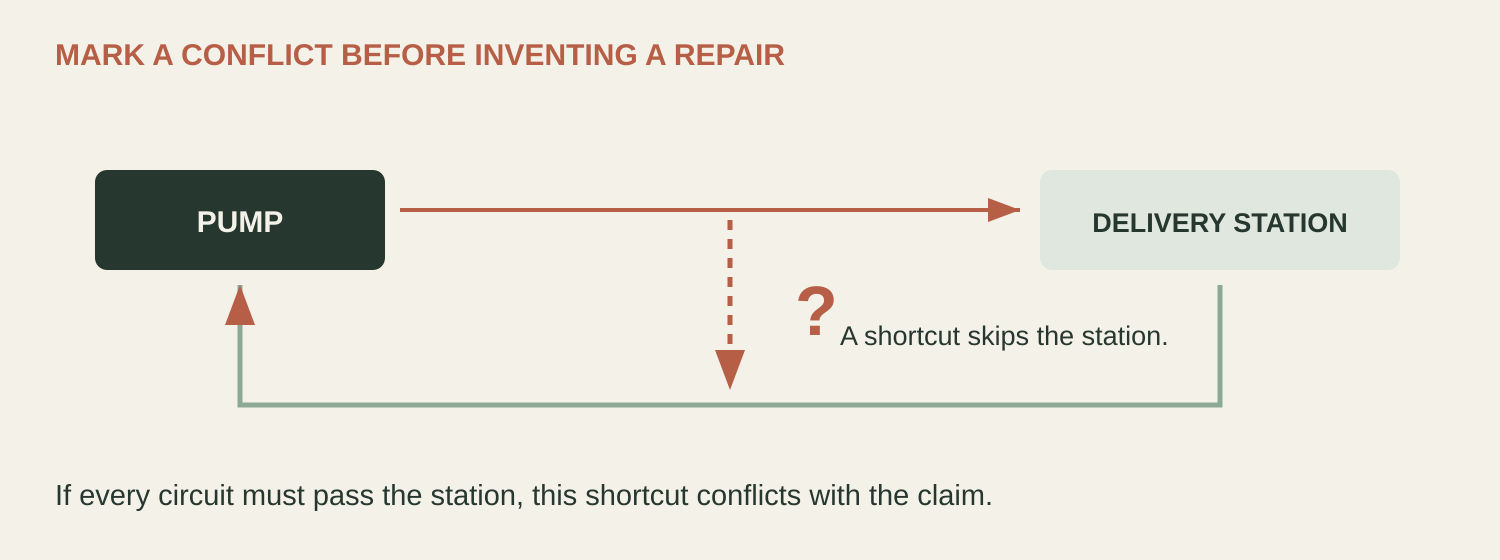
Figure 3. A learner flags a conflicting route in a concept sketch. Noticing the conflict is monitoring; explaining and testing a repair is a further step.
Check the connection rather than the length
Read a small sample of explanations and underline the relationship each one adds. If there is nothing to underline, decide whether the learner needs help interpreting the sentence or a more focused prompt. If the proposed relationship is wrong, make the correction visible instead of praising elaboration in general. Fluency is not a substitute for a defensible model.
Revise one “explain this” prompt so it asks for a relationship, inference or unresolved question rather than extra words. Keep the categories distinct in your feedback, and give learners a chance to check what they have inferred.
