

You open a lesson to fix one question. Forty minutes later, you are choosing a new font and wondering whether the whole unit needs a different theme. The original question is still there.
A lesson refresh can become a surprisingly effective way to avoid the part of the lesson that needs attention. I would start smaller: choose one moment, identify what it asks students to do, and decide whether their response will show the thinking you need to see.
As a middle school social studies teacher, I am interested in changes that can survive an actual teaching week. A useful edit should have a clear purpose. It does not have to come with a new slide deck.
Choose a moment you can actually improve
Start with the first task in a lesson you already teach. Keep the topic, materials, and broader sequence in place while you investigate that task.
Look for a recurring point of confusion: students begin the wrong job, finish without using the information, or produce answers that tell you very little. Those are clues, not proof that the whole lesson has failed. A task can also be confusing because students need vocabulary, a clearer model, or knowledge the lesson assumes they already have.
Write one sentence describing the problem. For example: ‘Students can name a primary source, but their explanations do not show whether they can choose one for a particular question.’ That is a more useful starting point than ‘Make this engaging.’
Separate the topic from the thinking
‘Primary sources’ is a topic. ‘Choose a source for a question and explain what it cannot tell us’ describes something a learner can do.
That distinction changes the edit. If the immediate goal is learning a definition, recording the definition may be appropriate. If the goal is selecting evidence, students need a chance to select evidence. The task should fit the goal at that point in the sequence.
You do not have to make every minute complicated. A short explanation can prepare students for a useful decision. The question is whether the lesson eventually gives them the decision you want to examine.
A small before-and-after example
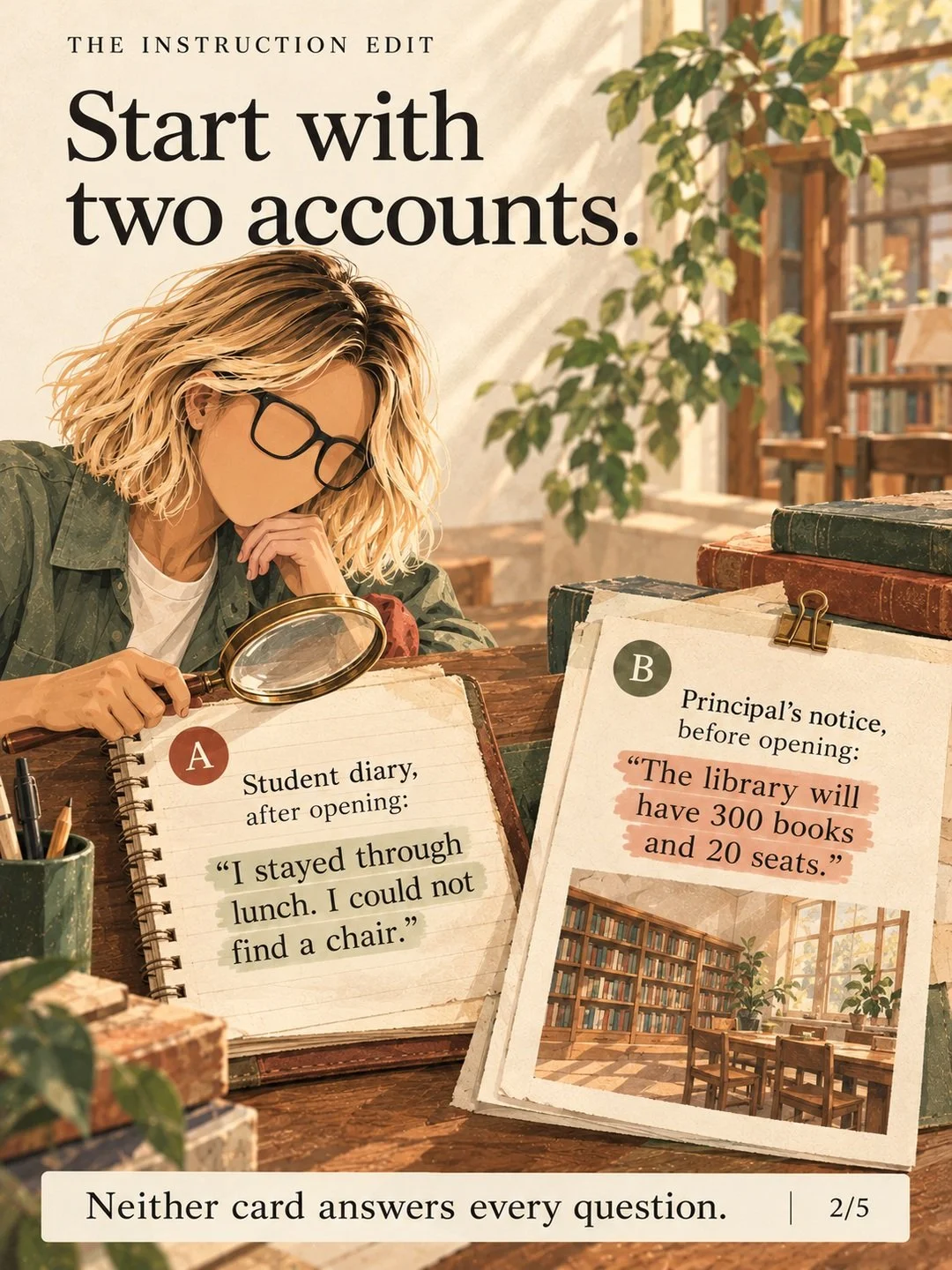
Here is an invented classroom example. The source cards below are fictional teaching materials, not historical documents.
Original task: Copy the definition of a primary source. List two examples.
Revised goal: Choose a source that helps answer a particular question, and explain a limitation.
Investigation question: How did one student experience the opening of a new school library?
Card A: A student’s diary entry written that afternoon: ‘I stayed through lunch to look at the new books. The room was so crowded that I could not find a chair.’
Card B: A principal’s announcement written before the opening: ‘The new library will have 300 books and seating for 20 students.’
Revised task: Which card would you start with? Use a detail to explain your choice. What can that card not establish?
Card A directly describes one student’s experience. It does not establish what every student thought, or whether the room was always crowded. Card B may help investigate the planned facilities, but it does not describe a student’s experience after opening. Both can be useful for different questions.
The point is not to teach that diaries are automatically better sources. The question determines which evidence is useful.
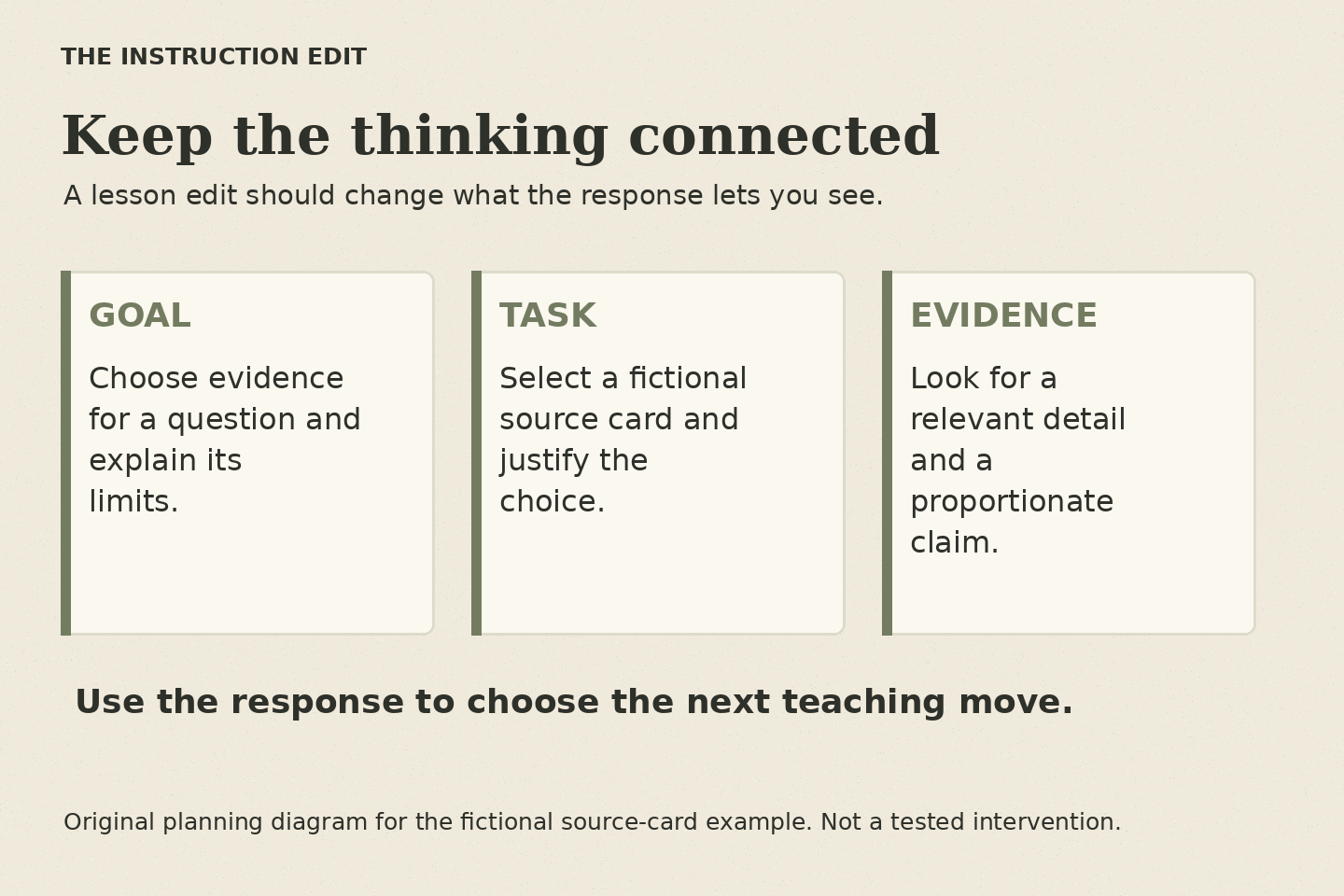
Keep the goal, task, and evidence connected.
Check the support before adding more activity
A student might need help understanding ‘experience’ or ‘establish.’ Another might need the source descriptions read aloud. A third may understand the words but assume that a firsthand account speaks for everybody. Those barriers call for different support.
Keep the cards visible. Model how you connect a source detail to a question using a different example. Offer a temporary sentence frame if needed: ‘I would start with ___ because ___. It cannot tell us ___.’
For younger learners, use two short illustrated accounts and invite an oral explanation. For older students, add questions about perspective or corroboration only after the basic choice is secure. These are adaptations to consider, not evidence that one task fits every age.
Making the directions easier to enter should preserve the thinking you are trying to teach.
Decide what you will look for
Before teaching the revision, imagine a few possible answers. ‘A, because it is a diary’ names a source type but does not fully connect it to the question. ‘A, because the student describes staying at lunch’ uses relevant evidence. ‘A proves everyone loved the library’ overstates what one account can show.
Those responses suggest different next moves: model the connection, extend the reasoning, or discuss the limits of the claim. You have something more specific to respond to than a completed page.
EEF’s feedback guidance emphasizes the principles behind useful feedback, rather than treating written or verbal delivery as the main decision. Its guidance covers ages 5–18. The example here is my own proposed application, not a tested intervention from that report.[1]
Keep, cut, change
Keep the parts that already serve the goal: useful context, a clear source description, or a model students can follow.
Cut duplication that consumes time without adding information you need. Do not remove vocabulary practice simply because it looks less exciting than the new task. Check whether learners still need it.
Change the part that prevents you from seeing the intended thinking. That may be one question, a missing example, or the feedback after an answer.
Then try the revision and inspect the responses. Notice what students understood, where they paused, and whether the task took a reasonable amount of time. A promising draft still needs classroom use to tell you how it works.
Try one edit before you open a new template
Choose one opening task and write down its goal, the learner’s action, and the evidence you expect. If those three do not line up, make one change. Keep a note of why you made it so you can evaluate the result later.
This is the kind of work I am building The Lesson Refresh around: refreshing the first ten minutes of a lesson you already teach. The free course is still in development. For now, start with one task you already use and ask what its answer would actually show you.
Sources
1. Education Endowment Foundation, Teacher Feedback to Improve Pupil Learning (2021). Scope: ages 5–18; cited for feedback principles, not validation of the fictional source task.
