
The most useful AI book for an educator is not the one with the longest prompt collection. It is the one that improves decisions about the learning goal, the work people should still do, the information a tool may receive and the checks a human must make.
Teaching with AI, second edition, is the more directly education-focused candidate for assignment and policy thinking. Ethan Mollick's Co-Intelligence is the broader conceptual primer on working with AI. Read either alongside current institutional policy and tool documentation, because a printed book cannot keep every interface, capability or risk current.
Start with a no purchase policy-and-task check
Begin with your institution's current rules and UNESCO's guidance on generative AI in education and research. Identify the exact task and the people affected. A tool that is allowed for staff brainstorming is not automatically approved for student accounts, personal data or assessment decisions.
Use a synthetic example while exploring. Do not paste identifiable student work or confidential institutional material into an unapproved service. Check the current tool's data settings and the institution's permitted workflow rather than relying on a book's description of an earlier product version.
Then ask what learning or professional judgment the human should demonstrate. If the task is meant to develop a learner's reasoning, outsourcing the reasoning can defeat the purpose even when the output looks polished. If a draft is only a starting point, specify what review and revision will make it usable.
Teaching with AI: the educator-specific choice
This article contains affiliate links. The Instruction Edit may earn a commission if you purchase through them. As an Amazon Associate I earn from qualifying purchases.
Teaching with AI: A Practical Guide to a New Era of Human Learning, second edition, on Amazon, affiliate link, by José Antonio Bowen and C. Edward Watson, is the Johns Hopkins University Press edition released in December 2025, paperback ISBN 9781421453392. Do not substitute a first-edition listing without recognizing the difference.

Teaching with AI: A Practical Guide to a New Era of Human Learning, 2nd edition (2025), by José Antonio Bowen and C. Edward Watson. Cover source: Open Library; publisher: Johns Hopkins University Press.
The publisher's full contents include AI literacy, policies, detection and grading, feedback, roleplay, assignment design, writing and simulations. That documented scope supports considering it when the recurring decision concerns teaching and assessment, rather than general workplace productivity.
The comparison is based on those contents, not a claim that the full second edition was read or tested in a classroom. Its primarily higher-education orientation also matters. A chapter about a university practice is not permission to use the same approach with younger learners, and a discussion of detection is not evidence that a detector is reliable enough for a particular decision.
Choose it for structured educator questions. Keep safeguarding, accessibility, procurement, assessment rules and current tool limitations as separate checks under your institution's authority.
Co-Intelligence: a broader collaboration primer
Ethan Mollick's Co-Intelligence: Living and Working with AI on Amazon, affiliate link, is the identified Portfolio 2024 hardcover, ISBN 9780593716717. This is deliberately an older conceptual primer, not a claim to recommend Mollick's latest publication.
The publisher description and lawful introduction frame AI as a collaborator across work and learning. The introduction itself acknowledges evolving uncertainty and early evidence, including work that had not yet been peer reviewed.
Choose this candidate when you need language for discussing human-AI collaboration and its boundaries across several kinds of work. Do not buy it expecting a ready-made school policy, current platform instructions or validated recipes for every subject. A persuasive example from one task does not establish dependable performance on another.
Mollick has subsequently published Co-Existence; that newer title has not been evaluated for this comparison. Newness alone would not settle which book fits the specific decision here.
| Your recurring question | More relevant candidate | Additional check |
|---|---|---|
| How should an assignment or teaching policy change? | Teaching with AI, second edition | Institutional rules, learner age and the intended learning |
| How should humans collaborate with AI across tasks? | Co-Intelligence | Current capabilities, evidence and task-specific verification |
| Can this exact workflow be used tomorrow? | Current approved documentation and policy | A book cannot authorize a tool or data transfer |
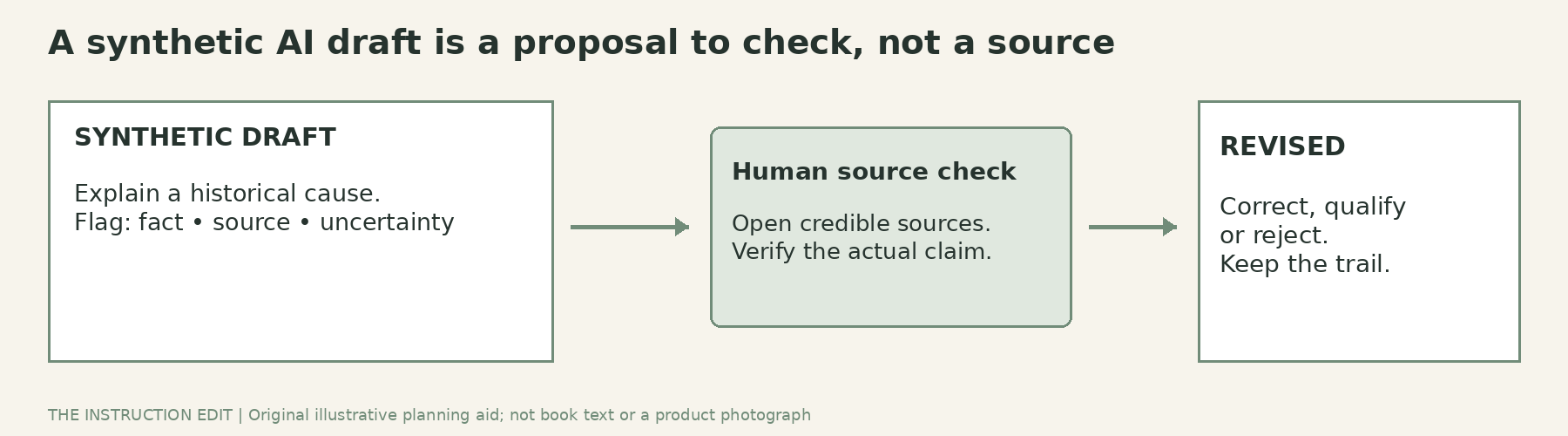
A synthetic AI checking exercise. Original conceptual illustration.
An illustrative judgment exercise
Use a short synthetic request: draft an explanation of a historical cause for a teacher to review. Include no student details. Treat any generated answer as a proposal, not as a verified source or an account of an actual classroom trial.
Mark three things in the draft: factual statements that need checking, sources that must actually exist and wording that hides uncertainty or alternative explanations. Open the relevant credible sources yourself. A plausible-looking citation is not confirmation that the cited work says what the draft claims.
Then revise the explanation for the intended audience. Check whether it oversimplifies the causal relationship, omits necessary context or introduces vocabulary learners have not encountered. Decide which reasoning students should perform rather than receive as a completed answer.
The outcome may be to use a corrected small portion, rewrite the whole explanation or not use the output. That is a judgment exercise, not a contest to preserve as much generated text as possible. Keep the source trail and the human decision visible.
Evaluate a book through a real decision
Before purchasing, inspect the contents and available lawful samples. Look for a match to your question: assignment design, policy, feedback, collaboration or evidence appraisal. Check the publication and edition, but do not assume a newer book can remove the need for live policy and documentation checks.
Write down what a useful reading outcome would be. For example: revise one assignment so the required human reasoning is explicit; create a verification checklist for staff drafts; or identify a task that should not use the proposed tool. These are practical outputs, not promised time savings.
Avoid purchasing on the strength of a demonstration alone. An attractive output can conceal errors, inaccessible presentation or a mismatch with the learning goal. Likewise, a book's discussion of a capability does not prove that your approved account has it or that its use is permitted.
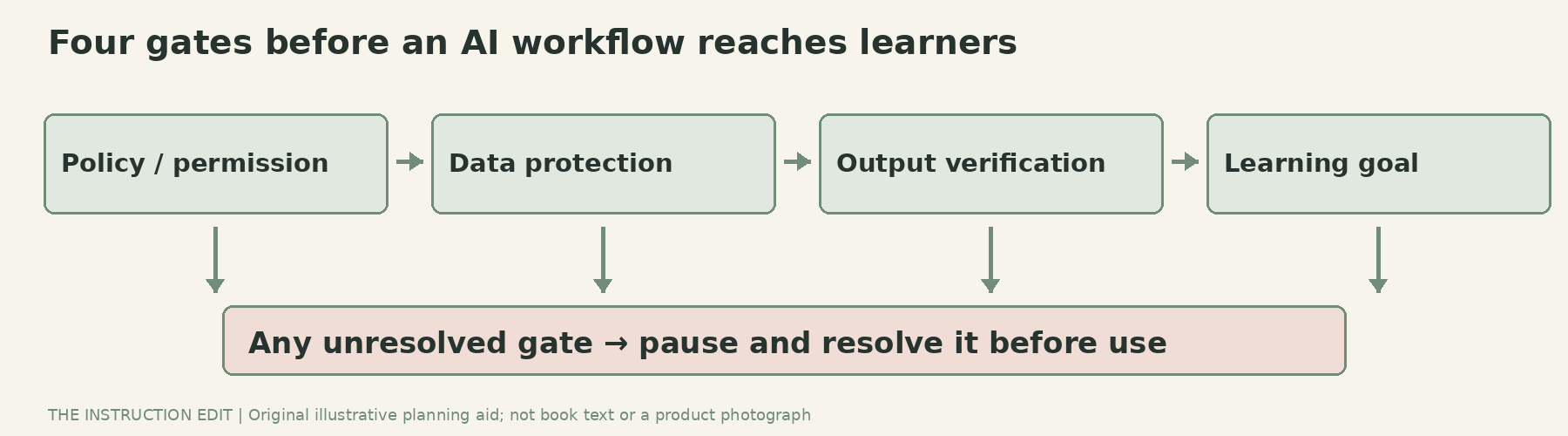
Four gates before classroom use. Original conceptual illustration.
Who should not buy yet
Pause if the real blocker is an unresolved institutional rule, an unapproved data flow or uncertainty about the purpose of the assignment. Those questions need a decision from the responsible people, not another prompt template.
Choose Teaching with AI for an educator-specific framework and Co-Intelligence for a broader starting vocabulary. Borrow first when possible. The best next step is one carefully bounded, permitted task with a clear human review standard—not adopting every example in either book.
Sources and selection basis
Publisher contents, the named lawful introduction, edition identities and author-linked Amazon destinations were checked on 25 October 2026. The complete books were not inspected. No firsthand classroom testing, detector accuracy, time savings, student outcomes, price or stock claims are made.
